
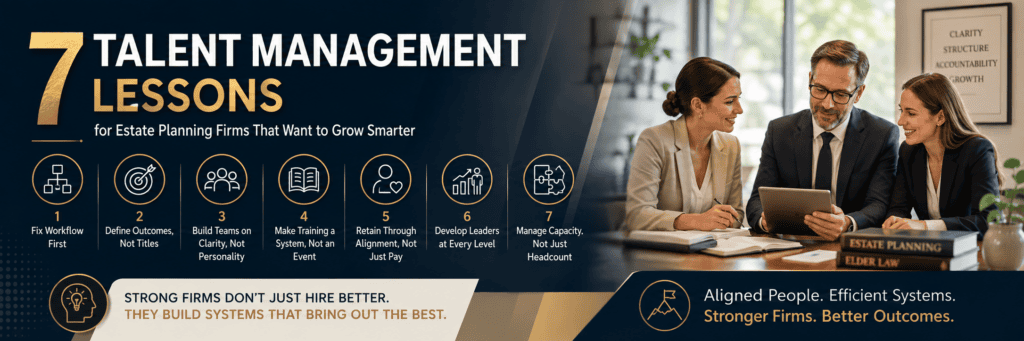
7 Talent Management Lessons for Estate Planning Firms
Estate planning firms often assume talent management begins when a position opens. In reality, effective talent management starts much earlier, with how work is structured, delegated, and supported across the firm. For many owner-led practices, staffing challenges are less about finding people and more about creating an environment where the right people can succeed.
Before engaging in talent management consulting, firm leaders benefit from understanding the operational factors that influence hiring success, retention, productivity, and long-term profitability.
Why Talent Management Matters in Estate Planning Firms
Estate planning and elder law practices face unique operational demands. Matters often involve emotionally sensitive circumstances, extensive documentation, ongoing client communication, and long planning horizons.
As firms grow, staffing challenges tend to emerge in predictable ways:
- Attorneys become approval bottlenecks
- Staff roles evolve without clear ownership
- Training becomes inconsistent
- Hiring decisions are made under pressure
- Team members stay busy while productivity feels uneven
In many cases, firms don’t have a people problem. They have a talent strategy problem.
Lesson 1: Hiring Cannot Fix Workflow Problems
One of the most common mistakes in small professional services firms is assuming additional headcount will automatically solve operational strain.
When responsibilities, handoffs, and decision rights are unclear, new hires often inherit confusion rather than clarity.
Before hiring, firm leaders should understand:
- Where work slows down
- Which tasks unnecessarily reach attorneys
- Where accountability becomes unclear
- Which bottlenecks repeatedly create delays
Hiring into an inefficient workflow often increases management complexity without improving results.
Lesson 2: Define Outcomes Before Defining Roles
Many estate planning firms begin recruiting by identifying a title.
They need a paralegal.
They need an intake coordinator.
They need an administrative assistant.
But titles rarely clarify what success looks like.
Strong talent management begins by defining:
- The outcome the role owns
- The decisions the role can make
- The handoffs connected to the role
- The metrics that indicate success
When expectations are clear, hiring becomes more precise and onboarding becomes substantially easier.
Lesson 3: Team Building Requires More Than Personality Fit
Team building is often discussed as a culture initiative, but culture is largely influenced by operational clarity.
Even highly talented employees struggle when:
- Responsibilities overlap
- Priorities constantly shift
- Communication channels are inconsistent
- Decision-making authority is unclear
Healthy teams are typically built on clear contribution rather than personal compatibility alone.
The most successful firms create environments where employees understand how their work connects to firm objectives and client outcomes.
Lesson 4: Training Should Be a System, Not an Event
Many law firms provide an intensive first week of onboarding followed by informal learning.
Unfortunately, this approach often creates long-term inconsistency.
A stronger talent strategy includes structured development beyond initial hiring.
Examples include:
- Role-based training milestones
- Defined competency progression
- Regular coaching conversations
- Cross-training opportunities
- Process documentation updates
Training systems reduce dependency on individual managers and create more predictable performance across the organization.
Lesson 5: Retention Begins With Role Alignment
When firm owners think about retention, compensation often becomes the primary focus.
While compensation matters, many departures result from misalignment rather than pay alone.
Employees are significantly more likely to remain engaged when:
- Expectations are clear
- Strengths align with responsibilities
- Authority matches accountability
- Work feels meaningful
- Growth opportunities exist
A recurring challenge in estate planning firms is placing capable people in roles that require a fundamentally different set of skills or instincts.
Retention improves when firms design roles around operational needs and align people accordingly.
Lesson 6: Growth Requires Leadership Development at Multiple Levels
In many owner-led firms, leadership exists almost exclusively at the attorney level.
As workload increases, every question, approval, and exception flows back to the owner or partners.
Eventually, this becomes a scaling constraint.
Firms that grow sustainably develop leadership capacity throughout the organization.
This may include:
- Team leads
- Department coordinators
- Practice managers
- Senior administrative staff
Developing leaders creates operational leverage and reduces dependence on any one individual.
Lesson 7: Talent Management Is Really Capacity Management
The strongest talent management consulting engagements often reveal an unexpected truth:
The issue is not always people.
Frequently, the issue is capacity design.
Many firms operate under constant pressure because work exceeds the organization’s ability to process it efficiently.
This creates:
- Overload
- Bottlenecks
- Reactive decision-making
- Burnout
- Hiring urgency
Busy does not necessarily mean productive.
Likewise, adding people does not always increase capacity.
Firms improve profitability when they understand how people, systems, workflows, and responsibilities interact as a single operating model.
From Hiring Decisions to Talent Strategy
The most effective estate planning firms view talent management as more than recruitment.
They view it as an ongoing effort to align people, workflow, accountability, and firm objectives.
When owners focus only on hiring, they often overlook the systems that determine whether employees succeed after they arrive.
When they focus on talent strategy, hiring becomes one component of a broader operational framework that supports growth, profitability, and sustainability.
Closing Reflection
Most staffing challenges do not begin with recruiting. They begin with how work moves through the firm.
Before searching for the next employee, it may be worth asking a different question: if your current team operated inside a clearer system with stronger ownership and better role alignment, how much additional capacity already exists?
Thoughtful talent management starts there.