Best Talent Management Consulting for Small Law Firms
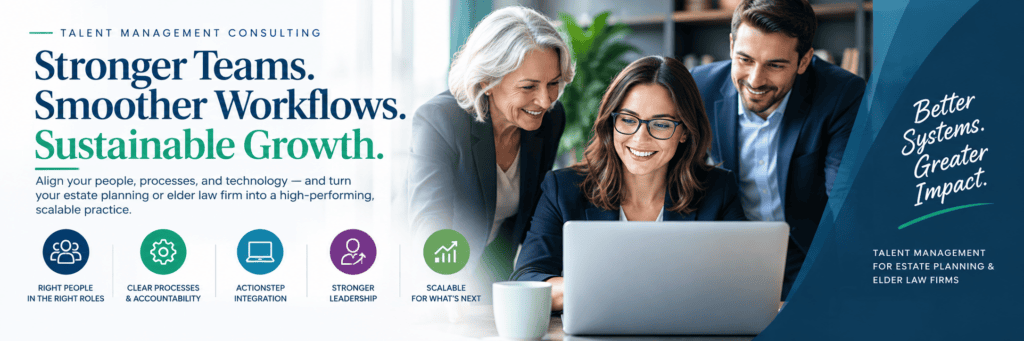
Small estate planning and elder law firms rarely struggle because people are unwilling to work hard. More often, growth becomes difficult because talent, workflows, technology, and role clarity have not evolved together. The best talent management consulting for small law firms helps firms align people with processes, define accountability, improve delegation, and create a structure that scales without increasing operational chaos.
For firms using Actionstep, talent management should extend beyond hiring and retention. It should address how work moves through the firm, who owns each step, and whether the system supports consistent execution. As many growing firms discover, busy teams are not automatically productive teams, and hiring alone does not solve workflow challenges.
What Talent Management Consulting Means for a Small Law Firm
In larger organizations, talent management often focuses on recruiting, performance systems, leadership development, and succession planning.
For owner-led estate planning and elder law firms, the challenge is usually more practical:
- Attorneys remain involved in too many operational decisions
- Staff are busy but responsibilities overlap
- Important work depends on individual memory
- New hires require constant supervision
- Workflow slows as case volume increases
Effective talent management consulting addresses these realities by improving how people, processes, and systems work together.
Rather than asking, “Who should we hire next?”, firms should often begin with a different question:
“How should work move through the organization?”
That distinction has major implications for profitability and scalability.
Why Hiring Alone Often Fails to Solve Growth Problems
Many firms reach a point where intake slows, drafting takes longer, communication becomes inconsistent, and attorneys feel overwhelmed.
The natural response is often to add staff.
Sometimes additional capacity is necessary. However, staffing and workflow improvement solve different problems. Staffing increases capacity. Workflow improvement increases clarity, efficiency, accountability, and profitability.
When firms hire into an unclear environment:
- Responsibilities become blurred
- Escalations increase
- Training becomes inconsistent
- Existing bottlenecks remain
The result is often more payroll without meaningful operational improvement.
For growing law firms, talent strategy works best when structure comes before expansion.
Evaluating Talent Management Services for Small Law Firms
Not every consulting provider approaches talent management the same way.
When comparing talent management services, consider five criteria.
1. Workflow Alignment
The strongest consultants connect staffing decisions to workflow design.
They evaluate:
- How matters enter the firm
- How work is assigned
- How responsibilities transfer between team members
- Where delays consistently occur
Without understanding workflow, talent recommendations are often incomplete.
2. Role Clarity
Many operational issues stem from unclear ownership.
Strong consulting engagements help firms define:
- Decision authority
- Communication responsibilities
- Escalation paths
- Expected outcomes for each role
When ownership is clear, delegation becomes more effective.
3. Technology Integration
Many firms already invest heavily in systems like Actionstep.
Yet technology frequently becomes a repository rather than an operational guide.
Consultants should evaluate whether workflows are actually being supported by the platform and whether team members are using technology consistently.
Technology should reinforce behavior, not merely document activity.
4. Leadership Development
Owner-led firms often depend heavily on attorneys to solve daily operational issues.
A strong legal talent strategy develops managers and team leaders who can:
- Resolve issues independently
- Make informed decisions
- Support team accountability
- Reduce reliance on attorney intervention
This creates leverage throughout the organization.
5. Long-Term Scalability
The best consulting engagements build systems that continue functioning as the firm grows.
Scalable firms rely less on heroic effort and more on predictable execution.
Talent Management Consulting vs. Traditional HR Consulting
The distinction matters.
Traditional HR consulting often focuses on:
- Recruiting
- Employee relations
- Compliance support
- Compensation planning
Talent management consulting typically addresses broader operational questions:
- Are the right people in the right roles?
- Is work distributed appropriately?
- Can responsibilities be delegated effectively?
- Are leaders creating accountability?
- Can the firm scale without creating bottlenecks?
For estate planning and elder law firms, these questions frequently have a greater impact on profitability than recruiting alone.
Special Considerations for Firms Using Actionstep
Actionstep provides significant process management capabilities, but software alone does not create operational consistency.
Many firms experience challenges because:
- Processes exist but are not standardized
- Workflows are incomplete
- Staff interpret procedures differently
- Attorneys remain heavily involved in operational decisions
Talent management consulting can help align:
- Role expectations
- Workflow ownership
- Task accountability
- System utilization
When people and technology work together, firms often experience smoother handoffs, more predictable timelines, and reduced administrative burden.
Signs Your Firm May Benefit from Talent Management Consulting
Several indicators appear repeatedly among growing firms:
Attorney Dependency
If most operational questions ultimately return to an attorney, the system is likely creating unnecessary escalation.
Recurring Bottlenecks
Intake, drafting readiness, approvals, and follow-up frequently become workflow constraints when ownership is unclear.
New Hires Struggle to Integrate
When onboarding requires excessive supervision, process documentation and role expectations may be insufficient.
Workload Feels Heavier Than Volume Suggests
Many firms are not overwhelmed by volume itself.
They are overwhelmed by rework, interruptions, and unclear processes.
Growth Creates More Stress Than Opportunity
When every new matter increases organizational strain, operational systems may need attention before additional hiring.
Questions to Ask Before Selecting a Consulting Partner
Before choosing a provider, firm owners should ask:
- Do they evaluate workflows alongside staffing?
- Do they understand owner-led professional service firms?
- Can they connect operational improvements to profitability?
- Do they address delegation and accountability?
- Do they understand legal practice management systems such as Actionstep?
- Will they help clarify roles rather than simply recommend additional hiring?
The answers often reveal whether the engagement is focused on sustainable growth or short-term staffing solutions.
The Most Important Talent Strategy Question
Many firms begin their search asking who they should hire next.
The more valuable question is often:
“Is the current team operating within a system designed for growth?”
If workflows remain unclear, adding talent frequently adds complexity rather than capacity. Conversely, when roles, systems, ownership, and processes work together, talent can perform at a much higher level.
This is why effective talent management consulting for small law firms extends beyond recruiting. It focuses on creating an operating environment where people can succeed consistently, delegation becomes practical, and growth feels deliberate rather than reactive. Operational clarity is often the difference between a firm that stays busy and a firm that becomes sustainably profitable.
The Million Dollar Solution® (MDS) provides consulting, coaching, and educational services only. The information, recommendations, tools, templates, and examples contained in these materials are for informational purposes and should not be construed as legal, accounting, tax, financial, or other professional advice. Attorneys, CPAs, and other professionals are responsible for complying with the laws, regulations, ethical requirements, licensing obligations, and professional standards applicable to their own jurisdictions and professions. Users should consult qualified professional advisors regarding their specific circumstances before implementing any recommendation.