
Choosing Consulting for Estate Planning Firms
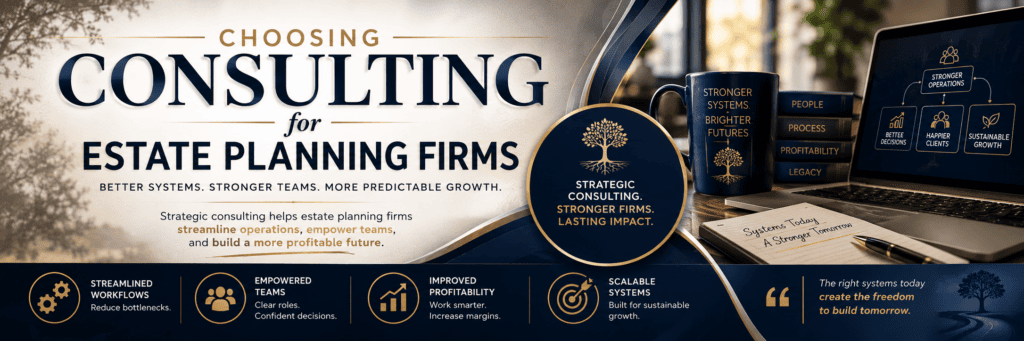
Small estate planning and elder law firms often seek consulting support when growth starts creating operational strain. The right consulting relationship helps a firm improve workflow, delegation, staffing, accountability, and profitability by creating systems that allow work to move more predictably without increasing attorney involvement in every decision.
For many firms, the challenge is not a lack of demand. It is the growing gap between being busy and operating efficiently.
Drawing on operational themes frequently discussed within The Million Dollar Solution’s workflow, hiring, retention, and practice management resources, successful firms tend to focus on systems, ownership, talent development, and process design rather than relying solely on additional staffing.
Why Estate Planning Firms Consider Practice Management Consulting
Growth creates complexity.
As a firm adds clients, staff members, and service offerings, informal processes that once worked begin to show strain. Attorneys become the default problem-solvers. Team members wait for approvals. Matters move inconsistently through the firm.
This is often the point where estate planning practice management becomes a leadership issue rather than simply an administrative one.
Consulting can help firms:
- Clarify workflow ownership
- Improve delegation
- Reduce attorney bottlenecks
- Create operational visibility
- Align staffing with firm goals
- Increase consistency across the client experience
The goal is not to create more procedures. The goal is to create more reliable outcomes.
Busy Does Not Always Mean Profitable
Many owner-led firms assume a full calendar indicates a healthy operation.
In reality, profitability is often constrained by hidden inefficiencies:
- Frequent interruptions
- Rework and corrections
- Unclear handoffs
- Attorney involvement in administrative decisions
- Slow intake-to-engagement timelines
- Lack of role accountability
When these issues accumulate, revenue may grow while margins remain flat.
This is one reason strategic consulting has become increasingly relevant for estate planning firms. The focus shifts from doing more work to improving how work moves through the organization.
What Good Consulting Actually Evaluates
Many firms begin searching for small law firm consulting services expecting recommendations about software, staffing, or marketing.
Those areas matter, but effective consultants usually start somewhere more fundamental: workflow.
A thorough assessment often examines:
Workflow Design
How does work move from intake to matter completion?
Where are matters getting delayed?
Which steps require attorney involvement unnecessarily?
Role Clarity
Do team members know exactly what they own?
Can decisions be made without constant escalation?
Are responsibilities documented and understood?
Capacity and Bottlenecks
What work is creating the most friction?
Where does overload consistently occur?
Are high-value employees spending time on low-value activities?
Leadership Structure
Are partners making strategic decisions or operational decisions?
Can the firm function effectively when key individuals are unavailable?
These questions often reveal opportunities that additional hiring alone would not solve.
Hiring Is Not Always the First Solution
When workload increases, many firms immediately consider adding headcount.
Sometimes that is necessary.
However, hiring into unclear systems often amplifies existing problems.
A new employee entering a disorganized workflow typically requires:
- More supervision
- More clarification
- More attorney involvement
- More operational coordination
Instead of relieving pressure, the firm may create additional complexity.
This is why talent management coaching is frequently paired with operational consulting. Strong firms define ownership, expectations, and workflows before expanding their teams. Training, onboarding, and role alignment become more effective when the underlying structure is clear.
Selecting the Right Practice Management Provider
Not every consultant serves estate planning firms in the same way.
When evaluating practice management providers, consider the following criteria.
Industry Familiarity
Estate planning and elder law firms operate differently than many other professional service businesses.
Long client relationships, emotionally complex matters, and extensive documentation create unique operational demands.
Consulting recommendations should reflect those realities.
Focus on Systems, Not Quick Fixes
Beware of solutions that depend entirely on hiring, technology, or marketing.
Sustainable improvement usually comes from stronger systems, clearer accountability, and better workflow design.
Operational Measurement
Effective consulting should help leadership answer practical questions:
- Where are matters slowing down?
- What is consuming attorney time?
- Which processes generate the most rework?
- How is capacity being utilized?
Without measurement, improvement becomes difficult to sustain.
Talent and Organizational Development
Operations and people are interconnected.
The strongest consulting engagements often include guidance around:
- Hiring strategy
- Role design
- Employee development
- Team communication
- Leadership growth
- Retention planning
A well-designed organization supports efficient workflow.
Signs a Firm May Benefit From Strategic Consulting
Most firms do not seek consulting because business is slow.
They seek support because growth is beginning to expose weaknesses.
Common indicators include:
- Partners constantly solving operational problems
- Team members waiting on attorney decisions
- Repeated workflow breakdowns
- Increased staff without improved productivity
- Client communication inconsistencies
- Unclear accountability
- Difficulty scaling despite strong demand
These signals often suggest the firm has outgrown its informal operating model.
Operational Maturity Creates Scalability
The most sustainable estate planning firms eventually make a shift.
Instead of relying on individual effort, they rely on systems.
Instead of depending on memory, they create repeatable workflows.
Instead of adding people to every problem, they improve ownership and accountability.
That transition does not happen automatically.
It requires intentional design, leadership attention, and often an outside perspective that can identify inefficiencies hidden inside daily operations.
Final Thought
Choosing consulting for an estate planning firm is less about finding answers and more about gaining clarity.
When workflows are aligned, roles are understood, and leadership can focus on direction rather than constant intervention, growth becomes more predictable. Firms often discover that the greatest opportunity is not generating more activity, but improving how existing work flows through the organization.