
Client Intake Sales Coaching for Elder Law Firms
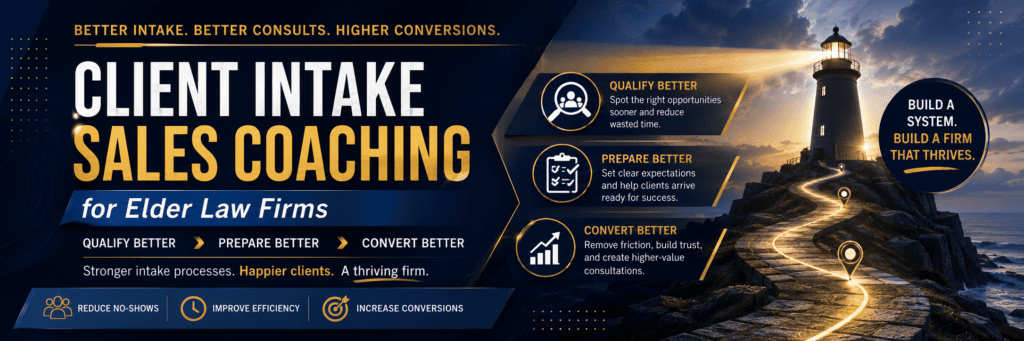
Client intake sales coaching can help elder law and estate planning firms improve consultation quality, strengthen conversion rates, and create a more consistent client experience. The most effective coaching programs do not focus on persuasion. They focus on improving how prospects move through the firm’s intake process, reducing uncertainty, and preparing both staff and attorneys for higher-quality consultations.
For many firms, conversion challenges begin long before the attorney enters the room. Intake is where expectations are set, urgency is identified, decision-makers are confirmed, and consults are positioned for success. When those steps are inconsistent, firms often experience lower conversion rates, increased no-shows, and operational inefficiencies that ripple throughout the organization.
Why Client Intake Deserves More Attention
Many elder law firms view intake as an administrative function. In reality, intake is one of the most influential stages in the client journey.
Prospective clients are typically navigating stress, uncertainty, family dynamics, and time-sensitive decisions. By the time they contact a firm, trust is already being formed. Coaching programs that improve intake performance help firms create a more structured and reassuring experience from the very first interaction.
Strong intake systems help firms:
- Improve consult readiness
- Reduce no-show rates
- Identify qualified opportunities earlier
- Create smoother attorney consultations
- Increase operational consistency
- Improve resource allocation across the team
The result is often better efficiency, not simply more appointments.
What Effective Client Intake Sales Coaching Actually Teaches
Not all sales coaching programs are designed for elder law and estate planning practices.
The most relevant programs focus on communication, workflow, process improvement, and consultation preparation rather than generic sales tactics.
Core areas typically include:
Understanding Client Psychology
Families rarely delay planning because they do not understand the need.
More often, delays stem from uncertainty, fear of making the wrong decision, competing family opinions, or simple overwhelm. Effective elder law firm coaching helps intake professionals recognize these factors and respond appropriately.
Asking Better Qualification Questions
Strong intake teams learn to uncover:
- Why the prospect is reaching out now
- What triggered the inquiry
- Who will participate in the decision
- Whether the matter is appropriately aligned with the firm’s services
This creates better consultations and minimizes preventable scheduling errors.
Preparing Clients for Success
The highest-performing firms understand that preparation is a service.
Client intake training often focuses on helping prospects arrive prepared emotionally, financially, and logistically. This reduces friction during consultations and allows attorneys to spend more time providing value rather than gathering missing information.
Signs Your Firm May Benefit from Intake Coaching
Many owners assume conversion challenges indicate a marketing problem.
Frequently, the issue exists further downstream.
Indicators may include:
- High inquiry volume but inconsistent conversions
- Frequent no-shows
- Missing documents before consults
- Attorneys repeating the same explanations
- Consults that feel rushed or disorganized
- Difficulty identifying qualified prospective clients
- Staff uncertainty during intake calls
These issues often represent workflow breakdowns rather than individual performance concerns.
That distinction matters.
A busy intake department is not necessarily an effective intake department. Just as a busy firm is not automatically a profitable firm, activity alone does not guarantee results. Operational clarity matters more than volume.
How Intake Coaching Supports Consultation Conversion Optimization
Consultation conversion optimization is frequently misunderstood.
The goal is not to make consultations more aggressive.
The goal is to remove obstacles that make decisions harder.
Strong coaching programs help firms create:
Consistent Expectations
Clients understand:
- What happens next
- What information is needed
- Who should attend
- What outcomes to expect
Clear expectations reduce anxiety and improve engagement.
Better Attorney Preparation
When intake gathers meaningful information upfront, attorneys begin consultations with context.
This allows conversations to move beyond basic fact gathering and focus on higher-value guidance.
Reduced Friction
Many prospective clients hesitate because uncertainty remains unresolved.
Coaching helps firms identify common friction points and address them before they derail the consultation process.
Choosing the Right Sales Coaching Program for Your Firm
The right program depends on your firm’s growth objectives.
When evaluating sales coaching programs, consider these questions:
Does It Address Operations, Not Just Scripts?
A coaching program should improve systems, workflows, handoffs, and consistency.
Teaching staff what to say matters.
Teaching the firm how work moves matters more.
Is It Designed for Estate Planning and Elder Law Practices?
Elder law consultations involve unique emotional, family, and decision-making dynamics.
General business sales training may not address those realities effectively.
Does It Improve Team Alignment?
Successful intake depends on coordination between:
- Intake staff
- Attorneys
- Operations leaders
- Marketing personnel
Coaching should strengthen communication across the entire intake workflow.
Does It Include Measurement?
Effective programs help firms track:
- Consultation booking rates
- Show rates
- Conversion rates
- Intake completion metrics
- Common bottlenecks
Improvement becomes difficult when firms cannot clearly see where prospects disengage.
Why Hiring More Staff Is Not Always the Answer
Many firms reach a point where intake feels overwhelmed.
The instinctive response is to hire.
Sometimes that is appropriate.
Often, however, the underlying issue is workflow design.
When processes remain inconsistent, adding people frequently creates additional complexity rather than better results. New team members inherit unclear expectations, inconsistent procedures, and communication gaps that already existed.
The most sustainable growth usually occurs when firms:
- Clarify the intake process.
- Standardize key steps.
- Define ownership.
- Improve coaching and accountability.
- Add capacity when the system can support it.
This sequencing creates scalability rather than simply increasing headcount.
Building a Stronger Intake Function
Client intake sales coaching for elder law and estate planning firms is ultimately about creating clarity.
Clarity for prospective clients.
Clarity for intake teams.
Clarity for attorneys.
And clarity for leadership.
When intake operates as a structured business process rather than a scheduling task, consultations become more productive, conversion rates become more predictable, and growth becomes easier to manage. The firms that scale most effectively are rarely the firms doing the most. They are the firms that create the most intentional systems around the work that matters most.