
Estate Planning Intake Coaching in 2026
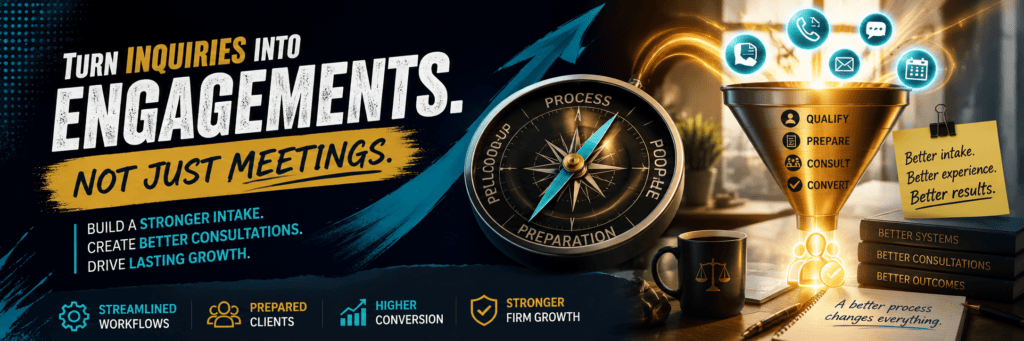
Small estate planning firms looking to improve consultation conversion should evaluate intake coaching through an operational lens, not just a sales lens. The most effective coaching programs help firms create a repeatable intake process, reduce bottlenecks, improve client readiness, and give attorneys higher-quality consultations rather than simply teaching staff how to “sell.”
In 2026, client intake sales coaching for estate planning firms is increasingly tied to workflow design, team accountability, and operational consistency. Firms that view intake as part of a larger client journey often see stronger conversion outcomes than firms that focus on consultation performance alone.
Why Intake Coaching Matters More Than Ever
Many owner-led firms assume consultation conversion is primarily an attorney issue.
In reality, conversion challenges often begin earlier.
By the time a prospective client reaches a consultation, they may already be experiencing uncertainty, information overload, family dynamics, financial concerns, or confusion about next steps. How intake staff manage those early interactions frequently shapes the quality of the consultation that follows.
This is why intake coaching has become a growing area within estate planning practice coaching.
The goal is not creating a more aggressive sales process.
The goal is creating a more predictable client experience.
What Good Intake Coaching Actually Improves
When evaluating sales coaching services, firms should look beyond closing techniques.
Strong coaching programs typically improve:
- Intake workflows
- Qualification processes
- Consultation preparation
- Team communication
- Follow-up consistency
- Lead conversion tracking
- Client expectation management
These improvements often have a broader operational impact than many firm owners initially expect.
When intake becomes more structured, attorneys spend less time clarifying misunderstandings and more time delivering value during consultations.
Common Signs a Firm May Need Client Intake Training
Many firms seek coaching after noticing declining consultation conversion.
However, other operational indicators often appear first.
You may benefit from client intake training if you notice:
- Consultations frequently end without clear next steps
- Staff members handle inquiries differently
- Attorneys repeatedly answer questions that should have been addressed before the meeting
- Prospective clients arrive unprepared
- Follow-up responsibilities are unclear
- No one consistently tracks conversion metrics
- Intake performance depends heavily on one employee
These symptoms often point to process inconsistency rather than individual performance issues.
The Difference Between Coaching and Hiring
One of the most common growth mistakes in small law firm growth is assuming a staffing problem exists when a systems problem exists.
A firm experiencing poor lead conversion may immediately begin recruiting additional staff.
That can create new expenses without addressing the underlying cause.
Before expanding headcount, consider whether:
- Intake responsibilities are clearly defined
- Scripts and workflows exist
- Consultation preparation standards are documented
- Follow-up procedures are consistent
- Performance metrics are visible
Hiring more people into an unclear process rarely produces sustainable improvement.
In many firms, coaching reveals workflow gaps that can be fixed before additional hiring becomes necessary.
How to Evaluate Intake Coaching Programs
Not all coaching programs are designed for estate planning firms.
When reviewing options, focus on practical implementation rather than motivation or theory.
1. Does the Program Address Process Design?
A coaching program should help create repeatable systems.
Look for support in:
- Intake mapping
- Consultation readiness workflows
- Handoff procedures
- Documentation standards
- Follow-up sequences
If coaching relies entirely on personality or persuasion skills, results may be difficult to sustain.
2. Does It Include Metrics?
Improvement requires visibility.
Effective programs typically help firms measure:
- Inquiry-to-consultation rates
- Consultation conversion rates
- No-show percentages
- Response times
- Follow-up completion rates
Without measurable benchmarks, it becomes difficult to determine whether coaching generates operational value.
3. Is It Built for Small Firms?
Large-firm intake structures often depend on specialized departments and multiple layers of management.
Most owner-led estate planning firms operate differently.
The best coaching programs recognize resource limitations and focus on processes that smaller teams can realistically maintain.
4. Does It Support Delegation?
Many firms struggle because intake knowledge remains concentrated with one person.
Strong coaching encourages:
- Knowledge transfer
- Process documentation
- Accountability standards
- Cross-training
This creates organizational resilience and reduces operational dependency.
Consultation Conversion Is Often a Workflow Issue
Many owners view consultation conversion as a communication challenge.
Often it is a workflow challenge.
For example:
A prospective client may schedule a consultation but receive inconsistent instructions.
Required documents may be incomplete.
Decision-makers may not attend.
Questions remain unanswered.
The attorney then spends valuable time rebuilding clarity during the meeting.
Conversion becomes harder not because the consultation failed, but because preparation failed.
This distinction matters.
The firms that improve conversion most consistently often refine what happens before the consultation rather than focusing exclusively on what happens during it.
Building an Intake Process That Scales
As firms grow, intake complexity increases.
More leads, more staff members, and more communication channels introduce opportunities for inconsistency.
Scalable intake systems tend to include:
- Defined intake ownership
- Written workflows
- Standardized consultation preparation
- Automated reminders where appropriate
- Regular process reviews
- Conversion reporting
These elements create operational predictability.
Without them, growth can introduce additional bottlenecks rather than increased profitability.
This is one reason busy firms sometimes feel overwhelmed despite healthy demand.
More activity does not automatically create greater efficiency.
Questions to Ask Before Investing in Coaching
Before selecting a provider, firm leaders should ask:
- What specific intake outcomes are we trying to improve?
- Which conversion challenges are process-related versus people-related?
- How will success be measured?
- What workflows need documentation?
- Who owns intake accountability?
- What happens after coaching ends?
The clearer these answers become, the easier it is to choose a coaching solution aligned with long-term operational goals.
Final Thoughts
Client intake sales coaching for estate planning firms is rarely about sales alone. At its best, it helps create consistency between marketing, intake, consultation, and client onboarding.
For owner-led firms, the larger opportunity is often operational. Better intake creates better consultation conditions. Better consultation conditions support stronger conversion. And stronger conversion allows growth to occur with less friction, fewer bottlenecks, and greater confidence in the systems supporting the firm.
In that sense, intake coaching is not simply an investment in lead conversion. It is an opportunity to examine how work moves through the practice and whether that process is truly supporting long-term growth.