
Estate Planning Practice Management in 2026
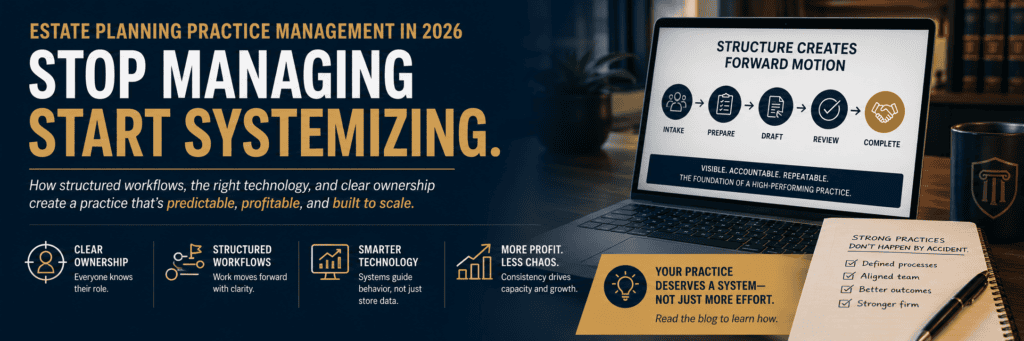
Effective estate planning practice management in 2026 comes down to one core shift: firms that treat workflows as structured systems—not individual effort—operate with more clarity, consistency, and profitability. When processes, technology, and team roles are aligned, the practice becomes easier to manage without sacrificing client experience.
Why Practice Management Feels Harder Than It Should
Most small estate planning and elder law firms are not underperforming because of legal skill or commitment. They are under strain because their operations evolved informally while demand increased.
This creates a familiar pattern:
- The team is consistently busy
- Attorneys stay deeply involved in day-to-day work
- Progress feels slower than effort suggests
Over time, busy becomes the default—but profitability does not follow.
The underlying issue is not capacity. It is structure.
Diagnosing Inefficient Estate Planning Operations
Before improving systems, firms need to understand where breakdowns typically occur.
1. Work Depends on People, Not Process
When workflows live in memory instead of systems, progress becomes inconsistent and fragile.
- Intake varies depending on who answers the phone
- Drafting readiness is subjective
- Follow-up depends on individual tracking
This creates rework and delays that compound over time.
2. Technology Exists—but Doesn’t Guide Behavior
Many firms already use elder law software or practice management systems. But those systems often function as storage, not workflow drivers.
Without structured workflows:
- Tasks are manual instead of automated
- Visibility into workload is limited
- Accountability is unclear
Technology alone does not improve operations—configuration does.
3. Attorneys Become the Default Solution
When roles and handoffs are unclear, everything escalates upward.
- Staff defer decisions
- Bottlenecks form at review and approval stages
- Attorneys spend time on administrative coordination
This is where many firms feel stuck: hiring increases headcount, but not efficiency.
Legal Process Optimization: Where to Focus First
Not all improvements carry equal weight. In most estate planning operations, bottlenecks cluster in a few areas.
Intake and Qualification
Unstructured intake introduces unclear or incomplete matters into the workflow, leading to downstream inefficiencies.
Drafting Readiness
If “ready for drafting” is loosely defined, files stall or cycle backward.
Review and Approval
Work waits on availability instead of moving predictably through defined stages.
Follow-Up Ownership
Without clear responsibility, next steps become reactive rather than scheduled.
Individually, these are manageable. Collectively, they create the sense that adding more work only adds more pressure.
Reframing Practice Management: Systems Over Effort
Improving estate planning practice management is not about increasing pace—it is about reducing unnecessary work.
A well-designed system does three things:
Defines Ownership
Every stage has a clear owner, reducing escalation and ambiguity.
Standardizes Handoffs
Work moves forward based on triggers—not memory.
Aligns the Team to the System
Processes are followed because they are embedded in the workflow, not because they are remembered.
When this alignment happens:
- Interruptions decrease
- Rework declines
- Work becomes more predictable
Firms often find capacity without adding staff, simply by redesigning how work flows.
Getting More Value from Practice Management Software
Practice management tools (including many elder law software platforms) are most effective when they actively guide how work moves—not just where it’s stored.
Configured properly, systems can:
- Assign tasks automatically based on matter stage
- Enforce sequence and accountability
- Provide visibility into workload and capacity
This is where legal technology services and law firm consulting intersect.
Technology should reflect your firm’s actual operations—not force your team into generic structures.
Why Hiring Isn’t the First Solution
When workloads increase, hiring feels like the logical next step.
But without structured workflows:
- New hires escalate decisions instead of owning them
- Attorneys remain involved by default
- Responsibility becomes more diffused
This is why many firms grow in size—but not in efficiency.
Hiring into unclear systems often amplifies inefficiency rather than resolving it.
The Role of Law Firm Consulting in 2026
As estate planning practices become more complex, operational clarity becomes harder to build internally.
Workflow and practice management consulting provides:
- External perspective on blind spots
- Proven frameworks for process design
- Faster implementation than trial-and-error internally
Importantly, operational improvements are interconnected:
- Workflow affects staffing
- Staffing affects profitability
- Profitability affects growth decisions
Effective consulting addresses the system—not isolated symptoms.
A More Sustainable Model for Estate Planning Practice Management
A busy firm can still feel controlled when systems are clear.
A growing firm can scale without strain when workflows are structured.
And a small firm can operate at a high level without constant oversight when:
- Roles are defined
- processes are consistent
- systems actively guide the work
A nonstop workflow is not a failure—it is a signal that your practice has outgrown its original design.
The opportunity is not to work harder, but to operate more intentionally.