
How Do Estate Planning Firms Learn Which Clients Actually Help Them Grow?
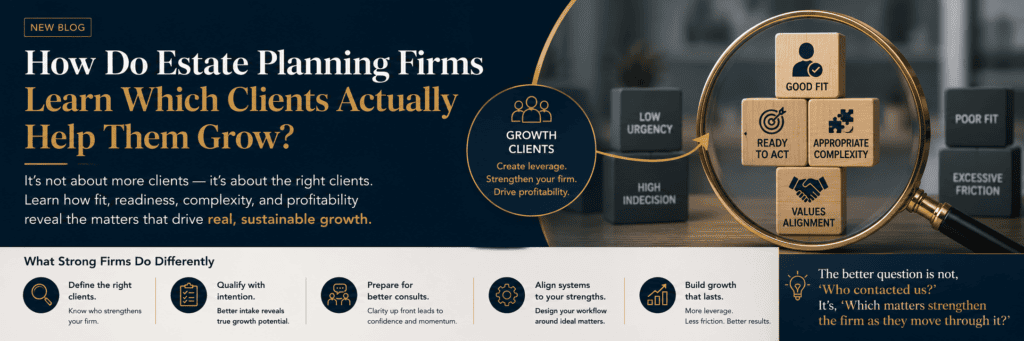
Estate planning firms learn which clients help them grow by paying closer attention to fit, readiness, complexity, and profitability — not just conversion volume. The matters that help a firm grow are usually the ones that align with the firm’s strengths, move through its systems more predictably, and support healthy margins without excessive friction.
Growth clients are not always the most obvious clients
A firm may assume its best clients are the easiest to sign or the most frequent referrals. But over time, stronger firms usually learn to evaluate matters through a broader lens:
- Does this matter match our strengths?
- Does it require the kind of strategic guidance we do well?
- Does it move with reasonable clarity through intake, consult, and completion?
This is an important distinction. Some matters generate revenue while quietly creating strain. Others create less friction, better outcomes, and more dependable growth.
The client signals that matter most
Internal materials on ideal client definition emphasize four useful dimensions:
- urgency
- complexity
- values alignment
- decision readiness
These factors help firms identify which matters are likely to move forward well and which are more likely to stall, loop backward, or require repeated reassurance without forward progress.
Intake is where firms start learning this
Most firms do not learn which clients help them grow by intuition alone. They learn through better qualification. Intake is where the firm gathers the first real evidence:
- why now
- what outcome is needed
- who decides
- what level of readiness exists
When intake teams resist jumping straight to scheduling and instead clarify urgency, decision authority, and readiness, the firm gets a much clearer sense of whether the inquiry is a true growth opportunity or simply more activity.
Which matters usually create drag
The cases that tend to weigh a firm down are often not “bad” matters. They are simply misaligned matters:
- low urgency with high indecision
- limited readiness but high demand for reassurance
- work that does not fit the firm’s strengths
- expectations that exceed what the system is designed to support
Over time, these patterns affect morale, scheduling, throughput, and profitability.
What strong firms do differently
More intentional firms define not only the clients they want more of, but also the cases that consistently create friction, burnout, or stalled conversions. That kind of clarity changes:
- marketing
- intake scripts
- consultation preparation
- internal workflow planning
Once the firm names those patterns, client selection becomes more disciplined and less reactive.
Estate planning firms learn which clients help them grow when they stop measuring demand by volume alone. The better question is not, “Who contacted us?” It is, “Which matters strengthen the firm as they move through it?” That shift usually marks the beginning of more intentional growth.