
How Do I Reduce Attorney Workload Without Reducing Revenue?
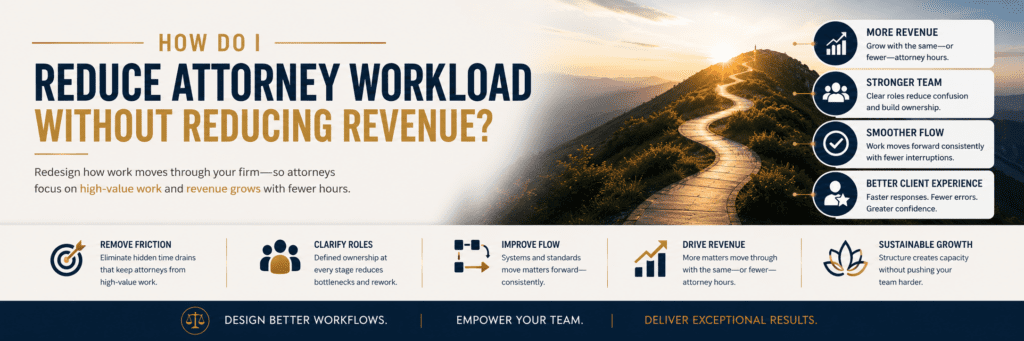
You reduce attorney workload without reducing revenue by redesigning how work moves through the firm—not by asking attorneys to work harder or by immediately hiring more people. When workflows, roles, and handoffs are clear, attorney time shifts back to high‑value work, and revenue becomes easier to sustain with fewer hours.
Busy Hours Don’t Equal Profitable Hours
Many estate planning and elder law firms experience the same pattern: attorneys are logging more hours, yet revenue plateaus. This usually isn’t a demand problem. It’s a workflow problem.
When attorneys spend time:
- Chasing intake details
- Managing file status
- Correcting avoidable errors
- Answering routine client questions
The firm is using its most expensive resource on work that doesn’t increase margin. Effort goes up. Output does not.
Why Hiring Often Fails to Fix the Problem
Hiring feels like the logical response to overload. In practice, it often adds friction.
Without clear workflows:
- New staff escalate decisions instead of owning outcomes
- Training and supervision pull attorneys deeper into operations
- More people create more coordination—not more capacity
This is why firms can grow headcount and still feel stretched. Hiring redistributes pressure when structure is missing.
The Real Issue: Attorneys as the Default Solution
In many firms, anything unclear eventually lands on an attorney’s desk. Not because attorneys want it there—but because the system pushes it there.
This happens when:
- Intake standards are inconsistent
- “Ready for drafting” isn’t defined
- Ownership between roles is unclear
- Decisions aren’t standardized
Reducing attorney workload requires separating legal judgment from administrative execution—and designing the handoff intentionally.
How Workload Drops Without Revenue Dropping
Revenue grows when more matters move through the firm with the same—or fewer—attorney hours. That only happens when the workflow supports flow.
Operationally stable firms focus on:
- Clear intake and readiness standards
- Defined role ownership at each stage
- Structured review and approval steps
- Fewer informal check‑ins and interruptions
When these pieces are in place, attorneys spend more time on strategy, counsel, and review—the work clients value and pay for.
Scaling Without Burnout
Scaling doesn’t require pushing the team harder. It requires removing friction that quietly consumes time.
Firms that scale sustainably tend to:
- Design workflows around roles, not people
- Let systems guide work instead of relying on memory
- Measure capacity by flow, not by hours worked
Often, the firm already has enough people. It simply doesn’t have enough structure.
A Different Definition of Capacity
Capacity isn’t how many hours your attorneys can work. It’s how smoothly work moves when they’re not involved.
When workflow design catches up to growth, attorney workload drops naturally—and revenue becomes more predictable, not more fragile.