
How Do I Scale a Law Firm Without Burning Out My Team?
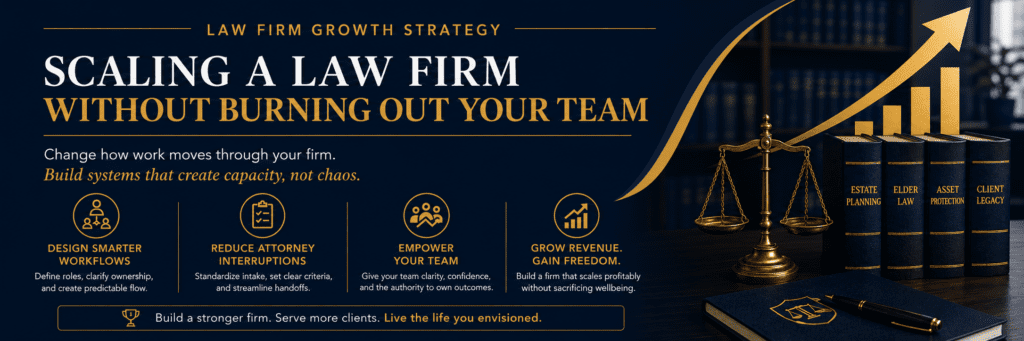
Scaling a law firm without burning out your team requires changing how work moves through the firm—not simply adding more work or more people. Sustainable growth happens when systems, roles, and decision-making are designed to absorb demand without increasing stress.
Many estate planning and elder law firms reach a point where they are busy, profitable on paper, and still overwhelmed. Calendars are full. Revenue is coming in. Yet attorneys remain deeply involved in administrative work, staff feel stretched, and growth feels fragile rather than freeing.
Busy Is Not the Same as Scalable
A full pipeline can mask operational strain. When every new matter requires custom handling, constant attorney oversight, or reactive problem-solving, growth increases pressure instead of capacity.
Common signals include:
- Attorneys acting as default problem-solvers
- Files stalling while waiting for decisions
- Staff escalating issues instead of owning outcomes
- Revenue rising without corresponding margin or time freedom
These are not people problems. They are workflow design problems.
Why Hiring Often Feels Necessary—but Disappoints
Hiring is frequently the first response to overload. Sometimes it is appropriate. Often, it simply spreads confusion across more people.
When processes are unclear:
- New hires rely heavily on attorneys for direction
- Training consumes already-limited leadership time
- Responsibility becomes diffused instead of clarified
Hiring into an undefined system increases payroll without reducing strain. Growth feels more expensive, not more stable.
Scaling Starts With How Work Moves
Efficient firms focus less on volume and more on flow. That means intentionally designing how work enters, progresses, and exits the firm.
Operationally strong firms tend to:
- Define what truly requires attorney judgment
- Delegate preparatory and administrative work with clarity
- Standardize repeatable decisions
- Assign clear ownership at each stage of a matter
When expectations are defined, work moves predictably. Attorneys spend more time on high-value work, and staff can operate with confidence.
Reducing Attorney Workload Without Reducing Revenue
Workload reduction does not require fewer clients. It requires fewer interruptions, fewer bottlenecks, and fewer decisions that default back to the attorney.
This often involves:
- Clear intake standards
- Defined “ready” criteria before drafting or review
- Structured review and approval workflows
- Explicit handoffs instead of informal check-ins
Each improvement reduces friction. Collectively, they change how heavy the work feels.
When Outside Perspective Becomes Valuable
Many firms attempt incremental fixes—new software, more checklists, another hire—without stepping back to evaluate the operating model as a whole.
A practice management consultant becomes useful when:
- Growth creates complexity faster than clarity
- Owners are pulled back into daily operations
- Revenue increases without corresponding freedom
At that stage, the issue is not effort. It is structure.
A Different Definition of Scale
True scale is not about doing more. It is about doing work in a way that protects energy, time, and margin.
A firm does not need to slow down to stabilize. It needs systems that match the level of success it has already achieved.
Growth should create capacity. When it doesn’t, the operating model—not the market—is asking for attention.