
How Estate Planning Firms Win More Clients in 2026
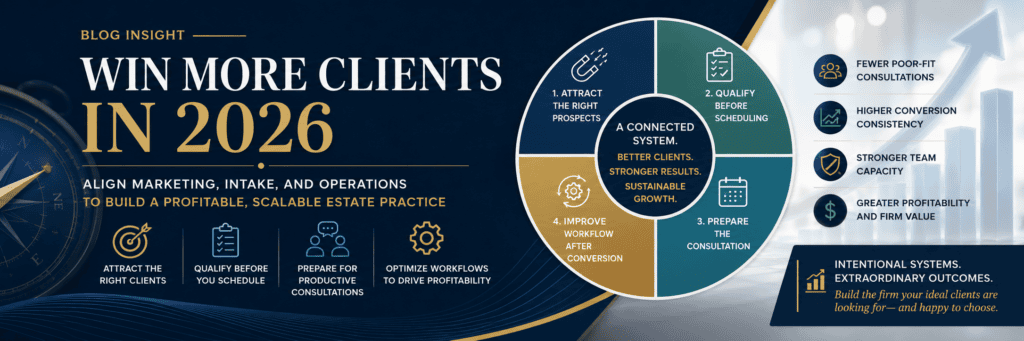
Estate planning firms that consistently win more clients in 2026 are not relying on better marketing alone. They are aligning estate planning marketing, client intake, and operational workflows into a system that attracts the right prospects, prepares them for productive consultations, and moves matters through the firm efficiently. Firms that treat marketing and intake as separate functions often become busier. Firms that integrate them tend to become more profitable. Based on internal growth and intake frameworks emphasizing ideal-client alignment, intake qualification, and operational clarity, sustainable growth comes from attracting better-fit matters rather than simply increasing inquiry volume.
The Shift Happening in Estate Planning Marketing
Many estate planning firms still evaluate marketing success by lead volume.
More website inquiries. More consultation requests. More phone calls.
Yet many firms discover that increased activity does not automatically improve profitability.
Prospective clients are arriving more informed, more selective, and often more overwhelmed than ever before. They are researching providers, comparing options, and looking for clarity before they ever contact a law firm. Strong firms recognize that growth is no longer about generating the highest volume of inquiries. It is about becoming the obvious choice for the right people.
This distinction matters because poor-fit matters create operational strain:
- Excessive follow-up
- Low-quality consultations
- Scheduling congestion
- Attorney bottlenecks
- Staff frustration
In other words, busy does not necessarily mean healthy.
Why Marketing Coaching Alone Is Not Enough
Many law firm marketing initiatives focus primarily on visibility:
- Search rankings
- Content marketing
- Referral development
- Social media presence
- Community education
These activities are important. But they only solve the first half of the client acquisition equation.
Marketing answers:
“How do people find us?”
It does not answer:
“What happens after they do?”
Without operational alignment, marketing improvements can expose weaknesses rather than create growth. Additional inquiries simply place more pressure on an intake process that was never designed to scale. Internal growth frameworks consistently emphasize that lead generation creates demand, but growth requires design.
This is where marketing coaching services and client intake coaching intersect.
The Missing Link: Client Intake Coaching
Many estate planning firms underestimate the influence of intake.
It is often viewed as an administrative task when it is actually the first stage of the consultation process.
Before a prospective client ever speaks with an attorney, intake determines:
- Expectations
- Preparedness
- Confidence
- Fit
- Decision readiness
Effective intake coaching teaches teams to move beyond scheduling and begin facilitating informed decision-making. Firms that strengthen intake often discover improvements in:
- Consultation quality
- Attorney utilization
- Conversion consistency
- Workflow efficiency
- Client experience
Intake is not administrative overhead. It is a growth function.
How Marketing and Intake Create a Repeatable Client Acquisition System
The most effective client acquisition systems follow a predictable sequence.
Step 1: Attract the Right Prospects
Strong estate planning marketing starts with clarity.
Firms that grow intentionally define:
- Their ideal client
- Preferred case types
- Desired complexity levels
- Values alignment
- Decision readiness indicators
Clear positioning helps the right prospects identify themselves before they call while encouraging poor-fit prospects to self-select elsewhere. This reduces wasted consultations and preserves team capacity.
Step 2: Qualify Before Scheduling
Many firms move immediately from inquiry to calendar.
High-performing firms do not.
Instead, intake professionals gather information related to:
- Urgency
- Decision authority
- Readiness
This structure helps determine whether the consultation is likely to move forward productively. It also helps prepare both the client and attorney for a more meaningful conversation.
Step 3: Prepare the Consultation
Preparation reduces friction.
Clients should understand:
- What will happen
- What documents are needed
- Who should attend
- What decisions may need to be made
When expectations are established early, attorneys spend less time rebuilding clarity and more time providing value.
Step 4: Improve Workflow After Conversion
A new client should enter the firm through a structured process.
Otherwise, growth creates operational stress.
Many firms assume hiring additional staff will solve growth challenges. In reality, bottlenecks often originate from unclear processes rather than insufficient personnel. Workflow, onboarding, delegation, and training systems frequently create more leverage than additional headcount. Operational development frameworks repeatedly emphasize systematic training, process clarity, and role alignment as key drivers of scalability.
Why Hiring Is Not Always the Answer
A common pattern appears in growing estate planning firms.
Demand increases. Capacity feels constrained. Leadership decides to hire.
Sometimes that works.
Often it does not.
Additional employees entering an inefficient system simply increase complexity.
Before adding staff, firm leaders should evaluate:
- Intake consistency
- Task ownership
- Consultation preparation
- Workflow handoffs
- Process documentation
- Delegation clarity
Many bottlenecks stem from work moving unpredictably rather than from insufficient staffing levels. Firms frequently discover that process improvement produces greater capacity than another hire.
What Practice Management Consulting Often Reveals
This reality connects directly to broader conversations around legal practice management consulting.
When firms investigate profitability challenges, the root cause is often not marketing.
Nor is it always staffing.
Instead, consultants frequently uncover operational friction between:
- Marketing and intake
- Intake and attorneys
- Attorneys and staff
- Staff and systems
The result is hidden inefficiency.
Work flows into the firm faster than it can move through the firm.
That is why the most successful growth strategies focus on the entire client journey rather than isolated departments.
Fixing Estate Planning Workflow Bottlenecks
Workflow bottlenecks rarely announce themselves clearly.
They often appear as:
- Backlogged consultations
- Repeated follow-up requests
- Attorney interruptions
- Delayed matter completion
- Burnout among high performers
The solution is not simply to work harder.
It is to create clearer systems.
The strongest firms build repeatable processes around:
- Client qualification
- Intake standards
- Consultation preparation
- Matter onboarding
- Delegation
- Training and development
Structure reduces overload. Clarity reduces rework. Predictability improves profitability.
The Firms That Will Grow Most Effectively in 2026
The firms that win more clients in 2026 will not necessarily have the largest advertising budgets.
They will be the firms that connect:
- Estate planning marketing
- Client intake coaching
- Workflow optimization
- Team development
- Operational clarity
When those elements work together, marketing becomes more efficient, consultations become more productive, and clients move through the firm with less friction.
Growth becomes repeatable rather than reactive.
And that often marks the transition from simply getting more clients to building a firm that can consistently serve them well.