
How Intake Coaching Helps Elder Law Conversion
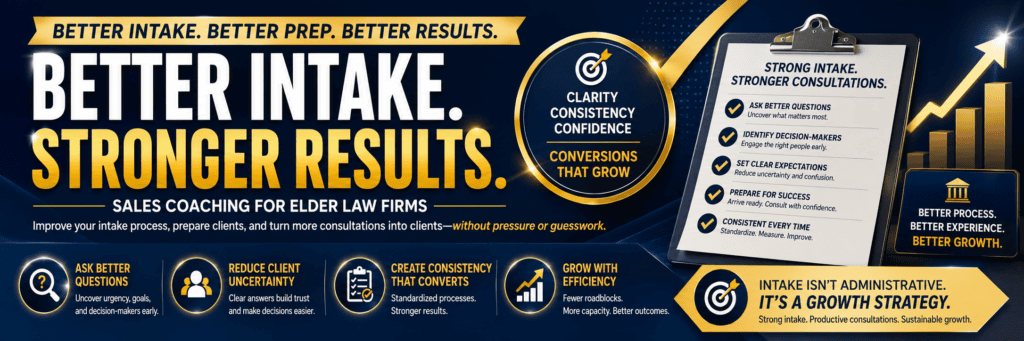
For many elder law firms, conversion challenges begin long before the attorney enters the consultation room. Sales coaching for elder law firms helps teams improve the client intake process by creating clarity, consistency, and confidence at every stage of the client journey. When intake conversations are structured well, consultations become more productive, clients arrive better prepared, and attorneys spend less time rebuilding trust or filling information gaps.
Intake Is Not Administrative Work. It Is Part of the Consultation.
Many small firms unintentionally treat intake as a scheduling function. The appointment gets booked, paperwork is requested, and the consultation begins.
In practice, however, intake often determines whether a consultation moves forward smoothly or stalls before it starts.
Strong intake processes help firms:
- Set expectations clearly
- Identify decision-makers early
- Prepare clients for the consultation
- Reduce attorney rework
- Improve overall conversion consistency
When these elements are missing, attorneys frequently spend valuable consultation time clarifying next steps, gathering basic information, or addressing confusion that could have been resolved earlier.
Why Elder Law Consultations Often Struggle
Many firm owners assume low conversion rates are primarily a marketing issue.
Often, they are an operations issue.
Prospective clients frequently arrive overwhelmed. In many cases, adult children, spouses, or multiple family members are involved in the decision-making process. By the time they contact an elder law firm, they have already spent considerable time researching options and trying to understand a complex situation.
Common intake-related conversion challenges include:
- Missing decision-makers
- Unclear expectations
- Missing documents
- Uncertain pricing assumptions
- Fear of making the wrong decision
- Information overload
These issues create friction before the attorney ever begins advising the family.
What Sales Coaching for Elder Law Firms Actually Improves
The phrase “sales coaching” can be misunderstood.
In successful elder law firms, coaching is rarely about persuasion. It is about helping staff and attorneys communicate more clearly, identify client concerns earlier, and guide conversations with confidence.
Effective coaching typically focuses on three areas.
1. Asking Better Questions
High-performing intake teams follow a logical conversation flow rather than jumping immediately to scheduling.
They learn how to uncover:
- Why the client is reaching out now
- What urgency exists
- Who will be involved in the decision
- Whether the client is ready to move forward
These questions provide context that improves both preparation and conversion.
2. Reducing Client Uncertainty
Many clients delay decisions because they are overwhelmed, uncertain, or worried about making a mistake.
Coaching helps staff recognize common forms of hesitation and respond with clarity instead of pressure.
When clients understand what happens next, what information is needed, and what outcomes are realistic, decision-making becomes easier.
3. Creating Consistency
A firm may have talented attorneys, but inconsistent intake creates inconsistent results.
Coaching helps establish:
- Standardized call flows
- Intake checklists
- Consultation preparation processes
- Communication standards
- Follow-up expectations
Consistency allows firms to measure performance and improve it over time.
Busy Does Not Always Mean Efficient
One of the more common growth mistakes among small elder law firms is assuming that increased activity automatically translates into stronger performance.
It frequently does not.
Firms become busier because:
- More inquiries arrive
- More staff are hired
- More consultations are scheduled
Yet conversion rates remain unchanged.
The underlying issue is often workflow design.
Without a structured intake process, additional volume simply introduces more confusion into the system. More inquiries create more bottlenecks. More staff increase coordination demands. More consultations consume attorney capacity without improving outcomes.
Why Hiring Alone Rarely Fixes Intake Problems
When firms experience conversion challenges, the instinct is often to hire another intake coordinator, marketing employee, or attorney.
But hiring does not solve unclear processes.
If expectations, scripts, workflows, and responsibilities remain undefined, additional staff frequently inherit the same problems that already exist.
The result is:
- Inconsistent client experiences
- Escalating attorney involvement
- Variable conversion outcomes
- Training challenges
- Reduced profitability
Improvement usually starts with process clarity before headcount expansion.
The Connection Between Intake and Law Firm Conversion Optimization
Many conversion discussions focus on sales techniques.
The stronger operational perspective is to focus on preparation.
The best consultations are often not “closed.”
They are prepared.
When clients arrive with:
- The right information
- Realistic expectations
- Appropriate decision-makers
- Greater confidence
The attorney can spend more time providing value and less time overcoming preventable obstacles.
This is where law firm conversion optimization becomes less about persuasion and more about operational design.
How Better Intake Supports Small Law Firm Growth
Growth becomes easier when work enters the firm with clarity.
A strong intake system creates benefits beyond conversion:
- Better client experience
- More predictable workflows
- Reduced attorney interruptions
- Improved delegation
- Higher staff confidence
- Greater operational scalability
Over time, firms that invest in coaching and intake development often discover that efficiency improvements create more capacity than additional hiring.
Final Thought
The client intake process is often the most overlooked growth lever inside an elder law firm.
While marketing generates opportunities, intake determines how effectively those opportunities move forward. Sales coaching for elder law firms helps teams create consistent client experiences, remove friction from consultations, and build operational systems that support sustainable growth.
The firms that convert more effectively are rarely the firms applying more pressure. They are usually the firms creating more clarity.