
How to Choose Actionstep Consulting for Small Firms
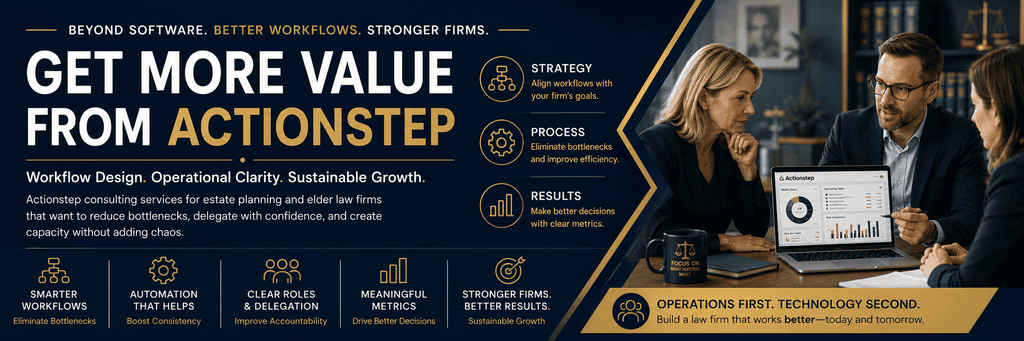
Many small law firms invest in Actionstep expecting immediate efficiency gains, only to discover that software alone rarely solves operational bottlenecks. The firms that get the most value from Actionstep consulting services are usually not looking for technical setup alone. They are looking for a way to improve how work moves through the firm, how responsibilities are delegated, and how capacity is created without increasing chaos.
For estate planning and elder law firms, the right consulting engagement should focus as much on workflow design and operational clarity as it does on technology configuration. Firms often remain overloaded not because they lack software, but because the software has not been aligned with how the firm actually operates.
Why Small Firms Seek Actionstep Consulting
As firms grow, processes often develop informally.
A team member creates a workaround.
A paralegal develops a personal tracking system.
An attorney becomes the default problem solver.
Over time, these adjustments create hidden complexity.
Actionstep is capable of supporting structured workflows, but successful implementation requires firms to define:
- How matters should move through the firm
- Who owns each stage
- Which tasks require attorney involvement
- Which tasks can be automated or delegated
- What metrics indicate workflow health
Without these answers, even a well-configured system can become little more than a digital filing cabinet.
Start With Workflow, Not Technology
One of the most common mistakes firms make is treating Actionstep as an IT project.
In reality, it is an operations project.
Before evaluating Actionstep consulting services, firms should understand:
Where Work Gets Stuck
Look for recurring delays such as:
- Intake bottlenecks
- Draft review queues
- Missing document follow-up
- Attorney approval dependencies
- Matter closing delays
Technology can help solve these problems, but only after they have been clearly identified.
Who Owns Each Process
A surprising amount of inefficiency comes from unclear ownership rather than inadequate staffing.
When responsibilities overlap, work stalls.
When ownership is clear, delegation improves, accountability increases, and attorneys spend more time on high-value work.
This is particularly important for firms that feel perpetually busy but struggle to increase profitability. Activity and profitability are not the same thing.
What Good Actionstep Consulting Should Include
Not all consulting engagements are structured the same way.
Strong Actionstep consulting services typically address five interconnected areas.
1. Workflow Mapping
The consultant should begin by understanding how work currently moves through the firm.
Questions should include:
- How does a matter enter the system?
- What triggers the next action?
- Where do delays occur?
- Which tasks repeat consistently?
The objective is not to force a generic process onto the firm.
The objective is to create workflows that reflect how the firm serves clients while removing avoidable friction.
2. Legal Workflow Automation
Automation should eliminate routine administrative work, not create complexity.
Examples may include:
- Task generation by matter stage
- Automated reminders
- Document workflows
- Status tracking
- Internal handoffs
The goal is consistency.
When routine activities happen automatically, staff can focus on client service and case progression.
3. Practice Management Alignment
Many firms use only a fraction of their law firm practice management software’s capabilities.
A consultant should help align:
- Matter stages
- Task structures
- Reporting
- Team responsibilities
- Capacity management
The software should support the firm’s workflow rather than forcing the workflow to adapt to the software.
4. Role and Delegation Design
Some firms pursue hiring when the larger issue is workflow design.
Additional headcount can temporarily reduce pressure, but unclear systems often create additional management complexity.
Before expanding the team, effective consultants examine:
- Attorney task utilization
- Administrative workload
- Delegation opportunities
- Staff capacity
- Process consistency
Hiring may still be necessary, but it should follow operational clarity rather than attempt to replace it.
5. Visibility Through Meaningful Metrics
Actionstep contains valuable operational data.
Consulting should help firms determine:
- Average matter completion time
- Intake conversion performance
- Task backlog levels
- Capacity utilization
- Workflow bottlenecks
Visibility allows leadership to make decisions based on operational reality rather than assumptions.
Questions to Ask Before Hiring an Actionstep Consultant
A productive evaluation process often includes questions such as:
- How do you approach workflow analysis before technology configuration?
- How do you identify bottlenecks?
- How do you align technology with delegation and staffing?
- How do you measure implementation success?
- How do you help firms maintain improvements after implementation?
The answers reveal whether the consultant focuses primarily on software or understands the broader operational system.
Signs a Firm May Need Actionstep Optimization
Many firms postpone optimization because they assume their challenges stem from growth.
Sometimes the issue is growth.
Often it is workflow design.
Potential indicators include:
- Attorneys regularly handling administrative tasks
- Repeated bottlenecks in the same process stages
- Difficulty tracking matter status
- Inconsistent client experiences
- Team members relying on spreadsheets outside the system
- Overflow work despite recent hiring
These symptoms usually point toward process alignment opportunities rather than effort deficiencies.
The Technology Should Support the Firm, Not Define It
The strongest Actionstep consulting engagements help firms build operational structure first and software structure second.
When workflow design, role clarity, automation, and accountability work together, technology becomes significantly more valuable.
Small estate planning and elder law firms rarely suffer from a lack of effort. More often, they have outgrown the systems that once worked. Actionstep can become a powerful operational platform when it is configured to support intentional workflows, clear ownership, and sustainable growth rather than simply storing information. That distinction is often what separates a busy firm from an efficient one.
The Million Dollar Solution® (MDS) provides consulting, coaching, and educational services only. The information presented is for general informational purposes and does not constitute legal, accounting, tax, or other professional advice. Attorneys, CPAs, and other professionals are responsible for complying with the laws, regulations, ethical requirements, and professional standards applicable to their own jurisdictions and professions.