
How to Choose Law Firm Growth Consulting in 2026
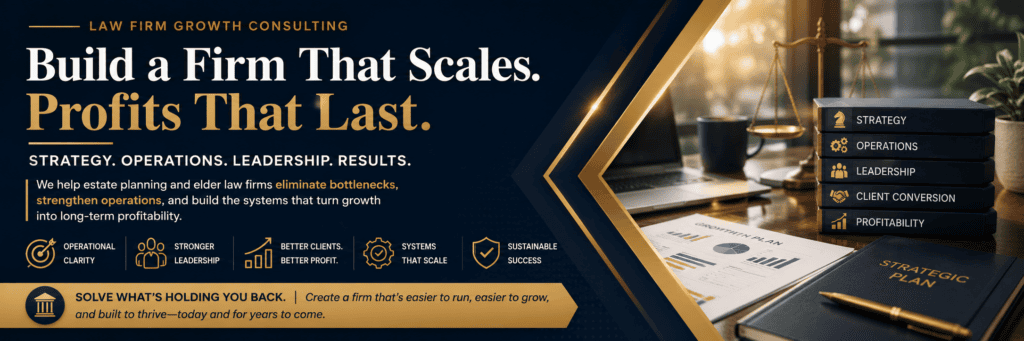
Small law firms rarely struggle because attorneys lack legal skill. More often, growth becomes difficult because operations, staffing, leadership, and client workflows fail to scale alongside demand. Choosing the right law firm growth consulting partner in 2026 means finding someone who can improve how the firm functions—not simply increase activity.
For estate planning and elder law firms, the best consulting relationships focus on profitability, operational clarity, delegation, leadership development, client conversion, and sustainable systems that support long-term growth. Many firms discover that their biggest challenge is not attracting more work, but creating a practice capable of handling growth effectively.
Why Law Firm Growth Consulting Has Changed
A few years ago, many consultants focused primarily on marketing and lead generation.
Today, firm owners face a different reality.
They are often:
- Managing overloaded teams
- Struggling with inconsistent workflows
- Experiencing attorney bottlenecks
- Fighting staffing turnover
- Dealing with operational complexity created by growth
More cases do not automatically create more profit.
In fact, growth frequently exposes operational weaknesses that were hidden when the firm was smaller. As volume increases, unclear processes, inconsistent intake, weak delegation, and undefined ownership create friction throughout the organization.
A quality practice management consulting engagement should address those foundational issues before pursuing aggressive expansion.
Start With the Firm’s Real Problem
Before evaluating consultants, owners should ask:
What is currently limiting growth?
Common answers include:
Capacity Problems
The calendar is full, but work continues to pile up.
Workflow Problems
Work depends on memory instead of process.
Staffing Problems
Employees are busy but accountability remains unclear.
Leadership Problems
Partners remain involved in nearly every decision.
Conversion Problems
Prospective clients reach out, but many fail to move forward.
Each challenge requires a different solution.
Consultants who prescribe the same answer to every firm often create more complexity than improvement.
The Best Consultants Focus on Profitability, Not Activity
One of the easiest traps for small firms is confusing motion with progress.
Teams look busy.
Attorneys work longer hours.
Case volume rises.
Yet profitability remains stagnant.
Strong law firm growth consulting focuses on eliminating friction inside the business rather than simply adding more work to the system.
Areas that deserve attention include:
- Process design
- Delegation structures
- Client journey management
- Staff utilization
- Leadership bandwidth
- Technology adoption
- Operational accountability
The goal is creating leverage throughout the organization—not making everyone work harder.
Evaluate Their Approach to Legal Operations Management
Many consulting firms discuss growth but rarely discuss operational flow.
That should raise concern.
Effective legal operations management improves how work moves through the firm from initial inquiry to matter completion.
Questions worth asking include:
Do they map workflows?
Growth becomes difficult when firms cannot clearly see where work slows down, stalls, or loops backwards.
Do they address ownership?
Every step should have a clear owner.
Unclear responsibility is one of the most common sources of bottlenecks.
Do they separate attorney work from administrative work?
When attorneys routinely handle operational tasks, profitability declines and scalability suffers.
Do they improve handoffs?
Many workflow issues appear at transition points between team members.
Strong consultants focus heavily on those moments.
Assess Their Philosophy on Hiring
Many firms assume additional hiring will solve growth challenges.
Often it does not.
Hiring into unclear systems simply adds more people to existing confusion.
The strongest consultants view hiring as part of a broader operational strategy.
They help firms:
- Define roles clearly
- Align responsibilities effectively
- Improve onboarding
- Develop training frameworks
- Create retention plans
- Build leadership pipelines
Organizations that establish operational clarity before expanding headcount often experience stronger and more sustainable results.
This is particularly important for owner-led firms where partners frequently become the default solution for every problem.
Consider Their Expertise in Leadership Development
Many growth issues are leadership issues wearing operational disguises.
The challenge may look like:
- Missed deadlines
- Poor delegation
- Staff dependency
- Slow decision-making
In reality, the root issue is often leadership capacity.
Strong law firm leadership coaching helps owners transition from technician to leader.
Rather than personally solving every problem, leaders learn to:
- Establish expectations
- Build accountability
- Coach employees effectively
- Develop future leaders
- Create organizational resilience
This shift becomes increasingly important as firms grow beyond a handful of employees.
Look Closely at Their Client Conversion Philosophy
The best growth consultants understand that client acquisition and operations are connected.
Many firms focus heavily on attracting prospects while neglecting intake and qualification processes.
Strong conversion systems help firms:
- Identify the right prospective clients
- Set expectations early
- Improve readiness
- Reduce consultation friction
- Increase confidence in the decision process
Successful firms do not simply generate more leads.
They create systems that attract better-aligned matters and move those opportunities through a predictable process.
That distinction matters.
More inquiries can create additional workload.
Better-fit inquiries improve profitability.
Why Actionstep Alignment Matters
In 2026, technology should support operations—not compensate for weak operations.
If a consultant works with firms using Actionstep, they should understand how systems, workflows, and accountability structures interact inside the platform.
Technology implementation alone rarely creates transformation.
The real value comes from aligning:
- Intake procedures
- Matter workflows
- Task ownership
- Reporting standards
- Team accountability
- Operational visibility
The software should reinforce the process—not become the process.
Firms that approach technology this way tend to achieve stronger adoption and more consistent outcomes.
Questions to Ask Before Hiring a Consultant
Before making a decision, ask:
- How do you evaluate workflow bottlenecks?
- How do you measure profitability improvement?
- How do you approach delegation and attorney workload reduction?
- How do you improve staff accountability?
- What role does leadership development play?
- How do you evaluate intake and client conversion?
- How do you align operational processes with technology platforms such as Actionstep?
- How do you determine whether hiring is actually necessary?
Their answers often reveal whether they focus on symptoms or root causes.
The Best Growth Strategy Is Often Simpler Than Expected
Many estate planning and elder law firms are not struggling because they need more marketing, more software, or more staff.
They are struggling because growth has exposed gaps in workflow design, leadership structure, operational accountability, and delegation.
The right law firm growth consulting relationship helps owners see those patterns clearly. From there, sustainable profitability becomes less about doing more and more about creating systems that allow good work to flow predictably.
Growth becomes easier when the firm itself becomes easier to run.