
How to Improve Client Intake for Elder Law Firms
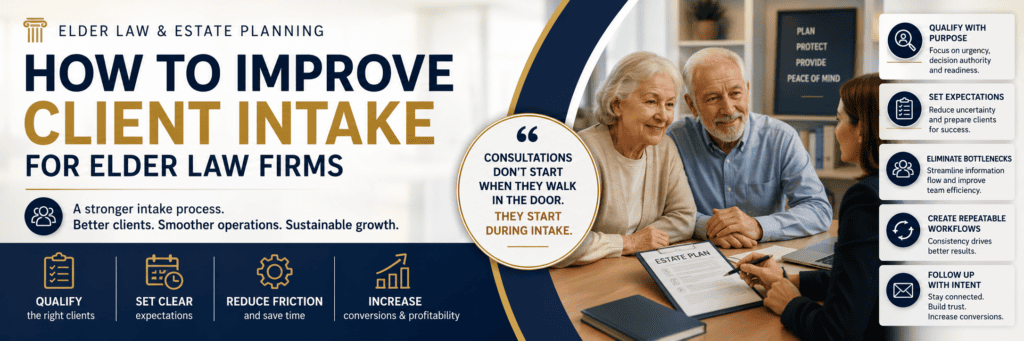
Client intake is one of the most influential—and most overlooked—operational systems inside an estate planning or elder law firm. The quality of the intake process often determines whether a consultation begins with clarity and trust or starts with confusion, missing information, and uncertainty.
For firms focused on sustainable growth, improving intake is not just about scheduling appointments more efficiently. It is about creating a structured pathway that helps the right clients move forward while reducing internal friction, bottlenecks, and wasted time.
Why Intake Matters More Than Most Firms Realize
Many law firms treat intake as an administrative function.
In reality, intake is the first stage of the client experience. It shapes expectations, establishes confidence, identifies fit, and gives attorneys the information necessary to have productive consultations. When intake is handled inconsistently, attorneys often spend valuable consultation time rebuilding clarity that should have been established earlier.
This is especially important in elder law and estate planning, where clients are often making complex and emotionally significant decisions.
The strongest firms understand that consultations do not begin when the client walks into the meeting. They begin during intake.
Signs Your Intake Process Is Creating Growth Problems
Many firms assume conversion challenges are marketing problems.
Often, they are intake problems.
Common warning signs include:
- Frequent no-shows
- Consultations with missing decision-makers
- Incomplete documentation
- Repeated pricing confusion
- Attorneys answering the same preliminary questions repeatedly
- Long follow-up cycles before engagement decisions
- Staff uncertainty about qualification standards
These issues create more work without necessarily creating more revenue.
This is where many firms become trapped in a common growth misconception:
Being busy does not automatically mean the firm is profitable.
A calendar filled with low-quality consultations, incomplete matters, and operational rework can keep everyone occupied while limiting profitability.
Build Intake Around Qualification, Not Scheduling
Many intake teams move immediately to appointment scheduling.
That approach misses critical information.
A more effective model focuses on understanding three factors before selecting a consultation date:
1. Urgency
Why is the client reaching out now?
Understanding the triggering event helps staff identify timing realities and prioritize appropriately. Urgency provides important context that influences the entire consultation process.
2. Decision Authority
Who will ultimately make the decision?
Many consultations fail simply because the necessary people are not present. Identifying decision-makers early reduces delays and follow-up cycles.
3. Readiness
Is the prospective client prepared to move forward?
Readiness includes documentation, financial understanding, emotional preparedness, and practical expectations about the next steps.
Firms that consistently assess these three elements often experience stronger consultations and smoother conversions because conversations become more focused and productive from the beginning.
Create Clear Expectations Before the Consultation
Uncertainty is one of the primary reasons consultations stall.
Prospective clients often arrive with questions they are hesitant to ask:
- What will happen during the meeting?
- What documents should I bring?
- Who should attend?
- What decisions may need to be made?
- What happens afterward?
When these expectations remain unclear, clients often become overwhelmed or postpone action.
A structured intake system proactively answers these questions before the consultation.
The result is a client who feels prepared rather than pressured.
Use Intake to Reduce Operational Bottlenecks
Many firms attempt to solve growth challenges by adding staff.
Sometimes additional hiring is necessary.
However, hiring rarely fixes a broken intake process. In fact, unclear systems often create more complexity because new team members inherit inconsistent procedures.
A better approach is to examine where information slows down.
Consider:
- Who owns each intake stage?
- Where does information get lost?
- Which questions vary by team member?
- What decisions require attorney involvement?
- What can be standardized?
Intake improvements often produce faster operational gains than additional hiring because they remove friction from every future matter.
Turn Intake Into a Repeatable Workflow
Growing firms tend to view intake as a system rather than an event.
Instead of treating every inquiry differently, they create a predictable workflow:
Inquiry → Qualification → Preparation → Consultation → Follow-Up → Engagement Decision
Each stage has ownership, accountability, and defined expectations.
This does not make the client experience feel impersonal.
It makes it reliable.
Consistency allows the team to spend more energy helping clients and less energy managing preventable confusion.
The Often-Ignored Role of Follow-Up
Many firms invest significant effort in consultations but little effort in what happens afterward.
Not every prospective client is ready to make a decision immediately.
In elder law and estate planning, hesitation often reflects uncertainty, family dynamics, timing concerns, or fear of making the wrong decision rather than a lack of interest.
A deliberate follow-up process helps firms:
- Maintain continuity
- Reduce decision friction
- Create client confidence
- Improve conversion consistency
The objective is not pressure.
It is providing enough structure that clients can move forward when they are ready.
Why Intake Is Really a Practice Management Issue
Many firms view intake separately from operations.
The strongest firms do not.
Intake influences:
- Workflow efficiency
- Attorney utilization
- Staff capacity
- Client experience
- Conversion rates
- Profitability
When intake is inconsistent, operational problems appear throughout the practice.
When intake is structured, work moves more predictably across the firm.
This is one reason law firm practice management consulting, estate planning consulting, and law firm sales coaching increasingly focus on intake systems before addressing larger growth initiatives.
The intake process often reveals where the firm’s processes, communication, and delegation systems need attention.
A Final Thought
Many estate planning and elder law firms assume growth requires more leads, more staff, or more hours.
Often, sustainable growth begins somewhere much simpler.
It begins by creating clarity before the consultation ever starts.
When intake becomes intentional, consultations improve. When consultations improve, operational strain decreases. And when operations become more predictable, the firm gains something many growing practices struggle to maintain: control.