
How to Optimize an Elder Law Firm in 2026
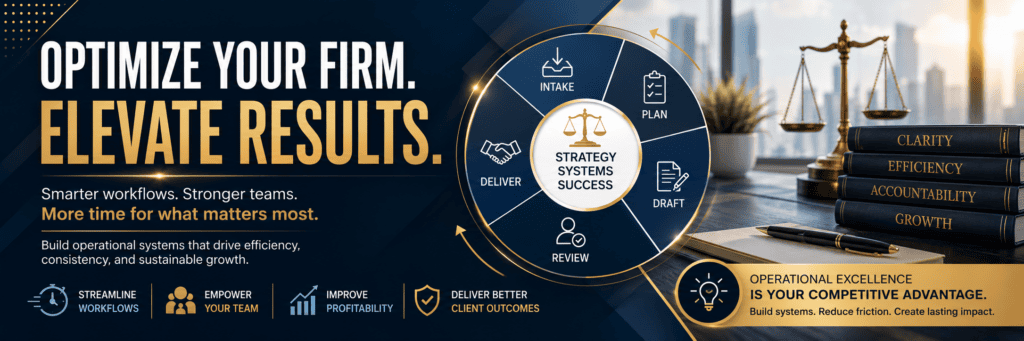
Small elder law firms rarely struggle because they lack commitment, expertise, or demand. More often, growth creates operational complexity that existing systems can no longer absorb. Firms improve performance when they intentionally design workflows, clarify team responsibilities, and build operating systems that allow work to move efficiently without constant attorney intervention.
As elder law practices continue to navigate increasing client expectations, staffing challenges, and administrative demands, operational optimization has become a business necessity rather than a growth initiative.
Why Optimization Matters More Than Growth
Many owner-led firms reach a point where the calendar is full, staff members are busy, and revenue appears healthy. Yet partners often feel trapped inside the business.
Common symptoms include:
- Attorneys solving routine operational problems
- Work stalling between team members
- Inconsistent client experiences
- Delays in drafting, review, or execution
- Team members waiting for direction before moving matters forward
These issues are rarely caused by a lack of effort.
They are usually signs that the firm’s operational structure has not evolved alongside its growth.
Busy Does Not Automatically Mean Profitable
One of the most common misconceptions in small law firm operations is assuming workload and profitability move together.
In reality, many elder law firms experience growing demand while margins remain stagnant.
Why?
Because profitability is often lost through:
- Rework
- Bottlenecks
- Excessive attorney involvement
- Poor delegation
- Slow handoffs between staff
When experienced professionals spend significant time coordinating work rather than advancing client matters, productivity declines without anyone noticing.
Operational efficiency creates leverage. More activity does not.
The First Question: How Does Work Actually Move?
Effective legal workflow optimization begins with visibility.
Before evaluating software, hiring staff, or adjusting compensation, firms should understand exactly how a matter moves from intake to completion.
Key questions include:
- Who owns each stage?
- What information is required before work advances?
- When is attorney judgment truly necessary?
- Where do files consistently slow down?
- Which team members become bottlenecks?
Many firms discover that processes have evolved informally over time. Important decisions remain trapped in individual knowledge rather than documented systems.
As complexity increases, reliance on memory becomes increasingly expensive.
Why Hiring Alone Rarely Solves Operational Stress
When workloads increase, hiring often feels like the obvious solution.
Sometimes it is.
Often it is not.
Additional staff create additional communication pathways, training needs, supervision requirements, and handoffs. If underlying workflows remain unclear, firms frequently experience a surprising outcome:
They become busier without becoming more effective.
Hiring adds capacity.
Systems create leverage.
The most successful firms stabilize workflows before expanding headcount, ensuring new team members enter a structured environment that supports ownership and accountability.
Strengthening Talent Management for Lawyers and Legal Teams
Talent management is increasingly becoming an operational discipline rather than a purely HR function.
Many firms focus significant energy on recruitment while underinvesting in development, role clarity, and long-term retention.
Strong teams generally share several characteristics:
Defined Responsibilities
Every role should have clear ownership.
When responsibilities overlap excessively, accountability disappears.
Structured Onboarding
New hires should enter an environment with documented expectations, training plans, and measurable milestones. Structured onboarding accelerates productivity and improves retention.
Ongoing Coaching
High-performing firms treat development as a continuous process rather than an annual event.
Regular conversations about strengths, goals, performance, and career development help maintain engagement and alignment.
Cross-Training
Cross-trained teams reduce operational risk.
When key processes depend entirely on one individual, continuity becomes fragile. Firms gain resiliency when team members can provide coverage during absences, transitions, or growth periods.
The Hidden Bottleneck: Attorney Dependence
A recurring challenge in law firm operations is excessive reliance on attorneys for non-legal decisions.
Many firms unintentionally train staff to escalate routine questions upward.
Over time, partners become:
- Approval centers
- Information hubs
- Problem-solving engines
This creates delays throughout the organization.
Operational maturity occurs when routine decisions are handled at the appropriate level while attorneys remain focused on legal strategy, client guidance, and high-value work.
The goal is not less involvement.
The goal is more intentional involvement.
Building Systems That Support Scale
Effective practice management consulting often focuses on creating repeatable operating systems.
The strongest systems answer practical questions before confusion occurs:
- What happens next?
- Who owns it?
- When is it complete?
- What triggers the next step?
When these answers exist within the workflow itself, firms experience:
- Faster matter movement
- Fewer interruptions
- Better capacity planning
- Improved consistency
- Reduced stress
Optimization is ultimately about creating reliability.
Reliable firms tend to grow more predictably than reactive firms.
How to Evaluate Elder Law Firm Consulting Support
Not all consulting support is designed to solve operational problems.
When evaluating an elder law firm consulting partner, consider whether they focus on tangible operational outcomes.
Useful evaluation criteria include:
Workflow Visibility
Can they identify where matters stall, repeat, or slow down?
Staffing Alignment
Do they assess whether responsibilities match team capabilities and capacity?
Operational Metrics
Do they help establish measurable indicators for productivity, utilization, throughput, or bottlenecks?
Process Design
Can they create repeatable systems that reduce dependence on individual memory?
Leadership Capacity
Do they help firm owners spend less time managing daily friction and more time leading strategically?
Practice management consulting should create clarity, not complexity.
The objective is a firm that functions consistently, even when leadership is not directly involved in every decision.
The Future of Small Law Firm Services
The firms likely to thrive in the coming years will not necessarily be the largest.
They will be the most operationally intentional.
Technology will continue evolving.
Client expectations will continue rising.
Talent challenges will continue affecting the profession.
Firms that build clear systems, develop strong teams, and remove unnecessary friction will be better positioned to adapt regardless of market conditions.
Optimization is not about doing more.
It is about making the work you already do move more effectively.
A Closing Thought
The healthiest elder law firms are not defined by how busy they are.
They are defined by how reliably they convert effort into meaningful results for clients, staff, and leadership.
When workflows are intentional, roles are clear, and operational systems support the work instead of resisting it, growth becomes less stressful and far more sustainable.