
How to Optimize Law Firm Workflows in 2026
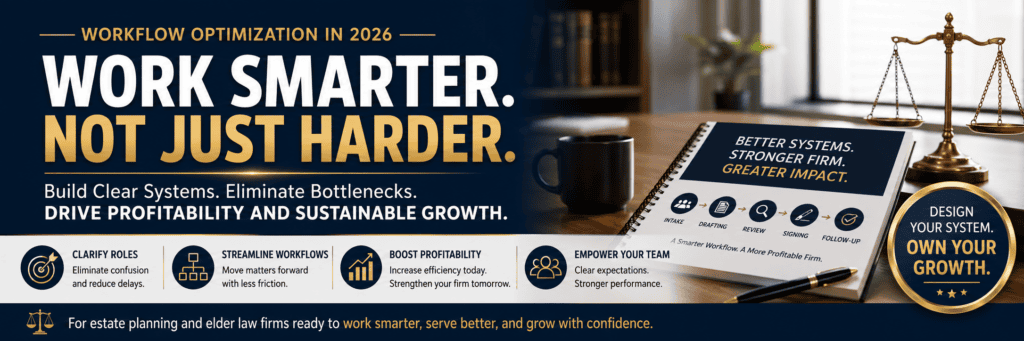
Small law firms rarely struggle because they lack effort. More often, they struggle because work moves through the firm inconsistently. In 2026, workflow optimization is less about working harder and more about creating clear systems that allow attorneys, staff, and clients to move through predictable processes with less friction and greater profitability. Insights throughout this article align with operational themes found in The Million Dollar Solution’s workflow and practice management resources, particularly the distinction between adding staff and improving workflow structure.
Why Workflow Optimization Matters More Than Growth Alone
Many owner-led estate planning and elder law firms reach a frustrating stage of growth:
- Phones are busy.
- Calendars are full.
- Staff are overwhelmed.
- Attorneys remain the default solution for operational problems.
From the outside, the firm appears successful. Internally, however, profitability often lags behind activity.
The issue is that growth and operational efficiency are not the same thing. When workflows are unclear, every new matter creates additional complexity. Bottlenecks become normal. Follow-up tasks slip through the cracks. Attorneys spend valuable time managing process failures instead of practicing law.
This is why many firms discover that being busy does not automatically translate into higher profits. A firm’s operating system must evolve alongside its growth.
The Most Common Workflow Bottlenecks in Small Law Firms
While every firm operates differently, several patterns appear repeatedly.
Intake Without Clear Standards
Many workflow issues begin before a client ever signs an engagement agreement.
When intake procedures vary between team members, firms experience:
- Incomplete information
- Poor matter qualification
- Unrealistic client expectations
- Increased attorney involvement early in the process
Strong intake systems establish clarity before work begins. They help clients understand next steps while giving attorneys the information they need to make better decisions.
Undefined Handoffs
Work frequently stalls between departments.
Files move from intake to drafting. Drafting moves to review. Review moves to signing. Yet responsibility is often assumed rather than assigned.
When ownership is unclear:
- Delays increase
- Accountability decreases
- Attorneys become escalation points
Workflow optimization requires clearly defined ownership at every stage.
Attorney-Centered Operations
Many firms unintentionally design workflows that require attorneys to answer every question.
This creates a hidden ceiling on growth.
If every decision, approval, update, or clarification must flow through one attorney, the firm becomes dependent on a single bottleneck. Sustainable growth requires separating legal judgment from administrative execution whenever appropriate.
Why Hiring Alone Rarely Solves Workflow Problems
One of the biggest misconceptions in small law firm growth is that more staff automatically creates more capacity.
Sometimes hiring is necessary.
Often, however, the firm has not yet identified the underlying operational issue.
Adding employees to an inefficient system commonly results in:
- More training demands
- More communication complexity
- More interruptions
- Higher payroll expenses
The workflow challenges remain.
A useful way to think about it is this:
Staffing increases capacity. Workflow optimization increases efficiency.
Both matter, but they solve different problems.
The firms that scale most effectively typically improve workflow first and hire into a stable system second.
Building a More Efficient Practice Management System
Workflow optimization should be approached systematically rather than reactively.
1. Map the Entire Client Journey
Begin by documenting how work actually moves through the firm.
Not how it is supposed to move.
How it truly moves today.
Review:
- Initial inquiry
- Intake
- Consultation
- Engagement
- Drafting
- Review
- Signing
- Follow-up
This process often reveals hidden delays, duplicated effort, and unclear ownership.
2. Clarify Role Expectations
Operational efficiency depends on role clarity.
Every team member should understand:
- What they own
- What requires escalation
- What success looks like
- Who receives work next
When roles are clearly defined, delegation becomes significantly easier. Staff gain confidence because expectations become predictable.
3. Standardize Repeatable Decisions
Many law firms recreate the same decisions daily.
Whenever possible, build systems around recurring choices:
- Matter readiness standards
- Client communication protocols
- File review processes
- Meeting preparation procedures
Standardization reduces friction without reducing quality.
4. Measure Workflow Performance
What gets measured gets improved.
Consider tracking:
- Matter completion times
- Intake conversion rates
- Draft turnaround time
- Revision frequency
- Client response delays
Even a few operational metrics can reveal significant opportunities for improvement.
Leadership Coaching and Workflow Optimization
Many workflow challenges are actually leadership challenges.
Firm owners often carry institutional knowledge that never becomes operational knowledge.
As a result:
- Staff wait for direction.
- Processes depend on memory.
- Growth creates stress rather than leverage.
Leadership coaching helps owners transition from being the primary problem-solver to becoming the architect of the firm’s systems.
The goal is not to remove leadership involvement.
The goal is to eliminate unnecessary dependency.
When processes are documented and expectations are clear, staff members can make more decisions independently while maintaining quality and consistency.
What Law Firm Consulting Should Focus on in 2026
The strongest law firm consulting engagements increasingly focus on operational design rather than simply marketing or staffing.
Key areas typically include:
- Workflow optimization
- Practice management systems
- Team structure
- Delegation strategies
- Operational accountability
- Leadership development
- Capacity planning
The objective is not faster growth at any cost.
The objective is controlled growth that protects profitability, client experience, and attorney capacity simultaneously.
For estate planning and elder law firms, this often means creating systems that allow high-value legal work to remain in attorney hands while routine operational tasks move through clearly defined processes.
Signs Your Firm Has Outgrown Its Current Workflow
Your workflow may need redesign if:
- Attorneys spend significant time on administrative tasks.
- Files regularly stall without a clear reason.
- Staff frequently seek clarification on routine decisions.
- Hiring has not reduced workload.
- Revenue growth feels harder than it should.
- Client communication becomes inconsistent during busy periods.
These are not necessarily staffing problems.
They are often signals that the firm’s operating system needs refinement.
A More Sustainable Approach to Small Law Firm Growth
Successful firms rarely scale because they become busier.
They scale because they become clearer.
Clear roles. Clear workflows. Clear expectations. Clear ownership.
When work moves predictably through the firm, profitability becomes less dependent on heroics and more dependent on design.
That shift creates something many owner-led firms ultimately seek: operational control.
And in 2026, operational control may be one of the most valuable growth assets a law firm can build.