
Is Hiring More Employees or Improving Processes Better for Law Firm Growth?
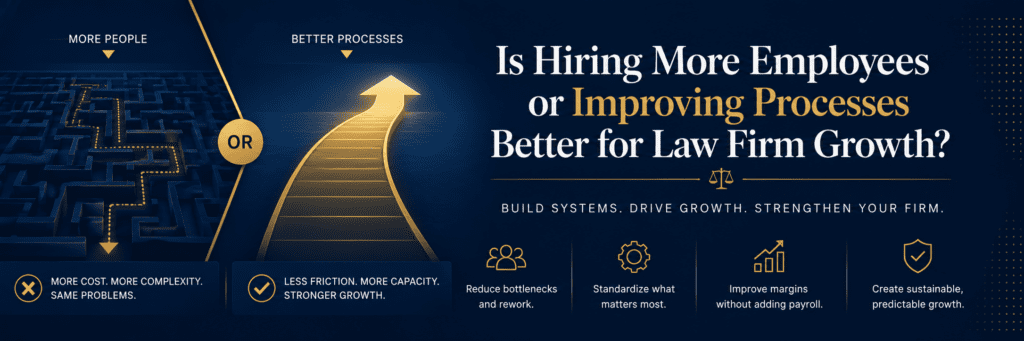
Most law firms don’t hit a growth ceiling because they lack people. They stall because their processes can’t support more volume. In many estate planning and elder law practices, improving workflow produces more sustainable growth than adding staff—especially when margins are tight and teams are already stretched.
Growth Pressure Shows Up as Staffing Pain
When intake is backed up, documents move slowly, or attorneys stay buried in follow-up, hiring feels like the obvious fix. But those symptoms usually point to workflow gaps, unclear delegation, or systems that rely too heavily on memory instead of structure.
Busy teams are not automatically productive teams. Without consistent processes, more staff often means more coordination costs, more training time, and more room for error.
Hiring Solves Capacity. Processes Solve Scale.
Hiring adds capacity in a linear way: more people, more payroll, more management. Workflow improvements scale differently. They remove friction, reduce rework, and allow the same team to handle more matters with less stress.
This is the core difference between staffing up and building systems. One absorbs pressure. The other reduces it.
For small firms, especially in elder law where cases are emotionally complex and administratively dense, process clarity matters more than headcount.
What Efficient Systems Actually Look Like
Efficient law firm systems are not about rigid scripts. They create consistency where it matters and flexibility where it counts. Common examples include:
- Defined intake and handoff steps so cases don’t stall
- Clear role ownership for client communication, documents, and follow-up
- Standard timelines for drafting, review, and execution
- Technology used intentionally, not as a patchwork of tools
These systems make delegation safer and hiring less risky when the time does come.
Scaling Without Burning Out the Team
Burnout rarely comes from volume alone. It comes from constant exception-handling, unclear expectations, and work that loops back unnecessarily. Process improvement removes those drains.
When workflows are visible and repeatable, attorneys focus on judgment, not chasing details. Staff spend less time reacting and more time completing work cleanly the first time.
That is how firms grow without exhausting their people.
Profitability Without Adding Payroll
Improving processes often increases profit margins faster than hiring. Fewer write-offs, faster billing cycles, and better capacity utilization all contribute—without adding fixed costs.
For many elder law firms, the smartest growth move is not the next hire, but the next system.
Growth becomes predictable when operations stop being improvised.
Operational discipline isn’t restrictive. It’s what makes growth sustainable.