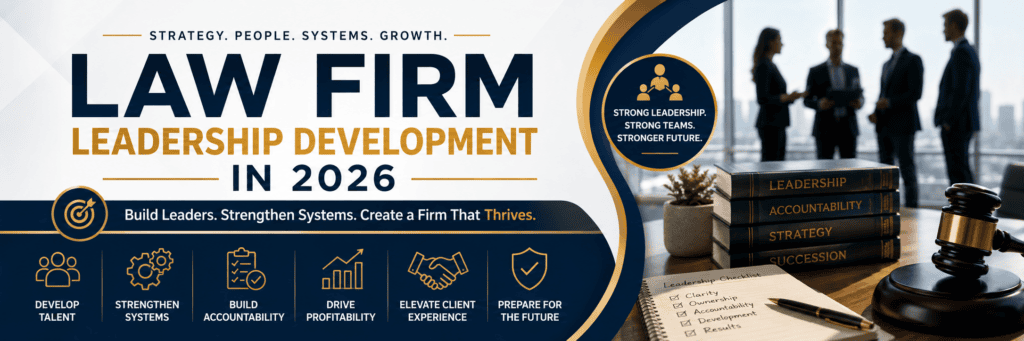
Law Firm Leadership Development in 2026
Strong law firm management in 2026 depends less on working harder and more on developing leaders who can build systems, delegate effectively, and create accountability across the firm. For small estate planning and elder law practices, leadership development is increasingly tied to operational performance, team capacity, client experience, and long-term profitability. Internal MDS leadership and operations resources consistently emphasize that sustainable growth comes from clearer ownership, stronger training systems, better role alignment, and intentional leadership development rather than simply adding staff.
Why Leadership Has Become an Operational Issue
Many small firms reach a common growth point.
The owner becomes the solution to every problem.
Questions flow upward. Decisions bottleneck. Team members wait for approval. Client matters slow down. Attorneys become involved in work that others should be equipped to own.
At first, this feels like commitment.
Eventually, it becomes a capacity problem.
Firm owners often assume the next step is hiring another employee. In reality, many firms are experiencing a leadership gap rather than a staffing gap. MDS workflow guidance notes that hiring without clear ownership, accountability, and process design often increases strain instead of relieving it.
Leadership development helps firms move from owner-dependent operations to team-driven execution.
What Law Firm Leadership Looks Like in 2026
Today’s effective law firm leadership extends beyond supervision.
It requires creating an environment where work flows predictably without constant intervention.
This includes:
- Defining ownership clearly
- Building repeatable workflows
- Establishing decision-making authority
- Creating accountability systems
- Developing future leaders inside the firm
- Training employees to solve problems independently
Leadership is increasingly less about individual effort and more about organizational clarity.
As firms scale, successful leaders create systems that reduce dependence on themselves rather than increase it. This theme appears repeatedly throughout MDS operational, succession, and talent development materials.
The Role of Legal Education in Leadership Development
Traditional legal education provides essential technical knowledge.
Leadership requires a different skill set.
Many attorneys receive extensive training in substantive law but limited training in:
- Delegation
- Team development
- Communication
- Coaching
- Workflow design
- Performance management
- Organizational planning
As a result, highly competent attorneys sometimes struggle when transitioning into leadership roles.
Modern leadership development often supplements legal knowledge with business and operational education focused on managing people, improving workflows, and building sustainable organizations. Firms that invest in these skills frequently create stronger team alignment and clearer operational consistency.
Why Professional Coaching for Lawyers Is Becoming More Important
One of the most significant shifts in 2026 is the growing value of professional coaching for lawyers.
Many leadership challenges aren’t knowledge problems.
They’re implementation problems.
Leaders often know what should happen but struggle with:
- Delegating consistently
- Holding employees accountable
- Conducting difficult conversations
- Managing change
- Scaling their involvement appropriately
Structured coaching helps bridge the gap between understanding and execution.
MDS leadership development frameworks emphasize coaching systems that encourage employee ownership, goal setting, self-evaluation, and ongoing development rather than relying solely on annual reviews or reactive management conversations.
When coaching becomes part of firm culture, leadership capacity expands beyond the owners and partners.
Talent Management Consulting and Leadership Growth
Many firms approach hiring and leadership as separate initiatives.
In practice, they are closely connected.
Effective talent management consulting focuses on aligning people, roles, responsibilities, and organizational goals.
This often includes:
- Organizational design
- Role clarity
- Succession planning
- Leadership pipelines
- Team communication
- Development planning
- Employee retention strategies
The objective is not simply hiring more people.
The objective is ensuring the right people are operating in the right roles with the right support.
Leadership development becomes significantly easier when expectations are clear, and team members understand ownership boundaries. MDS talent-management resources consistently emphasize role alignment, accountability structures, training plans, and leadership clarity as key drivers of retention and performance.
Why Busy Does Not Necessarily Mean Profitable
This remains one of the most important lessons for growing firms.
Many owners interpret constant activity as success.
But activity can hide inefficiency.
A firm can be:
- Busy with interruptions
- Busy with rework
- Busy with unnecessary attorney involvement
- Busy correcting preventable mistakes
- Busy managing unclear expectations
None of these activities directly improve profitability.
Leadership development helps owners distinguish productive work from reactive work.
Firms that strengthen leadership often discover that reducing bottlenecks improves profitability more than increasing workload volume. MDS growth and workflow materials also note that “more” is not always better, whether discussing leads, hiring, or operational activity. Better alignment frequently creates greater results than greater volume.
Leadership Lessons for the Modern Elder Law Practice
The modern elder law practice operates in an environment of increasing complexity.
Families arrive with more information, more questions, and often more emotional stress.
This places greater demands on firm operations.
Leadership development helps create consistency across:
- Intake
- Client communication
- Matter management
- Team coordination
- Workflow ownership
- Client experience
Strong leaders establish systems that allow the firm to deliver consistent service regardless of which team member is involved.
This is particularly important in elder law, where trust, clarity, and responsiveness significantly influence the client experience.
Leadership Development and Succession Readiness
Many firms think about succession planning later than they should.
Leadership development is often the foundation that makes succession possible.
A useful question appears in MDS succession planning materials:
If the owner stepped away for 90 days, what would be most vulnerable?
The answer frequently reveals leadership gaps.
Succession readiness requires:
- Documented processes
- Cross-training
- Leadership depth
- Accountability systems
- Operational consistency
Firms that invest in leadership development early tend to build greater resilience and flexibility over time.
Building a Leadership Development Strategy for 2026
For most small firms, leadership development does not begin with a major organizational change.
It begins with a few practical questions:
- What decisions still flow through the owner unnecessarily?
- Where do team members need greater authority?
- Which leadership skills are missing today?
- What training systems exist for future leaders?
- How are managers being developed?
- Are workflows supporting leadership growth or preventing it?
The goal is not to create more management layers.
The goal is to create clarity.
When leadership development is aligned with workflow design, talent management, and operational systems, firms become more scalable, more predictable, and less dependent on heroic effort.
Final Thoughts
Leadership development is no longer separate from law firm management.
For small estate planning and elder law firms, leadership directly influences workflow efficiency, staffing effectiveness, profitability, client experience, and long-term sustainability.
The firms that grow most successfully in 2026 are unlikely to be the busiest.
They will be the firms that build clear systems, develop capable leaders, create accountability, and reduce unnecessary dependence on owners and partners.
Leadership, ultimately, is not about being involved in everything.
It is about creating an organization that can perform consistently because everyone understands what they are responsible for and how success is measured.