
My Attorneys are Doing Admin Work—How do I Fix This?
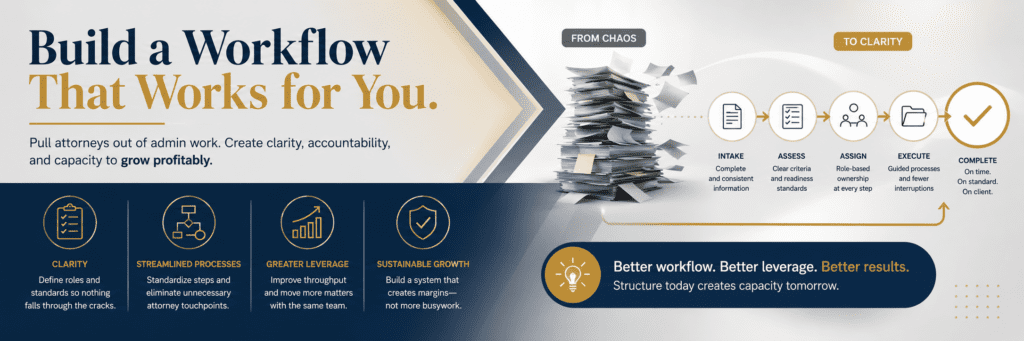
When attorneys are spending time on scheduling, chasing documents, or managing file status, it’s rarely a discipline problem. It’s a workflow problem. In most estate planning and elder law firms, administrative work lands on attorneys because the system quietly pushes it there.
Why this shows up as firms grow
As firms add volume, workflows often evolve informally. Tasks move based on habit, memory, or who happens to be available. When ownership isn’t clear, anything uncertain escalates to the lawyer. Attorneys become the safest default—not because they should, but because the system lacks guardrails.
This is why attorneys can work more hours without revenue increasing. Effort rises, but throughput doesn’t. Busy feels productive, yet margins stay flat.
The hidden cost of attorney-admin overlap
When licensed time is spent on administrative execution, three things happen:
- High‑value legal judgment is interrupted by low‑value coordination
- Files move slower due to constant context switching
- Growth requires more hours instead of better leverage
This pattern often triggers the next instinctive move: hiring.
Hiring staff vs. fixing workflow
Hiring can be necessary—but it doesn’t fix structural issues. Adding people to unclear processes usually increases questions, supervision, and handoffs. Pressure gets redistributed, not relieved.
Workflow improvement does something different. It clarifies:
- Which tasks truly require attorney judgment
- Which decisions repeat and can be standardized
- Who owns each step from intake through completion
When those answers are explicit, delegation becomes safe. Attorneys stop being the default solution.
How firms reduce attorney workload without reducing revenue
Firms that successfully pull attorneys out of admin work don’t ask lawyers to “let go.” They redesign how work moves.
Common stabilizing shifts include:
- Defined intake standards so incomplete matters don’t enter the system
- Clear readiness criteria for drafting and review
- Role-based ownership instead of person-based habits
- Systems that guide work, not just store information
As friction is removed, the same team can move more matters through with fewer attorney interruptions.
When “too many processes keep breaking”
If it feels like processes work “most of the time,” that’s not failure—it’s a growth signal. Informal systems that once worked have been outgrown. Stabilization isn’t about adding rules; it’s about creating reliability so work doesn’t depend on heroics.
A different way to measure capacity
Capacity isn’t how many hours your attorneys can work. It’s how smoothly work moves when they’re not involved.
Firms that address this shift often discover something unexpected: they already have enough people. What they were missing was structure.
A busy firm isn’t broken. But without intentional workflow design, it will stay busy without becoming meaningfully more profitable.