
My Law Firm Has Too Many Processes Breaking—How Do I Stabilize Operations?
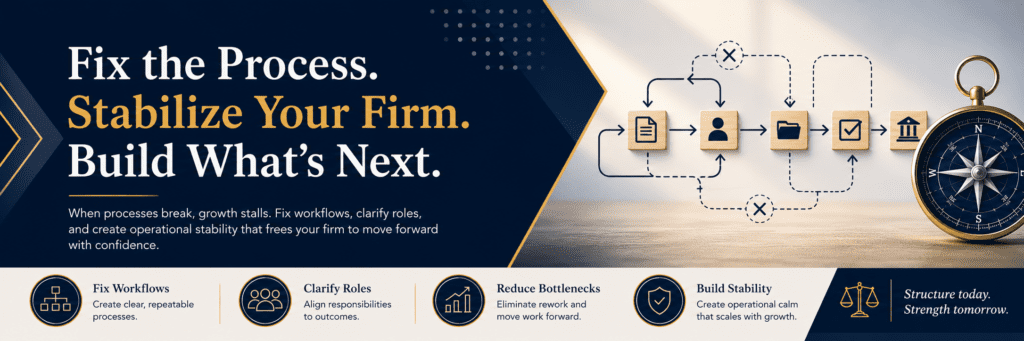
When processes keep breaking, the issue is rarely effort or intent—it’s usually structural. Most small estate planning and elder law firms hit a point where growth outpaces their systems, creating bottlenecks, rework, and exhaustion. Stabilizing operations starts by fixing how work flows, not by asking people to work harder or hiring reflexively.
Why “busy” firms feel unstable
Firms under operational strain often share the same symptoms:
- Attorneys handling intake, follow-ups, or document prep
- Staff improvising workarounds instead of following a clear process
- Inconsistent client experience depending on who touches the file
- Constant urgency with little forward momentum
This isn’t a talent problem. It’s a system problem. Activity increases, but profitability and capacity do not—because the workflow itself is fragmented.
Hiring vs. fixing workflow
A common instinct is to hire. Sometimes that’s necessary, but adding people to a broken process usually amplifies the chaos. New staff inherit unclear roles, inconsistent handoffs, and undocumented procedures. The firm feels “more staffed” but no more stable.
Improving workflow comes first. When processes are defined and repeatable, you can see:
- Where work actually slows down
- Which steps require attorney judgment vs. administrative execution
- Whether additional staff would relieve pressure or simply mask it
Only then does hiring become a strategic decision instead of a reaction.
The real cost of attorneys doing admin work
When attorneys routinely perform administrative tasks, it signals a delegation failure upstream. The cost isn’t just lost billable time—it’s decision fatigue, delayed client work, and limited growth capacity.
Fixing this doesn’t mean pushing work onto staff indiscriminately. It means:
- Clarifying ownership at each stage of the client journey
- Designing handoffs so work doesn’t boomerang back to attorneys
- Building trust in systems so delegation feels safe, not risky
The goal is not perfection. It’s predictability.
Stabilization before optimization
Many firms try to optimize before they stabilize. They add software, dashboards, or metrics while the underlying workflow is still inconsistent. Stability comes from a few foundational moves:
- Documenting the “normal” way work should move through the firm
- Reducing variations that depend on individual preference
- Aligning roles, not just job titles, to specific outcomes
This creates operational calm. Once work flows consistently, improvement becomes easier—and measurable.
When outside perspective helps
A practice management consultant is most valuable when the firm knows something is off but can’t see it clearly from inside. That moment usually arrives when:
- Leadership is too embedded in daily work to step back
- Internal fixes keep getting undone by volume or urgency
- Growth feels possible but operationally unsafe
An external lens helps separate symptoms from causes and designs systems that fit the firm’s size and practice focus.
A steadier way forward
Stabilizing operations isn’t about dramatic change. It’s about creating enough structure that the firm can breathe again—work moves, roles make sense, and leadership regains time to think. From there, growth becomes a choice, not a strain.