Strategic Practice Management for Estate Planning Firms
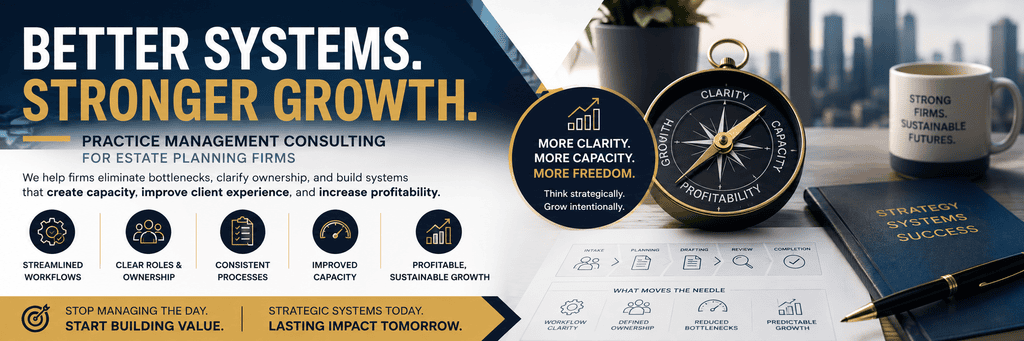
Estate planning practice management consulting helps firms improve how work moves through the organization. Rather than focusing only on marketing, staffing, or technology, effective consulting examines the systems, workflows, responsibilities, and operational decisions that influence profitability, client experience, and long-term growth.
For many estate planning firms, growth challenges do not stem from a lack of demand. They stem from bottlenecks, unclear ownership, inconsistent processes, and increasing complexity. Strategic practice management provides a framework for addressing those issues before they limit capacity. This aligns with operational themes emphasized throughout The Million Dollar Solution’s workflow and growth resources, including the importance of workflow clarity, defining ownership, reducing bottlenecks, and creating system-supported growth rather than effort-dependent growth.
What Is Estate Planning Practice Management Consulting?
Estate planning practice management consulting focuses on how a firm operates.
Unlike legal consulting, which centers on substantive legal matters, practice management consulting evaluates how the business functions day-to-day, including:
- Workflow design
- Team structure
- Delegation systems
- Intake processes
- Capacity planning
- Leadership responsibilities
- Operational efficiency
- Growth strategy
The goal is not simply to help firms become busier. The goal is to help firms become more predictable, scalable, and profitable.
Many small law firms reach a point where working harder stops producing better outcomes. At that stage, operational structure often becomes more important than additional effort.
Why Strategic Practice Management Matters More Than Ever
Estate planning firms operate in an increasingly complex environment.
Client expectations continue to rise. Cases require coordination across multiple team members. Attorneys are expected to deliver both expertise and responsiveness. Meanwhile, owners frequently find themselves managing people, projects, marketing, finances, and client matters simultaneously.
The result often looks like growth, but feels like overload.
Common signs include:
- Attorneys involved in routine administrative decisions
- Delays between workflow stages
- Staff uncertainty about ownership
- Inconsistent client experiences
- Difficulty onboarding new team members
- Increasing workload without corresponding profitability
These symptoms are often interconnected.
When a firm grows without improving its operating structure, inefficiencies become more visible. More files can expose workflow weaknesses. More clients can amplify communication challenges. More staff can introduce additional coordination requirements.
Growth tends to test systems, not fix them.
Types of Practice Management Consulting Providers
Not all consulting providers approach practice management the same way.
General Business Consultants
These consultants serve a wide range of industries.
They often provide insight into leadership, strategy, and organizational development. However, they may not understand the operational realities unique to estate planning firms.
Legal Practice Consultants
Legal practice consultants specialize in law firm operations.
They typically focus on:
- Law firm management services
- Workflow improvement
- Team development
- Operational systems
- Growth planning
For estate planning firms, this expertise can provide more relevant recommendations because many challenges are tied to legal operations specifically.
Technology-Focused Consultants
Technology consultants primarily focus on software selection, implementation, and integration.
While technology can support growth, software alone rarely solves workflow issues.
A poorly designed process supported by technology usually becomes a faster version of the same problem.
Strategic Operations Consultants
Strategic operations consultants evaluate how people, systems, workflows, and leadership interact.
Their focus is often broader than technology or staffing. They examine whether work is moving efficiently and whether growth can be supported operationally.
For many firms, this provides a more comprehensive perspective on practice management.
The Most Common Growth Mistake: Confusing Activity with Progress
One of the most persistent misconceptions in professional services is that being busy means the firm is healthy.
Busy firms can still experience:
- Poor margins
- Staff frustration
- Attorney overload
- Delayed work
- Inconsistent client experiences
Volume alone does not create profitability.
In many cases, excessive activity actually hides operational inefficiencies.
A firm may appear productive because everyone is working constantly. However, if work repeatedly stalls, waits for approvals, or requires rework, the organization may be generating effort rather than throughput.
The critical question is not:
“How much work are we doing?”
It is:
“How efficiently does work move through the firm?”
Why Hiring Is Not Always the Solution
When growth creates pressure, hiring often feels like the logical next step.
Sometimes it is.
Often it is not.
New employees enter the same system that existing employees use. If bottlenecks already exist, additional staffing can simply increase the number of people interacting with inefficient processes.
Common examples include:
- Unclear handoffs
- Undefined responsibilities
- Missing workflow standards
- Inconsistent client intake
- Lack of process documentation
Without addressing those issues, hiring may increase payroll without creating meaningful capacity.
The stronger question is:
What operational problem are we trying to solve?
Only then can firms determine whether the answer requires people, process improvements, technology, or leadership changes.
Areas a Practice Management Consultant Should Evaluate
Workflow Design
Every estate planning matter passes through multiple stages.
Consultants should examine:
- Where work stalls
- Where rework occurs
- Where handoffs create confusion
- Which tasks require attorney involvement
Improving workflow often creates capacity without adding headcount.
Intake Systems
Many firms underestimate the operational impact of intake.
Strong intake processes help clarify:
- Fit
- Urgency
- Decision authority
- Readiness
Weak intake systems often create downstream friction that affects the entire firm.
Delegation and Role Clarity
Growth becomes difficult when ownership is unclear.
High-performing firms establish:
- Defined responsibilities
- Clear escalation paths
- Appropriate decision authority
- Consistent accountability
The objective is not simply delegation.
The objective is confidence in delegation.
Staffing and Team Structure
Consultants should evaluate whether:
- Roles align with actual work
- Team members spend time on high-value activities
- Leaders are carrying unnecessary responsibilities
- Capacity constraints are real or perceived
Leadership Systems
Small firms frequently rely on ownership involvement for daily decisions.
That approach works early.
It becomes difficult to sustain during growth.
Strategic practice management helps leaders shift from solving problems personally to designing systems that solve problems consistently.
How Small Law Firms Should Prioritize Improvement Efforts
The most successful firms rarely try to fix everything at once.
Instead, they focus on sequencing improvements.
A common progression might be:
- Clarify workflows
- Define ownership
- Improve intake consistency
- Reduce bottlenecks
- Standardize recurring processes
- Evaluate staffing needs
- Scale intentionally
This sequence matters because systems create the foundation that allows people to succeed.
Without structure, additional growth often creates additional strain.
Signs Your Firm May Benefit from Strategic Practice Management
You may benefit from estate planning practice management consulting if:
- Growth feels increasingly difficult to manage
- Attorneys spend too much time on routine work
- Hiring has not solved capacity issues
- Work regularly sits waiting for the next step
- Staff frequently need clarification
- Client service feels inconsistent
- Profitability does not reflect workload
None of these issues necessarily indicate poor performance.
More often, they indicate that the firm’s operating model has not evolved at the same pace as its growth.
A Final Perspective
Most estate planning firms do not struggle because they lack talented people or strong client demand.
They struggle because complexity gradually outgrows structure.
Strategic practice management provides an opportunity to step back from daily activity and examine how the organization actually functions. When workflows become clearer, responsibilities become more defined, and systems support consistent execution, growth begins to feel more intentional.
The most sustainable firms are not necessarily the busiest.
They are often the firms where work moves predictably, capacity is understood, and leadership can focus on the future instead of constantly managing operational friction.
The Million Dollar Solution® (MDS) provides consulting, coaching, and educational services only. The information, recommendations, tools, templates, and examples contained in these materials are for informational purposes and should not be construed as legal, accounting, tax, financial, or other professional advice. Attorneys, CPAs, and other professionals are responsible for complying with the laws, regulations, ethical requirements, licensing obligations, and professional standards applicable to their own jurisdictions and professions. Users should consult qualified professional advisors regarding their specific circumstances before implementing any recommendation.