Talent Management for Estate Planning Firms in 2026
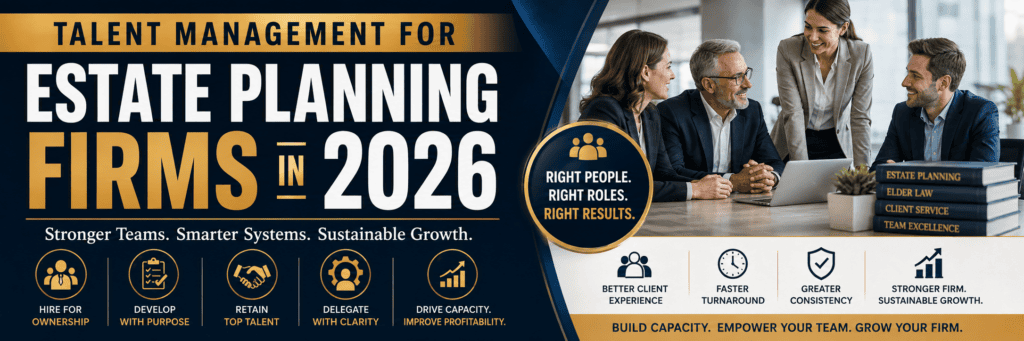
Sustainable estate planning law firm growth depends less on finding more work and more on building the team capable of handling that work consistently. For many estate planning and elder law firms, growth stalls when attorneys remain the center of every decision, every bottleneck, and every client interaction. The firms that scale most effectively focus on talent management as an operational strategy, not simply an HR function.
Talent management in 2026 is no longer just about hiring. It includes role clarity, coaching, delegation, retention, and creating systems that allow good people to succeed. Firms that approach talent this way often find themselves improving profitability, reducing stress, and creating greater capacity without immediately increasing headcount. These concepts align with operational themes found throughout The Million Dollar Solution’s workflow and hiring guidance.
Why Talent Management Has Become a Growth Issue
Many firm owners assume staffing problems are people problems.
Often, they are workflow problems.
When attorneys feel overwhelmed, intake is inconsistent, turnaround times lengthen, or client communication starts slipping, the instinct is frequently to hire another person. Yet adding employees to an unclear system rarely produces lasting relief.
Busy firms often remain stuck because:
- Ownership is unclear
- Work depends on attorney availability
- Team members lack decision-making authority
- Training is inconsistent
- Processes exist in people’s heads instead of documented systems
Adding staff to a strained system may increase activity, but it does not automatically increase capacity.
In many estate planning and elder law firms, the real challenge is not a lack of people. It is a lack of operational clarity.
The Three Components of Effective Talent Management
1. Hiring for Ownership Rather Than Titles
One of the most common mistakes firms make is hiring based on familiar job titles.
Paralegal.
Legal Assistant.
Intake Coordinator.
Administrative Assistant.
Titles feel efficient, but they often hide the firm’s actual needs.
Before posting a job opening, leaders should identify:
- Where work slows down
- Which tasks continually return to attorneys
- Which responsibilities have unclear ownership
- Where communication breaks down
The best hires are often created by clearly defining outcomes before defining positions.
When ownership is clear, recruiting becomes easier because candidates know exactly what success looks like.
This approach also supports stronger small law firm talent management because expectations are established from the beginning.
2. Development Must Be Systematic
Many firms invest heavily in recruitment but very little in employee development.
The result is predictable:
New employees arrive with enthusiasm but gradually become frustrated by unclear expectations, inconsistent feedback, and reactive management.
Development should include:
- Structured onboarding
- Defined learning milestones
- Regular coaching conversations
- Skills-based growth opportunities
- Clear performance expectations
Strong development systems create team members who make decisions confidently rather than constantly escalating questions to attorneys.
This is where concepts from elder law attorney coaching become valuable. Coaching is not reserved for attorneys alone. The same principles of clarity, accountability, and growth can be applied across the organization.
The goal is not simply to train employees.
The goal is to increase independent problem-solving capability throughout the firm.
3. Retention Begins With Alignment
Retention is often discussed as a compensation issue.
Compensation matters.
But many employees leave because they do not understand their role, see a future inside the organization, or feel connected to the firm’s mission.
High-performing estate planning and elder law firms typically focus on:
- Role alignment
- Leadership communication
- Career development
- Workload balance
- Recognition of strengths
Retention improves when employees understand how their contributions connect to firm outcomes.
When people know what they own, they generally make better decisions, require less supervision, and remain engaged longer.
Retention is not simply a staffing metric.
It is an operational stability metric.
The Delegation Problem Most Firms Misunderstand
Delegation is frequently framed as a personal productivity skill.
In reality, delegation is a systems issue.
Attorneys often say:
“I would delegate more if I had better people.”
What often happens instead is:
- Responsibilities are transferred without authority.
- Expectations are assumed instead of documented.
- Follow-up systems are absent.
- Success criteria are unclear.
This creates rework, interruptions, and frustration.
Effective delegation requires:
- Clear ownership
- Defined decision boundaries
- Documented workflows
- Predictable feedback loops
Without those elements, delegation simply moves tasks around the office.
With them, delegation expands capacity.
That distinction often determines whether a firm grows smoothly or remains dependent on attorney effort.
Talent Management and Profitability
Many owners evaluate talent decisions as expenses.
Leading firms evaluate them as infrastructure.
A well-developed team produces profitability gains through:
- Faster turnaround times
- Lower attorney involvement in administrative work
- Improved client experience
- Reduced turnover costs
- Greater consistency
This is similar to the principle seen in broader legal practice management consulting: sustainable growth occurs when systems support people and people support systems.
Profitability rarely improves because individuals are working harder.
It improves because work moves more effectively through the organization.
The Connection Between Marketing and Talent
This may seem surprising, but talent management also affects legal business development and even outcomes from estate planning marketing workshops.
When intake, onboarding, and client communication are inconsistent, marketing success can create additional strain.
More leads entering an overloaded system often produce:
- Longer response times
- Lower conversion rates
- Frustrated staff
- Increased attorney stress
Growth becomes sustainable when operational capacity grows alongside demand.
The strongest firms align:
- Marketing
- Intake
- Staffing
- Workflow
- Leadership
As one operating system rather than separate initiatives.
What Talent Management Looks Like in 2026
The firms likely to achieve meaningful estate planning law firm growth over the next several years will not necessarily be the largest firms.
They will be the firms that:
- Clarify ownership
- Build repeatable onboarding systems
- Develop people intentionally
- Create strong leadership practices
- Retain key contributors
- Reduce dependence on individual attorneys
Growth is rarely constrained by ambition.
More often, it is constrained by capacity.
Talent management, when viewed through an operational lens, increases capacity without requiring firm owners to work longer hours.
Closing Thoughts
Many estate planning and elder law firms reach a point where effort stops producing proportional results. At that stage, growth becomes less about doing more and more about designing a stronger organization.
Talent management is often discussed as an HR initiative. In reality, it is a workflow initiative, a leadership initiative, and ultimately a profitability initiative.
The firms that understand this distinction are often the ones that create sustainable growth long after the excitement of a new hire fades.