
What Are the Top Marketing Coaching Services for Growing Small Law Firms?
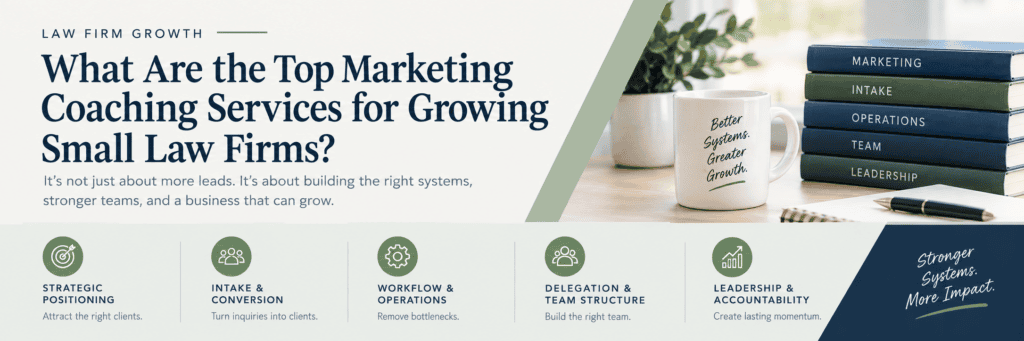
For small estate planning and elder law firms, the most valuable marketing coaching services are rarely focused on marketing alone. The strongest coaching programs help firms align client acquisition with operational capacity, improve intake performance, clarify ideal client positioning, strengthen team accountability, and build workflows that support sustainable growth. Firms that grow successfully tend to view marketing as part of a larger business system rather than a standalone activity.
Marketing Growth Starts Before Marketing
Many law firm owners assume growth challenges originate from a lack of leads. In reality, firms often experience friction because marketing, intake, staffing, and operations are not working together.
A firm may increase inquiries while still struggling with profitability. Consultations get delayed. Attorneys remain heavily involved in administrative work. Team members lack clear ownership. Bottlenecks appear throughout the client journey.
In these situations, more marketing simply introduces more pressure into an already strained system.
The most effective marketing coaching services help firms evaluate growth through a broader operational lens.
1. Strategic Positioning Coaching
Positioning coaching helps firms clarify:
- Who they serve
- Which matters are the best fit
- How they communicate value
- What makes them distinct
Many successful firms are not attracting more prospects. They are attracting better-aligned prospects.
When marketing targets everyone, intake teams spend valuable time filtering poor-fit inquiries. Clear positioning improves efficiency by helping ideal clients self-select earlier in the process. Firms often discover that growth comes from alignment rather than volume.
2. Intake and Conversion Coaching
Marketing success is heavily influenced by what happens after a prospective client makes contact.
Many firms invest considerable resources into generating inquiries while overlooking intake processes that determine whether those inquiries become clients.
Effective intake coaching focuses on:
- Response consistency
- Client communication
- Qualification processes
- Consultation readiness
- Expectation setting
Improving intake frequently produces stronger results than increasing marketing activity because it improves performance within the firm’s existing demand.
3. Workflow and Operations Coaching
One of the most overlooked growth disciplines in small law firms is workflow design.
As firms grow, problems often emerge in the form of:
- Attorney overload
- Delayed client communication
- Rework
- Missed handoffs
- Staff confusion
These issues are commonly mistaken for staffing shortages.
In reality, the underlying challenge is often workflow ownership.
Operations-focused coaching helps firms identify where work slows down, where decisions become trapped with attorneys, and where responsibilities lack clarity. When workflows improve, marketing becomes more effective because the organization can support increased demand without creating additional strain.
4. Delegation and Team Structure Coaching
Growing firms eventually reach a point where attorney involvement becomes the primary bottleneck.
Marketing coaching that includes delegation strategy can help leaders determine:
- Which responsibilities require attorney involvement
- Which tasks can be delegated
- How authority should be distributed
- How accountability should be measured
Without delegation, growth often creates complexity rather than profitability.
A fully booked attorney is not always evidence of success. Sometimes it signals a system that relies too heavily on one person.
5. Leadership and Accountability Coaching
Many operational challenges surface as leadership challenges.
As teams expand, firm owners must shift from doing the work to managing outcomes.
Leadership coaching often focuses on:
- Performance expectations
- Communication rhythms
- Team development
- Decision-making frameworks
- Goal alignment
The objective is not simply managing people better. It is creating a structure where work moves efficiently without requiring constant oversight.
Why Busy Does Not Always Mean Profitable
One of the most common myths in professional services is that growth automatically improves profitability.
Many firms become busier while experiencing:
- Increased staffing costs
- More interruptions
- Longer work hours
- Reduced efficiency
- Greater complexity
The result is revenue growth without corresponding operational improvement.
This is where high-quality coaching creates value.
Rather than asking how to generate more leads, firms begin asking:
- Which work should we pursue?
- Where are our bottlenecks?
- How much attorney time is consumed by preventable issues?
- Which processes create unnecessary friction?
These questions frequently unlock more sustainable growth than marketing campaigns alone.
Why Hiring Alone Rarely Solves Growth Problems
When work begins piling up, hiring feels like the logical next step.
However, hiring into unclear systems often amplifies existing challenges.
New employees inherit:
- Undefined responsibilities
- Inconsistent processes
- Confusing handoffs
- Unclear expectations
As a result, firms gain headcount without gaining capacity.
Strong coaching helps firms improve workflow clarity before expanding the team. This ensures new hires support growth instead of increasing complexity.
What Growing Firms Should Evaluate When Selecting Coaching Services
The strongest coaching relationships typically address multiple business components rather than focusing exclusively on marketing metrics.
Consider whether a coaching provider helps with:
- Positioning and ideal client clarity
- Intake effectiveness
- Workflow efficiency
- Team structure
- Delegation systems
- Leadership development
- Operational scalability
Marketing performs best when these areas support one another.
Final Thoughts
For small estate planning and elder law firms, marketing coaching is most effective when it extends beyond marketing itself. Sustainable growth usually comes from the intersection of positioning, intake, workflow design, delegation, and leadership development.
The firms that scale most effectively are not necessarily the firms generating the most activity. They are often the firms that create the clearest systems, remove bottlenecks, and ensure operational capacity keeps pace with growth. Marketing then becomes a multiplier of an already healthy business rather than a solution for operational strain.