
What Is Actionstep Practice Management Consulting?
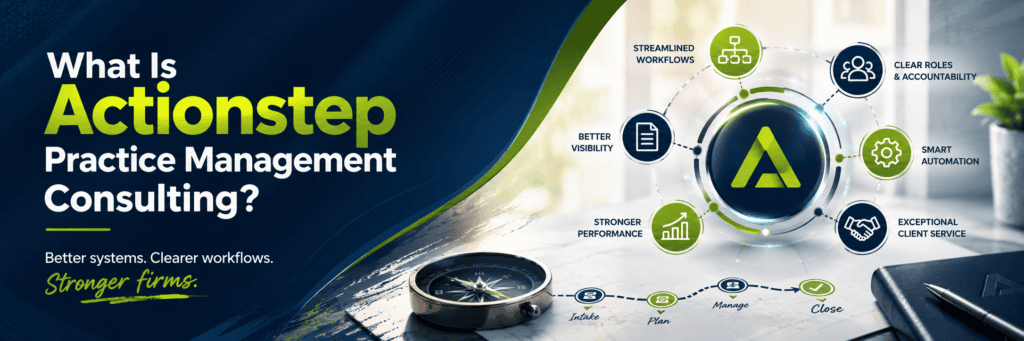
Actionstep practice management consulting is the process of evaluating, configuring, and optimizing how a law firm uses Actionstep to manage work, people, workflows, data, and client service. Rather than focusing solely on software features, effective consulting focuses on how work actually moves through the firm and whether the system supports efficiency, delegation, accountability, and growth.
For many small estate planning and elder law firms, Actionstep is already capable of supporting stronger operational performance. The challenge is rarely the software itself. More often, firms struggle with inconsistent adoption, workarounds, unclear processes, and workflows that evolved without a clear operational strategy.
Actionstep Is a Practice Management Platform, Not a Business System
Most firms purchase software hoping it will solve operational problems.
In reality, technology only amplifies the systems already in place.
If client intake is inconsistent, deadlines are unclear, or staff responsibilities overlap, those issues typically remain present inside the software. In some cases, they become harder to identify because the firm assumes the technology is managing the process.
Actionstep practice management consulting focuses on aligning the platform with how the firm actually operates.
That includes:
- Matter workflows
- Task ownership
- Intake and onboarding processes
- Document management
- Reporting and visibility
- Staff accountability
- Automation opportunities
The goal is not simply using more features.
The goal is creating operational clarity.
Why Many Firms Underutilize Actionstep
Actionstep is highly customizable.
That flexibility is valuable, but it can also create complexity.
Many firms gradually encounter challenges such as:
- Staff using different processes for similar matters
- Attorneys remaining involved in administrative work
- Workflows that have never been updated
- Manual steps replacing available automation
- Data entry occurring in multiple locations
- Reporting that fails to support decision-making
These issues often develop slowly.
A firm may remain busy and productive on the surface while underlying inefficiencies continue to grow.
This is similar to a common operational challenge seen across many legal practices: activity increases, yet profitability and capacity do not improve at the same pace. Being busy is not always the same as being efficient.
What Actionstep Optimization Actually Involves
Actionstep optimization looks beyond technology configuration.
It examines how work flows from initial inquiry through matter completion.
Common consulting areas include:
Workflow Mapping
Consultants examine:
- Where work begins
- Who owns each step
- When matters stall
- Which tasks require attorney involvement
- Where bottlenecks repeatedly occur
The objective is identifying friction before attempting automation.
Automating a broken process simply allows mistakes to happen faster.
Role Clarification
One of the most common causes of operational overload is unclear ownership.
When responsibilities are not clearly defined:
- Staff wait for instructions
- Attorneys become default decision-makers
- Tasks bounce between team members
- Follow-ups are missed
Strong practice management systems support clear delegation.
That requires role definition before workflow automation becomes truly effective.
Automation Review
Many firms only use a fraction of Actionstep’s automation capabilities.
Consulting efforts often examine opportunities such as:
- Automated task generation
- Workflow triggers
- Matter stage progression
- Client communications
- Document assembly processes
- Status updates
The objective is reducing repetitive work while preserving quality and consistency.
Reporting Improvement
Law firm leaders frequently struggle to answer simple operational questions:
- Where are matters getting stuck?
- Which teams are over capacity?
- How long do matters remain in specific stages?
- Which processes create the most delays?
Actionstep optimization helps firms create meaningful operational visibility rather than collecting data without action.
The Relationship Between Actionstep and Law Firm Practice Management
Many firms view practice management as software administration.
Effective law firm practice management is much broader.
It includes:
- People
- Processes
- Systems
- Technology
- Accountability
- Capacity planning
Actionstep becomes significantly more valuable when it supports these operational functions.
For example, if attorneys are spending substantial time on administrative activities, the issue may not be staffing. It may be workflow design, role clarity, or process ownership. Workflow improvement often creates greater operational leverage than simply adding headcount.
This distinction matters because technology should support delegation, not create more dependency on attorneys.
How Small Estate Planning and Elder Law Firms Benefit
Estate planning and elder law firms face unique operational demands.
Cases often involve:
- Multiple family decision-makers
- Extensive document collection
- Benefits coordination
- Ongoing client communication
- Highly detailed workflows
As volume grows, inconsistency becomes expensive.
Actionstep consulting helps firms create more predictable systems so work can move efficiently without relying on constant attorney oversight.
Benefits often include:
- Better staff utilization
- Reduced bottlenecks
- Improved client experience
- Clearer accountability
- Faster matter progression
- Greater operational capacity
- More reliable reporting
Importantly, these improvements are often achieved by improving how work flows rather than simply hiring additional staff.
Adoption Matters More Than Configuration
One of the least discussed areas of Actionstep optimization is adoption.
A perfectly designed workflow has little value if the team does not consistently use it.
Successful consulting efforts often focus on:
- Training expectations
- Workflow consistency
- Change management
- Leadership accountability
- Process documentation
Technology adoption is ultimately a people issue.
The most effective systems make the right actions easier and more intuitive for team members.
When Should a Firm Consider Actionstep Practice Management Consulting?
Consulting often becomes valuable when firms notice patterns such as:
- Attorneys continually handling administrative work
- Growing case volume without increased profitability
- Difficulty identifying bottlenecks
- Staff confusion about responsibilities
- Inconsistent client experiences
- Workflow breakdowns during growth
- Lack of confidence in reporting data
These symptoms rarely indicate a software problem alone.
More often, they reflect a need for stronger operational alignment between people, processes, and technology.
Final Thoughts
Actionstep practice management consulting is not fundamentally about software customization. It is about helping a law firm create operational systems that support consistency, accountability, delegation, and sustainable growth.
For small estate planning and elder law firms, the greatest opportunity often lies not in adding more technology or more people, but in improving how work moves through the organization. When processes are clear and Actionstep is aligned with those processes, the platform becomes far more than a case management tool. It becomes part of a stronger operational foundation.
This perspective reflects a broader operational principle seen across successful firms: sustainable growth comes from system design, workflow clarity, and intentional delegation, not simply increased activity or additional headcount.