
When Should a Law Firm Hire a Practice Management Consultant?
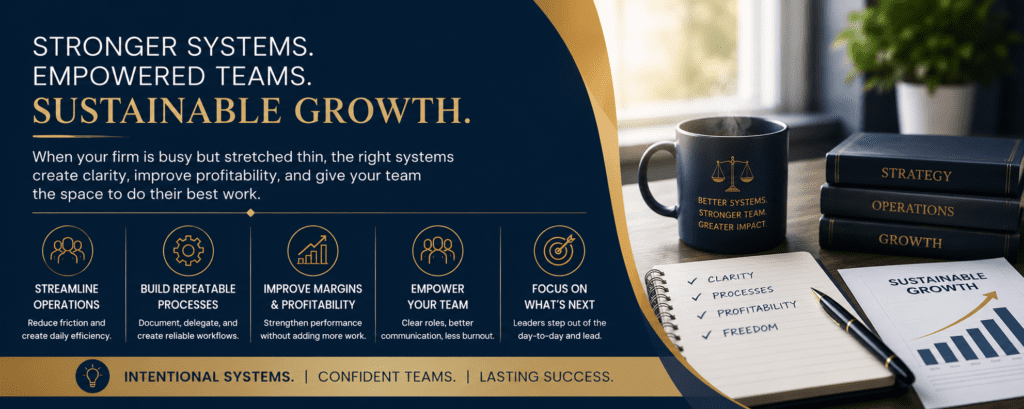
Most law firms don’t hire a practice management consultant because business is slow. They do it when the firm is busy, revenue is coming in, and the internal systems are starting to strain under the weight of growth. If work is piling up, decisions feel reactive, and small issues keep disrupting the day, that’s often the right moment to step back and examine how the firm actually runs.
A consultant becomes valuable when effort no longer translates cleanly into profit, clarity, or control.
Busy Isn’t the Same as Profitable
Many estate planning and elder law firms reach a point where calendars are full, staff feels stretched, and partners are still deeply involved in daily problem-solving. The firm appears successful from the outside, but internally:
- Matters take longer than they should
- Work is unevenly distributed
- Revenue growth requires constant personal involvement
This is usually not a talent issue. It’s a systems issue. Without intentional workflows, even strong teams spend too much time compensating for inefficiencies.
When Hiring More People Isn’t Fixing the Problem
A common response to overload is to add staff. Sometimes that’s necessary—but often it simply adds complexity. New hires need training, oversight, and clarity. If processes aren’t stable, growth amplifies the friction.
Signs this is happening include:
- Senior staff answering basic operational questions
- Partners acting as default problem-solvers
- Work being redone or corrected late in the process
A practice management consultant helps firms stabilize operations before adding headcount, so growth doesn’t create burnout.
Process Breakage Is a Signal, Not a Failure
Firms often say, “Our processes keep breaking.” That usually means the firm has outgrown informal systems that once worked. What used to live in someone’s head now needs to be documented, delegated, and measured.
This is where consulting work focuses:
- Clarifying who owns what
- Designing repeatable workflows
- Creating visibility into capacity and bottlenecks
The goal isn’t bureaucracy. It’s reliability.
Scaling Without Burning Out the Team
Sustainable growth requires separating strategy from execution. When leadership is stuck inside day-to-day operations, long-term planning disappears. Consultants help create space by building systems that allow:
- Work to move without constant supervision
- Decisions to be made at the right level
- Leaders to focus on direction, not triage
This is how firms scale without exhausting their people—or themselves.
Improving Margins Without Adding More Work
In elder law and estate planning, margin improvement often comes from refinement, not expansion. Small operational changes—better intake, clearer delegation, tighter timelines—can significantly improve profitability without increasing volume.
A consultant’s role is to identify where effort is leaking and help the firm keep more of what it already earns.
A Thoughtful Pause
Hiring a practice management consultant isn’t an admission that something is wrong. It’s recognition that the firm has reached a level of complexity where intentional design matters. When operations are stable, teams work with confidence, clients receive consistent service, and leadership can focus on what comes next.