
Where Workflow Consulting Helps Small Law Firms
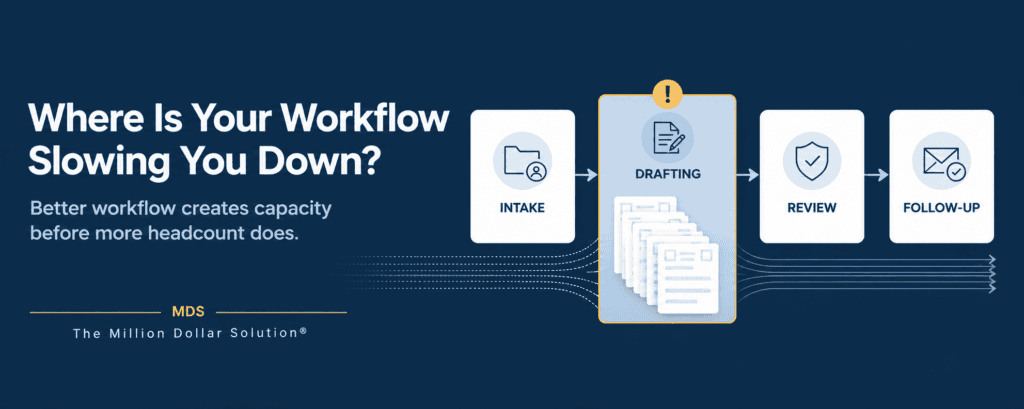
Workflow and operations consulting for small law firms is most useful where client work repeatedly slows down: intake, drafting readiness, attorney review, handoffs, follow-up, and delegation. For estate planning and elder law firms, improving those points can increase client work efficiency and capacity without assuming that more cases, more hours, or another hire will solve the underlying problem.
That distinction matters. A firm can be extremely busy while still losing time and margin to work that enters the system incomplete, waits unnecessarily, moves backward, or depends too heavily on an attorney to keep it moving. That pattern is consistent with The Million Dollar Solution’s existing operational content, which identifies intake, drafting readiness, review, and follow-up as recurring bottleneck areas.
Workflow Problems Often Look Like Staffing Problems
When a small firm becomes overloaded, hiring is an understandable response.
There are more matters to manage. Attorneys are stretched. Staff members are juggling priorities. Client follow-up becomes harder to maintain. Adding another person appears to be the clearest way to create capacity.
But adding capacity to an unclear process can simply give the inefficiency another place to go.
For example:
- A new paralegal cannot fully solve a drafting backlog if no one agrees on what makes a file ready for drafting.
- Additional administrative support will not eliminate intake rework if required information is collected inconsistently.
- Another attorney may not relieve the owner if routine approvals and exceptions still flow back to the owner.
- A larger team will not create reliable follow-up if next-step ownership remains ambiguous.
This is why effective law firm operations consulting looks at the work before assuming the firm needs more people. The goal is not to discourage hiring. It is to make sure the firm understands what work needs to be owned before defining who should own it. Existing Million Dollar Solution materials similarly emphasize defining what a role actually needs before hiring into it. [!USE-
1. Intake: Fixing Problems Before They Move Downstream
Intake is one of the highest-leverage areas for legal workflow optimization because decisions made at the beginning affect almost every step that follows.
When intake functions primarily as appointment scheduling, attorneys and staff may later discover missing decision-makers, incomplete information, unclear expectations, missing documents, or a matter that was not ready for the next step.
The Million Dollar Solution’s existing intake framework treats intake as more than an administrative transaction. It emphasizes establishing urgency, identifying decision authority, assessing readiness, setting expectations, and ensuring the attorney receives useful context before the consultation.
From an operations perspective, workflow consulting asks questions such as:
- What information must be collected before a matter advances?
- Who determines whether an inquiry is ready for the next stage?
- What happens when required information is missing?
- What should staff handle before attorney involvement becomes necessary?
- Is there a consistent handoff from intake to consultation?
A stronger intake workflow does not simply make the front desk more efficient. It protects capacity throughout the rest of the firm.
2. Drafting: Defining What “Ready” Actually Means
Drafting bottlenecks are not always caused by a lack of drafting capacity.
Sometimes work reaches the drafting stage before it is actually ready.
A file may be technically assigned but still lack information, decisions, internal notes, client documents, or clear instructions. The drafter begins, encounters a missing dependency, sends the matter backward, waits for clarification, and later has to reconstruct the context.
Multiply that pattern across an active caseload and the firm becomes busy without becoming proportionally more productive.
One useful small firm process improvement is to establish a clear readiness standard.
Before work advances, the firm should know:
- What must be complete.
- Who confirms completion.
- Who owns the next stage.
- What happens when an exception occurs.
The objective is not more bureaucracy. It is fewer backward loops.
The Million Dollar Solution’s workflow content identifies unclear drafting readiness as a recurring constraint because files can stall or loop backward when “ready for drafting” has no consistent operational definition.
3. Handoffs: Making Ownership Visible
Small law firms often rely on experienced employees who simply know what happens next.
That can work for years.
Then the firm grows, someone goes on leave, responsibilities shift, another employee is added, or case volume increases. Suddenly the unwritten process becomes difficult to follow.
A handoff is not complete merely because one person finished a task. It is complete when the next person knows the work belongs to them and has what they need to act.
Useful handoff design therefore establishes:
- a clear completion point for the prior stage,
- a named owner for the next stage,
- required information or documentation,
- an expected timeframe,
- and a process for exceptions.
This is where workflow consulting frequently creates relief without adding headcount. Instead of asking people to work harder to compensate for ambiguity, the firm removes ambiguity from the work itself.
4. Attorney Review: Protecting the Firm’s Most Constrained Capacity
In many estate planning law firms and elder law firms, attorneys become the default checkpoint.
Questions come to them. Exceptions come to them. Files wait for them. Staff seek confirmation because the expected decision rules have never been made explicit.
Eventually, attorney involvement becomes the bottleneck.
This does not mean attorney review should disappear. It means the firm should distinguish between work that genuinely requires attorney judgment and operational decisions that can be standardized, delegated, or prepared more effectively before review.
Consider tracking attorney review for several weeks:
- What is being reviewed?
- Why did it require attorney involvement?
- Was something missing?
- Could staff have resolved part of it with a documented standard?
- Is the attorney making the same operational decision repeatedly?
Patterns usually emerge.
That matters for profitability because attorney capacity is difficult to scale when valuable time is repeatedly absorbed by avoidable workflow friction. Existing Million Dollar Solution content makes the same broader distinction: longer attorney hours do not automatically increase revenue when work is repeating itself, moving slowly, or landing on the wrong desks.
5. Follow-Up: Removing the “Who Has This?” Problem
Follow-up is often where a technically completed task becomes an unfinished process.
A client needs an update. A document needs to be returned. A next meeting needs to be scheduled. A missing item needs to be requested. Everyone assumes someone else owns the next step.
The problem is not always effort. It is ownership.
A stronger workflow makes four things visible:
Current status: Where is the matter now?
Next action: What specifically needs to happen?
Owner: Who is responsible for making it happen?
Trigger or timeframe: What tells that person to act?
Without these elements, follow-up becomes dependent on memory, inbox management, and individual vigilance.
With them, the system begins carrying part of the operational load.
6. Delegation: Moving Beyond “Who Has Time?”
Weak delegation distributes tasks according to availability.
Strong delegation assigns ownership based on role, capability, workflow position, and appropriate responsibility.
That difference matters as firms scale.
If employees routinely wait for an owner or senior attorney to decide what happens next, the bottleneck is not necessarily employee capacity. The firm may not have defined decision authority clearly enough.
Workflow consulting can help separate work into categories:
- activities that require attorney judgment,
- work staff can fully own,
- work staff can prepare for attorney review,
- routine decisions that can follow documented standards,
- and low-value steps that may no longer be necessary.
This provides a better foundation for staffing decisions because the firm can hire for a defined operational need rather than a general sense of overload.
The broader principle is consistent with The Million Dollar Solution’s people-development materials: effective delegation works best when responsibility is aligned with the role and the person’s strengths rather than treated simply as pushing work onto someone else.
7. Systems: Making the Right Process Easier to Follow
Software alone does not create a workflow.
A practice management platform can track tasks, automate reminders, organize documents, and make status visible. But automation layered over an unclear process often makes the unclear process move faster.
The process should come first.
Before changing technology or building automations, a firm should be able to explain:
- where a matter starts,
- which stages it moves through,
- who owns each stage,
- what qualifies it to advance,
- what information accompanies the handoff,
- and how exceptions are handled.
Then technology can reinforce the process instead of becoming a substitute for designing it.
The Million Dollar Solution has applied this same foundation-first principle in its technology material: software, data, people, and processes perform better when the underlying operating foundation is deliberately designed before more technology is layered onto it.
How Workflow Improvement Connects to Profitability
Busy does not automatically mean profitable.
A firm can have full calendars, a growing caseload, and an exhausted team while still losing margin through rework, excessive attorney involvement, stalled files, duplicated communication, unnecessary handoffs, and work sitting between owners.
This is why workflow improvement is ultimately connected to profitability.
Better workflows can help a firm:
- preserve attorney capacity for higher-value work,
- reduce avoidable rework,
- use existing staff more intentionally,
- improve throughput without automatically increasing headcount,
- create greater consistency in the client experience,
- and see where new staffing would genuinely create leverage.
That is also why “we need to hire” and “we need more cases” should not automatically be the first responses to growth pressure. Existing Million Dollar Solution content makes a similar point on the demand side: more volume is not always productive when the work itself strains team capacity or creates friction.
What Workflow and Operations Consulting Should Examine First
For a small estate planning or elder law firm, an operational review does not need to begin with a massive redesign.
Start with the point where work repeatedly slows down.
Map one client matter from inquiry through completion and ask:
- Where does it wait?
- Where does it move backward?
- Where does information get requested twice?
- Where is ownership unclear?
- Where does an attorney become involved unnecessarily?
- Which steps depend on one person’s memory?
- What breaks when that person is unavailable?
Those questions reveal more than an org chart or software list.
They show how the firm actually operates.
That distinction is important because sustainable scaling depends on the strength of the operating system underneath the people doing the work. The Million Dollar Solution’s existing workflow content describes bottlenecks in much the same way: not as evidence that a firm is failing, but as signals that its operating structure has outgrown an earlier design.
A Better Definition of Capacity
For small law firms, capacity is not simply the number of people employed or hours available.
Capacity is the amount of appropriate client work the firm’s people and systems can move predictably without relying on chronic overtime, constant escalation, or owner intervention.
That is where workflow and operations consulting for small law firms can be most useful.
It helps firms see whether pressure is truly coming from insufficient staffing or from the way work travels through the organization.
For estate planning and elder law firms, that distinction can shape decisions about hiring, delegation, technology, profitability, and growth. When work has clear ownership, defined readiness standards, deliberate handoffs, and systems that reinforce the process, growth becomes less dependent on individual effort.
A firm does not need to eliminate every bottleneck. It needs enough operational clarity to know where the important ones are, why they exist, and what should change before more volume is added.
The Million Dollar Solution® (MDS) provides consulting, coaching, and educational services only. The information, recommendations, tools, templates, and examples contained in these materials are for informational purposes and should not be construed as legal, accounting, tax, financial, or other professional advice. Attorneys, CPAs, and other professionals are responsible for complying with the laws, regulations, ethical requirements, licensing obligations, and professional standards applicable to their own jurisdictions and professions. Users should consult qualified professional advisors regarding their specific circumstances before implementing any recommendation.