
Why Does My Law Firm Feel Overwhelmed Even After Hiring More Staff?
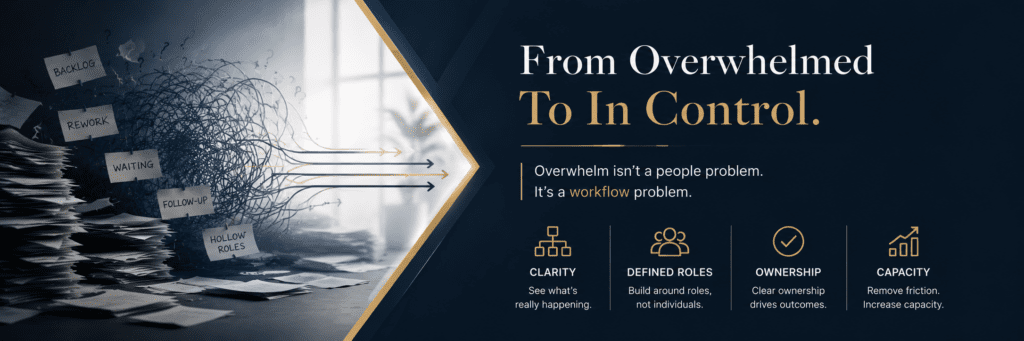
Many estate planning and elder law firms feel overwhelmed after hiring because the underlying workflow hasn’t changed. When work still depends on individual effort instead of clear processes, adding people increases coordination and complexity—often making the firm feel heavier, not calmer.
Growth Exposes Structure—It Doesn’t Create It
As firms grow, informal systems that once worked begin to strain. Intake varies by person. Drafting readiness isn’t clearly defined. Reviews happen out of sequence. The result is a team that stays busy while progress feels uneven. Effort increases, but efficiency does not.
This is why many owners feel stuck despite growth. More cases create motion, but not leverage. Busy days don’t reliably translate into profitability.
Hiring Without Workflow Design Redistributes Pressure
Hiring is often a response to strain. Attorneys are still involved in everything. Files back up. Communication slips. Without defined ownership, new hires escalate decisions instead of owning outcomes, pulling attorneys deeper into operations. Pressure shifts—it doesn’t disappear.
In estate planning and elder law, hiring is a workflow decision first. When roles are defined by titles instead of outcomes, capable staff wait, rework, or defer—while attorneys become the default solution.
Where Bottlenecks Commonly Form
Firms that feel busy but not profitable usually share a few structural constraints:
- Intake: Unstructured intake allows poorly defined work into the system, creating downstream rework.
- Drafting readiness: “Ready” isn’t standardized, so files loop backward.
- Reviews and approvals: Work waits on availability instead of moving predictably.
- Follow-up: Ownership is unclear, so next steps become reactive.
Individually manageable, these bottlenecks compound. Adding cases adds chaos.
Busy ≠ Profitable
When attorneys compensate for workflow gaps by working longer hours, output often stays flat. High-value professionals end up doing low-value tasks because the handoffs aren’t designed. Profitability stalls not from lack of demand, but from operational friction.
The Shift That Creates Capacity
Firms that regain control redesign how work flows:
- Map what actually happens, not what’s intended.
- Design around roles, not individuals.
- Clarify ownership and decision authority.
- Let practice management systems guide behavior, not just store information.
Capacity appears not by working faster, but by removing unnecessary work. Many firms discover relief without adding headcount.
A Thoughtful Close
Overwhelm is rarely a people problem. It’s a signal that the operating system has outgrown its original design. When structure catches up to growth, effort finally converts into progress—and the firm begins to feel steady again.