
Why Is My Elder Law Firm Busy but Not Profitable?
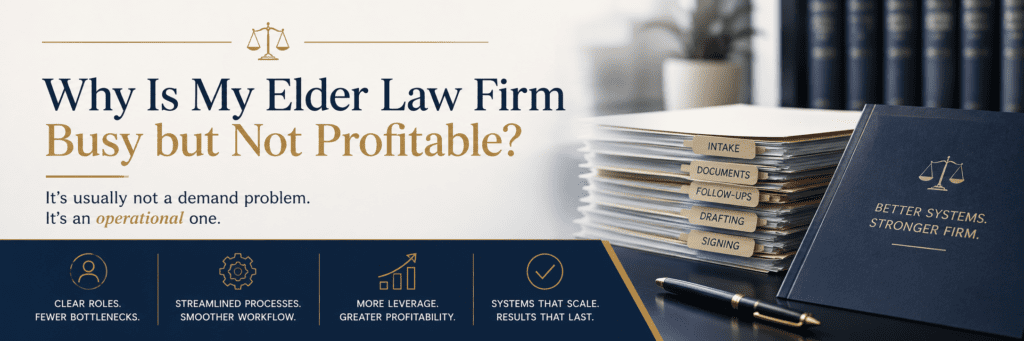
Many elder law firms reach a frustrating stage where calendars are full, attorneys are exhausted, and revenue still feels tight. This usually isn’t a demand problem. It’s an operational one. When workflow design, delegation, and systems don’t scale with case volume, busyness quietly erodes profitability.
Busy Work vs. Productive Work
In many estate planning and elder law firms, attorneys spend increasing hours on tasks that don’t directly generate revenue: chasing documents, clarifying intake notes, answering routine client questions, or reworking files that stalled earlier. The firm looks busy, but much of that activity isn’t moving cases efficiently toward completion.
This is why attorneys can work longer hours without seeing income rise. The firm is producing effort, not leverage.
Where Workflow Bottlenecks Begin
Workflow bottlenecks often form long before drafting or signing. Common pressure points include:
- Intake processes that rely too heavily on attorney involvement
- Inconsistent handoffs between team members
- Undefined ownership for follow-up tasks
- Files waiting on decisions because no one is clearly responsible
When each new case enters an already strained system, delays compound. Adding more cases doesn’t fix the problem; it amplifies it.
Why Hiring Doesn’t Automatically Solve the Problem
When firms feel overwhelmed, the instinct is often to hire. But adding staff to a broken workflow usually increases complexity rather than capacity. New team members require training, supervision, and clarification—often from the same attorneys who are already overloaded.
Without standardized processes and clear role boundaries, more people can mean more interruptions, more rework, and more confusion. The result is higher payroll without meaningful margin improvement.
The Real Driver of Profitability: Operational Design
Profitable firms focus on how work moves, not just how much work exists. That means:
- Defining which tasks truly require attorney expertise
- Delegating preparatory and administrative work intentionally
- Creating repeatable processes that don’t rely on memory
- Designing workflows that prevent files from stalling
When systems are designed to support flow, attorneys spend more time on high-value work, cases move faster, and revenue becomes more predictable—without increasing headcount.
Scaling Without Chaos
Growth only becomes profitable when the firm’s infrastructure can absorb it. This requires stepping back from daily urgency to examine where time is being lost, where decisions get delayed, and where responsibility is unclear.
Firms that make this shift often discover that profitability doesn’t require working harder or adding staff. It requires clearer systems, better delegation, and fewer friction points in how work actually gets done.
A busy firm isn’t broken. But without operational alignment, it will stay busy without becoming meaningfully more profitable.