The Journey of Authorship: What I’ve learned and Why I’m excited to share it

For years, I have had the privilege of working hand-in-hand with attorneys and financial advisors I trust and admire to help them reach their profitability goals. Partnering with each one has been an incredible journey and I am proud to have played a part in their success. Without doubt, I am a better CPA, strategic financial analyst, coach, professional, and person for what I have learned along the way.

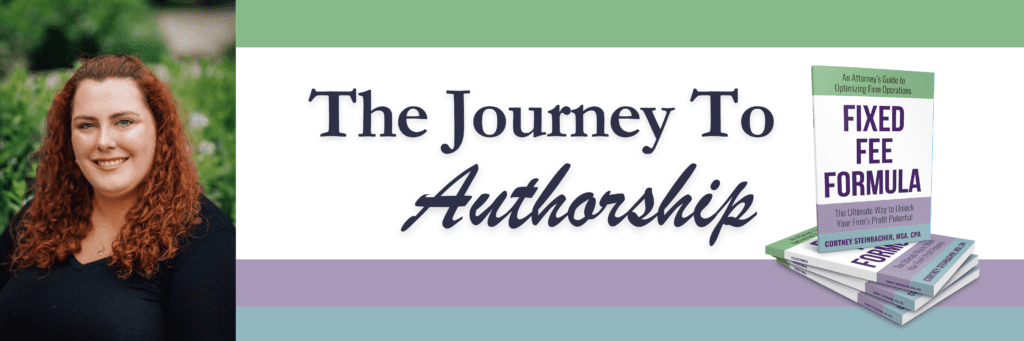
For quite a while now, I’ve wanted to share what I have learned on this adventure with others. So, I am thrilled to announce I have compiled my favorite proven tips, tricks, and insights in my first book: “Fixed Fee Formula”.

Dangerous Trends

There a few trends I have noticed throughout my coaching, that directly drain organizational profits across the board. Many businesses have subtle but significant ways that money slips through the cracks. These “little drips,” while seemingly unnoticeable, become a flood – having a huge impact on a firm’s bottom line.

Whether those drips are unused subscriptions, or monthly services charges, a little digging can help uncover these leaks. “Fixed Fee Formula” shares a number of common leaks – that you may have and not even recognize – and my recommendations to resolve them and prevent others.

Another common trend is a hesitancy to track and monitor an office’s productivity. And I get that!  No one wants to be “Big Brother.”  But there are great project and people management software options that promote visibility and accountability.

And if you take away nothing else – please remember this: visibility and accountability will always make you a more effective leader by empowering your staff and keeping you out of the nitty-gritty of daily operations.

Everyone Deserves To Be ProfitableEveryone running their own business and leading a hand-picked team deserves to be successful. The tips within “Fixed Fee Formula” are designed to be a resource for anyone—I’ve packed it with tips and tools that can benefit leaders in any field. Whether it’s working smarter, recognizing inefficiencies, or fostering better collaboration, my book highlights the small, manageable steps that lead to big results.

My Inspiration

As a strategic financial analyst and profitability coach, I’ve gained a deeper understanding of myself and my passion for this work. I am honored to share these insights with as many people as possible. That’s why I wanted to write “Fixed Fee Formula” and share it with you.

Authorship has taught me more than I ever expected. It reminded me why I do what I do and strengthened my belief in the power of mentorship, education, and proactive change. My hope is that this book is a useful tool for anyone looking to improve their financial outcomes, optimize their workflows, or simply find inspiration in the pursuit of excellence.

To everyone who’s been a part of this journey — thank you. Your stories, challenges, and successes have shaped this book and made it what it is. I’m excited to share it with you and hope it brings as much value to your life as coaching has brought to mine.

I’d love to share “Fixed Fee Formula” with you, and I’d love you to share what you learn to improve your team. I hope you’ll consider ordering Fixed Fee Formula today, and letting me know what you think.

It is an honor to walk this path toward profitability with each of you. I do not take for granted the trust you have placed in me, in MDS, and in “Fixed Fee Formula”

Dedicated to your success,

Cortney
New Approaches and Modern Solutions

The legal world is evolving faster than ever, and with it comes the need to re-evaluate and modernize how we serve our clients. Whether it’s utilizing modern technology to streamline operations, integrating well-being into estate planning, or offering specialized dementia-focused services, the tools and strategies available today can transform your practice.

By addressing the growing demand for long-term care solutions and embracing innovative approaches, you can deliver more value to clients while setting your practice apart in an increasingly competitive field.

A New Approach to Technology

Artificial Intelligence is no longer a futuristic concept — it’s a powerful tool shaping industries worldwide, including elder law. While the rise of AI brings immense potential, such as automating workflows and enhancing client services (both of which boost your profitability), many professionals are hesitant to adopt these modern tools.

Whether we are ready to embrace the future or not, the truth is – AI is here. If you haven’t explored these technological possibilities yet, I expect you will be pleasantly surprised that the technological “learning curve” isn’t nearly as steep as you may fear.

A New Approach to Estate Planning

Estate planning has always been about more than just finances— it’s about creating a framework that prioritizes a client’s overall well-being and the values they want to pass on to their loved ones. This evolving approach integrates health, emotional, and personal well-being into traditional estate planning, ensuring plans address not only wealth but also quality of life.

For example, Dementia Living Wills can outline stage-based care preferences, from medical interventions and nutrition to pain management and lifestyle choices, offering clarity as the disease progresses. 

Well-Being Trusts create purposeful legacies, funding initiatives like fitness programs, counseling, or even educational opportunities for beneficiaries. By setting clear expectations and aligning plans with individual and family values, well-being estate planning minimizes family conflict while fostering care and legacy that truly reflect what matters most.

A New Long-Term Care Insurance Solution

Long-term care insurance is a transformative tool in estate planning, offering a critical safety net for clients facing the rising costs of senior care. However, its value is often underestimated or misunderstood. It’s our responsibility to bridge this knowledge gap, educating clients who are already ill about available solutions, and about possible important tax advantages.

Many clients are unaware of the significant expenses associated with long-term care, whether it’s the monthly costs of assisted living, the hourly rates for in-home care, or the substantial expenses of private skilled nursing facilities. Without proper planning, these costs can deplete savings, disrupt retirement plans, and place enormous financial and emotional strain on family members who may need to step in as caregivers.

We can help them see how long-term care insurance acts as a shield—preserving their assets, maintaining their independence, and alleviating the burden on loved ones.

A New Chance to Embrace Professional Education

When you combine an understanding of modern technology, well-being estate planning strategies, and a deep understanding of long-term care insurance, you get the recipe for success. These tools don’t just improve how you work—they elevate the level service you provide your clients, increase your profitability, and emphasize the meaning of your work. It’s about being proactive, innovative, and ready to tackle the challenges of the future head-on.Encourage your clients to take control of their future, and you’ll elevate your practice in the process. Don’t miss the opportunity to dive deeper into these strategies at the “Advancing to Prosperity” conference on Friday, January 31st, and Saturday, February 1st, 2025, at the Grand Hyatt Tampa Bay. This exclusive event is your chance to learn from industry leaders, gain cutting-edge insights, and position your practice for long-term success. Spots are limited, and they’re selling fast—register today to secure your seat and take advantage of special discounts!

Great Wealth Transfer Intensive

Estate planners, elder law attorneys, and financial advisors are standing on the edge of the largest financial shift in history. Over the next 20 years, $84 trillion be transferred from Baby Boomers to younger generations.

What this means for you is an increased demand for services, a need for modern solutions, and complex estate planning.

The question isn’t if your office will be impacted by this Great Wealth Transfer – but how well prepared you are to capitalize on it. 

This momentous shift is already under way, and clients—especially Baby Boomers—are actively seeking advisors who are equipped to protect their legacy.


Are you ready?

To prepare for this massive shift, ask yourself some difficult questions about the very core of your business.

Are you using your time efficiently? Are you making data-driven decisions or using technology to increase your bottom line?

Or are you wasting your time manually tracking projects or following up with your staff?

Do you have a game plan in place for Long-Term care insurance? Do you truly understand trusts and collaboration with attorneys?

If these questions make you a little uncomfortable, the hard truth is: You’re not ready for The Great Wealth Transfer. And unless you start preparing now, you risk falling behind your competitors and putting your clients at risk to face estate taxes, legal complications, or long-term care costs that diminish their inheritances.

Fortunately, there is still time to set yourself up for success – and MDS can help.

The Great Wealth Transfer Intensive

MDS is bringing together a hand-selected team of industry giants for The Great Wealth Transfer Intensive. 


Beginning Thursday, Oct. 31, join us for three days of introspection and planning, then return to your office with a personalized road map to success and profitability in the Great Wealth Transfer.

Registrations for this event are extremely limited, by design, to create a close-knit educational environment to ask yourself the hard questions and voice your opinions.

What you’ll take away from the Great Wealth Transfer Intensive

Technology
Modern clients, like Millennials and Gen Z, demand modern, tech-savvy solutions to meet their expectations. The Great Wealth Transfer Intensive will provide a blueprint to automations, AI, and data insights to focus on what truly matters: securing your client’s legacy.

HR preparedness
​Personnel issues and poor HR policies drain your time, resources, and productivity. During the Intensive, your team will get the rools to attract and retain the right talent, foster a positive work environment, and promote compliance while reducing risk. 

Enhanced strategies for complex clients
Long Term Care Insurance will play a more pivotal role than ever in this competitive landscape. Spend extended time hearing from the experts, including Don Quante CLTC, to gain your competitive advantage over competitors.

Moving Forward
Investing in your professional advancement is crucial, and The Great Wealth Transfer Intensive is a unique opportunity to be in the same room with some of the greatest minds of our time and truly prepare to succeed.

The time is now. Register today for the Great Wealth Transfer Intensive and I’ll see you in Chicago

Embracing a Balanced Life with the “Chunk-it” Method

Image Not Found

I am not a mind-reader, but I bet I could guess your answer to this question: “Do you have enough time in your day to get it all done?”

You said “No,” didn’t you?

For each of us, the clock never stops ticking. We are at the mercy of our schedule and our interruptions, and the demands in both our professional and personal lives lead us on an seemingly-unending quest to find a manageable schedule.

If you are stretched thin, missing important milestones with your friends or family, or just can’t keep up the pace any longer – the answer might just lie in thinking about your calendar differently. For me, a methodical approach called “Chunk-it” has been life-changing. 

“Chunk” Your Time

The foundation of the Chunk-it method is in taking hold and taking control of your time, rather than letting others control it. Begin my distinguishing between breaks and distractions. Breaks are intentional pauses that help refresh your mind, necessary for maintaining stamina through your workday. In contrast, distractions are those unexpected interruptions that not only derail your focus but also require a significant chunk of time—about 23 minutes on average—to regain your previous concentration levels.

To protect productivity, develop strategies that shield your schedule from frequent interruptions. Something as simple as setting specific office hours for addressing questions and muting notifications during deep work sessions can help maintain your focus and prevent productivity theft.

“Chunk” Your Energy

Another aspect of the Chunk-it strategy is energy management. There’s only so much we can do if we don’t have the energy to accomplish everything. Effectively delegating tasks conserves your energy. Each item on your to-do list should be scrutinized: Is it essential that you personally handle it? If the answer is no, then delegate it. This clears your schedule for more critical tasks and empowers your team by trusting them with more responsibilities.

If recurring tasks consistently don’t fit into your daily or weekly schedule, it’s time to assess their relevance or find someone who can take them off your hands. This might mean hiring someone with a specific skill set (consider paying someone to mow your lawn or taking your work clothes to the dry cleaner) or reassigning duties within your team. Ensuring that only tasks of true significance occupy your calendar frees up time and energy, leading to higher efficiency and less burnout.

“Chunk” Your Presence

Being fully present is a gift you can give to those around you. So identify your priority – and stick to it. If you want to be home in time for your child’s soccer game, or grandchild’s recital – put it on your calendar. Schedule travel time if necessary.

The ultimate goal of segmenting your time and energy efficiently is to ensure that you can be fully present in each moment—whether at work or home. This requires clear boundaries between professional and personal life, so you can fully rest and still be efficient when necessary.

When you’re at work, dedicate yourself entirely to the tasks at hand, and when you are at home, you can fully engage with your family and personal activities without the nagging pull of unfinished work.

You no longer need to apologize for missing out on personal commitments due to work because your time and energy are allocated in a way that respects both your professional responsibilities and personal needs.

Integrating “Chunk-it” into Your Professional Life

The Chunk-it method offers a practical solution for law professionals seeking to transform their practice into a beacon of efficiency and balance. We can create a more fulfilling and balanced career by redefining how we manage our time, delegate our responsibilities, and engage in our environments.The Million Dollar Solution® is all about respecting the unique pressures law professionals face and advocating for strategies that promote well-being and productivity. If you’re ready to redefine your professional life for greater success and personal satisfaction, consider how integrating the Chunk-it method can help you achieve just that. Let’s make every minute, every decision, and every day count towards building a more balanced life.

The Unique Estate Planning Needs of the Sandwich Generation

Image Not Found

How are you serving clients in the Sandwich Generation?

Today, a quarter of American adults find themselves sandwiched between caring for both their aging parents and their growing children. Being a multidimensional caregiver carries increased responsibilities and the consequences of poor financial planning can impact generations.

Let’s take a deeper look at the estate planning strategies you can use to help your Sandwich Generation clients plan effectively to avoid debilitating debt, a lack of retirement funds, or even bankruptcy.

Comprehensive Financial Planning

Securing financial stability is the bedrock of effective estate planning – especially for those in the Sandwich Generation. A layered financial planning approach can help these individuals meet family obligations without compromising their financial health.

Discuss with your clients:

Diligent Retirement Planning
While it may not seem like a priority today for these caregivers, contributing maximally to retirement accounts now, and exploring other viable investment options, are prudent steps with compounding benefits in the future.

Maintaining a Robust Emergency Fund
Being prepared for the unexpected is vital to maintain the sandwich generation’s financial health. This fund acts as a financial cushion for unforeseen expenses, such as sudden medical needs for elderly parents or essential support for children, ensuring that these costs do not derail their financial stability.

Securing adequate insurance coverage
Family finances can be destroyed by ongoing medical care, like cancer treatments or nursing home care. Health, disability, and long-term care insurance can significantly alleviate financial burdens caused by health emergencies and preserve family assets for future generations. 

Estate Planning Across Three Generations

Proper estate planning for adults in the Sandwich Generation begins with ensuring estate plans are in order for all adult family members.

The importance of a sound, legally binding will cannot be understated – for both the elderly parents and the parents of young children. While ensuring that final wishes are met, wills are important to provide for minor children.

Powers of attorney and healthcare directives are vital documents for everyone, but especially for elderly parents to have in place. Not only do these documents ensure that medical wishes are met, they can alleviate stress for their adult children, and prevent familial disputes fueled by stressful situations.

It’s also important to employ strategies like gift tax exclusions to transfer wealth during your client’s lifetime, which can reduce the taxable estate while supporting family members when they need the most help.

Additionally, establishing family trusts can serve dual purposes: managing how children and grandchildren inherit assets and addressing the care needs of aging parents.

The Value of Professional Guidance

The Million Dollar Solution® team understands the unique challenges around estate planning for adults and families – across all generations. Schedule your free strategy session with The Million Dollar Solution® to receive essential guidance and personalized strategies to enhance your practice, and help clients manage these multifaceted responsibilities effectively and compassionately.

Part II: Enhancing Team Performance with the Kolbe Assessment

Image Not Found

Sometimes, your team’s energy and productivity just don’t meet your expectations. That’s something we experienced first-hand here at MDS. When turnover and dissatisfaction impacted our accounting department, we turned to the Kolbe System.

Optimizing Energy and Productivity

We began by examining how each employee’s duties and tasks aligned with their natural strengths and abilities. This is the first (and most crucial) step in the Kolbe Assessment, informing the decisions and changes you make next.

The assessment identified that staff thriving in our accounting department all had identical Kolbe results! Their inherent strengths lead them to be passionate, focused, and quality-driven in the world of numbers and statistics.

Teammates with contrasting Kolbe results were dissatisfied and stifled productivity. We provided those staff with different opportunities, and some – realizing they were operating in conflict with their natural abilities – found a better professional fit elsewhere.

Since we applied the Kolbe internally, staff turnover has decreased by nearly 70% in our accounting department.

Optimize Energy and Productivity

The Kolbe labels each person as a Fact Finder, Follow Through, Quick Start, or Implementor, and suggests each team member’s tasks should be divided accordingly across four energy levels: 

  • 40% of tasks should energize
  • 30% should maintain energy
  • 20% should modify energy
  • 10% should focus on envisioning or planning what’s next.

Assigning tasks within this framework can help you assign roles to maximize productivity and minimize burnout. 

Managing Stress Effectively

The Kolbe Assessment also reveals your staff’s natural response to professional demands. When job duties clash with their intrinsic strengths, stress, and strain can arise for everyone. To effectively manage this, you can adopt the “three D’s” strategy:

  • Delete unnecessary tasks,
  • Delegate tasks to more suitable team members,
  • and Do focus on completing essential tasks.

 Enhancing Team Cohesion and Communication

The Kolbe will guide you to communicate with each person effectively, keeping your office running smoothly:

  • Fact Finder: Thrives on detailed, written communications with comprehensive data, documented references, and analytical case studies.
  • Follow Thru: Effectively engages through visual presentations, such as graphs, charts, and detailed diagrams that outline processes and results.
  • Quick Start: Receptive to dynamic and spontaneous verbal communications, like impromptu discussions, colorful visuals, and succinct bullet points to capture key ideas.
  • Implementor: Responds best to interactive and physical forms of communication, involving direct interaction with hands-on materials, like physical models, practical demonstrations, and active experiences.

Use Kolbe to benefit your team

  • Regular Reviews: Integrate Kolbe assessments into regular performance reviews to align roles and responsibilities continuously with individual strengths.
  • Training Programs: Develop training modules that enhance employees’ fundamental talents and address any areas of discomfort.
  • Team Workshops: Conduct workshops that foster a deeper understanding of each team member’s strengths and how these can be synergized for improved collaboration.

Are you ready to unlock the full potential of your team and foster a thriving work environment? Schedule your consultation with Kolbe Certified Consultant, Dominic Loffredo, SHRM-CP today and explore how MDS can help you integrate the Kolbe Assessment across your organization. Together, we can transform your workplace dynamics for an optimized future and pave the way for sustained success and growth.

Leveraging the Kolbe Assessment for Organizational Success

Every business owner wants to find the “secret sauce” to optimize their daily operations. For firms working as a team, getting to know everyone’s core strengths and instinctive actions is an important step in that direction. The Kolbe Assessment offers a precise lens through which to view and harness these natural behaviors, transforming the way firms operate. By focusing on innate talents, law practices can craft a team that not only excels individually but also collaborates seamlessly, elevating their service to clients and enhancing firm success.

The Essence of the Kolbe A™ Index

The Kolbe A™ Index is at the heart of this strategic approach. It doesn’t measure intelligence, skill level, or personality but instead focuses on the instinctive methods individuals use to handle tasks and solve problems. This unique perspective is crucial for law firms aiming to build a team where each member’s natural strengths are recognized and utilized. By identifying these instinctive traits, the Kolbe Assessment provides a foundation for assembling a team that is both diverse in abilities and cohesive in function, ensuring that each person is in the best position to contribute to the firm’s objectives.

Strategic Integration in the Hiring Process

Integrating the Kolbe A™ Index into the hiring process, known as the “RightFit Process,” allows firms to align potential hires with the specific needs of their roles and teams from the start. This alignment is essential for maximizing office potential and creating an environment where every team member can thrive and contribute effectively. By understanding the natural behaviors of individuals, law firms can place them in roles where they will naturally excel, leading to improved performance and job satisfaction.

Continued Development and Organizational Growth

The utility of the Kolbe A™ Index extends far beyond the initial hiring. It serves as a continuous tool for development, aiding in onboarding and training by tailoring plans to each individual’s strengths. This ensures that new hires integrate seamlessly into their roles and the firm’s culture, fostering a productive and harmonious work environment. The Kolbe A™ session, particularly when conducted one-on-one, is a deep dive into an individual’s innate strengths, aligning them with the team and organizational goals.

This consistent practice of using the Kolbe A™ Index facilitates ongoing development and placement of team members in roles where they can naturally succeed. It’s a dynamic tool that adapts to each stage of an employee’s journey within the firm, supporting not just hiring but also long-term development and team dynamics.

Your Guide to The Kolbe A™ Index

The Kolbe A™ Index is not merely an evaluative tool; it’s a comprehensive approach to building and sustaining a high-performing team in the specialized field of elder law and estate planning. By leveraging this assessment, firms can ensure that their teams are not only competent but also instinctively aligned with their roles and the firm’s broader goals, leading to enhanced productivity and success.
We understand the critical role that instinctive strengths play in organizational success. Schedule your free strategy session with The Million Dollar Solution® today to explore how the Kolbe A™ Index can transform your team dynamics and drive your firm toward greater achievement. Let’s unlock the full potential of your team together.

Proactively Planning in Observance of Healthcare Decisions Day

In your eyes, April 16th may be known for being the National Wear Your Pajamas to Work Day, but it also recognizes a topic more pivotal than being comfy at work.  April 16th is also National Healthcare Decisions Day which was created to educate and empower individuals & providers on the value of proactively planning your care.  

In past years, my firm has collaborated with a local doctor to host a seminar for Healthcare Decisions Day in order to educate our community on what is being offered and why they need to begin planning now.  From a business perspective, this can be a key strategic planning adjustment your firm can start today.  Since April 16th is a nationally acclaimed day, it provides the opportunity to get free publicity with your local newspaper or gazette by coordinating your schedule with the national calendar.  The platform to educate individuals on end-of-life decisions and the importance of planning ahead will bring new and current clients who are more educated and invested individuals by taking the time to attend your seminar.  I have found these individuals to be some of the best clients to work with and I think you will too. 

Over the years we have used this seminar to educate people in several ways, one of which is focusing on the importance of a living will.  This was done by coordinating with a local doctor to discuss what is needed for someone to have the capacity and make decisions for themselves.  In past years, we had a reverend speak about end-of-life decisions.  Lately, we have put both the reverend and doctor in the same seminar to drive home the message at all levels.

If you have yet to integrate this into your seminar/webinar calendar, this is the PERFECT time to start in the midst of a year when people are trying to plan ahead. 


Dedicated to Your Success,

Julie

Addressing Incapacity with a Dementia Diagnosis in Mind

Addressing legal incapacity for individuals suffering from dementia is a profoundly sensitive matter that requires attorneys to navigate with the utmost empathy and tact. It’s not just about legal advisement but ensuring the dignity of those affected by dementia. Incorporating people-first language, as advocated for its respectfulness towards individuals’ identities and conditions, aligns with the necessary empathetic approach. This means using language that emphasizes the person, not their disability, which is crucial in legal interactions to make clients feel seen and respected.

Empathetic Approach

An empathetic approach involves recognizing the emotional and psychological state of individuals with dementia and their families. It means communicating in a way that is respectful and understanding of their condition. It’s more than just taking the time to explain legal concepts in accessible language; it’s about being patient with repeated questions or confusion. Empathy in this context is about more than just understanding; it’s about connecting with clients on a human level, offering reassurance, and making them feel seen and respected despite their cognitive challenges.

Upholding Dignity

Upholding dignity means recognizing the inherent value and rights of individuals with dementia. This involves including them in discussions about their legal affairs as much as possible and seeking their input on decisions that affect their lives. Even when dementia has progressed to the point where an individual’s legal capacity is questioned, attorneys can strive to acknowledge their client’s humanity, preferences, and previously expressed wishes. This could involve consulting advance directives, discussing matters with appointed guardians or powers of attorney in line with the client’s known values, and always speaking to and about clients with the respect they deserve.

Communication Strategies

Effective communication with dementia sufferers is key to maintaining empathy and dignity. This includes:

  • Use Clear, Simple Language: Simplify legal discussions by avoiding jargon and breaking information into manageable pieces. This makes complex legal matters accessible without overwhelming the individual.
  • Involve the Individual: Address the person directly, using their name and making eye contact to make them feel respected and involved. Simplify choices and ask straightforward questions to facilitate their participation.
  • Be Mindful of Non-Verbal Cues: Pay close attention to facial expressions, tone of voice, and body language. These cues can indicate comfort levels and understanding, guiding adjustments in communication for better clarity and reassurance.
  • Engage Family Members Carefully: While family members and caregivers can provide valuable support, ensure the individual with dementia’s preferences remain the focus. Their involvement should facilitate, not replace, the individual’s voice in discussions.

Client-Focused Approach

For attorneys working with dementia sufferers, the challenge is not only in guiding them with their legal needs but also in ensuring that the process respects the individual’s dignity and humanity. By employing an empathetic approach, legal professionals can significantly impact the lives of individuals with dementia and their families in a profoundly positive way. It’s about providing legal services that not only protect rights and interests but also honor the personhood of those affected by dementia.The Million Dollar Solution® provides tailored solutions to law firms. Our team understands the unique challenges of the legal industry, particularly those who work extensively with dementia sufferers and their families. Schedule your free strategy session with The Million Dollar Solution® today to access the insights and solutions that will drive future success.

Transforming Performance Reviews for 2024

As we turn the corner into 2024, aligning your company’s ambitions with your staffing needs is the perfect way to start the next quarter–especially in the context of performance reviews. This practice is notoriously met with dread by employees at the year’s end.

The typical annual review, often seen as a bureaucratic formality, rarely motivates staff or effectively sets goals. With only 14% of employees feeling inspired to improve post-review, according to a Gallup poll, it’s clear that a transformation is overdue. As March marks the end of Q1 for 2024, it’s an opportune time to rethink how performance assessments can truly benefit both the organization and its employees.

The dissatisfaction with traditional year-end reviews is not a secret. They often come across as disconnected from daily work, focusing more on past actions rather than future growth. High-profile companies like Microsoft, Netflix, Google, and Apple have shifted away from conventional methods, pointing towards a trend of more dynamic, continuous feedback systems. These companies understand that for feedback to be impactful, it must be immediate, relevant, and actionable.

Implementing Continuous Feedback

To align staffing with your 2024 goals, consider adopting a model of continuous feedback, like Catalytic Coaching. This approach involves regular check-ins between managers and employees throughout the year, rather than saving discussions for a formal year-end meeting. Such conversations can focus on recent achievements, areas for improvement, and most importantly, setting short-term and long-term objectives that align with broader company goals.

Catalytic Coaching is a concept created by Gary Markle, who wrote the Catalytic Coaching: The End of the Performance Review. We at The Million Dollar Solution® have effective meetings with each staff member throughout the year, instead of just annually which often creates unwanted pressure and stress.

For over 10 years, The Million Dollar Solution® and Steinbacher, Goodall & Yurchak, along with several of our members, have implemented Catalytic Coaching throughout their office. This provides a unique approach to showing your staff that you care about their careers, by enabling them to take leadership of their future at your office. Throughout the process, you will have opportunities to set clear expectations, align their role with mission and vision of the company and open up the quality level of communication between manager and employee. Time and time again we have learned things about an individual during this process that would never have been possible without the Catalytic Coaching process. 

Steps to Catalytic Coaching

Meeting 1

The employee fills out the first form to highlight where they are at and where they want to go in their career. The manager’s sole objective during this meeting is to listen and take notes. This gives the employee your undivided attention to ask questions and share their goals and aspirations. Also, since the employee has the reins for this meeting, it will foster a deeper buy-in by giving them control, which is not provided during an annual review.

Meeting 2

Now that you (the manager) have earned the right to speak by listening to the employee in the first meeting, you are now in charge of this meeting. The manager completes the second form which highlights strengths and developmental recommendations for the individual. This meeting completely switches roles. The employee now needs to listen and take notes regarding the manager’s feedback and insight into their role. This is the manager’s opportunity to set clear expectations with the employee and their role as well. Staff want to know what is expected of them, so eliminate gray area’s and provide a clear path forward.

Meeting 3

For this meeting, the employee gets an outline for a performance development plan. Here, they take ownership of their career by mapping out specifically how they will reach the goals previously discussed in the first two meetings. They can fill out up to three improvement goals, which includes the steps needed to achieve each one. Also, they will provide two to three strength goals, highlighting how they can utilize their strengths for greater efficiency and development. During this meeting, both the employee and the manager review this action plan together, make revisions, and finalize. This updated version will be referenced for the quarterly meetings ahead. 

Quarterly meetings

Now, after waiting 90 days, you conduct your first quarterly meeting. Each meeting you will review the third meeting form to discuss progress, address questions, challenges, successes and strategic insights on how to continue working towards the goals previously set.

Keeping the Ball Rolling for 2024 Goals

As we navigate 2024, aligning your staffing with your company’s goals through a revamped performance review system is not just beneficial; it’s necessary for fostering a motivated, engaged workforce. You can create a more dynamic, responsive, and ultimately more productive work environment—who doesn’t want more of that?

If you’re looking to revamp your performance review system and better align your staffing with your 2024 objectives, we’re here to help. Schedule your free strategy session with The Million Dollar Solution® to learn how you can implement the Catalytic Coaching process at your office and transform your 2024.