
What to Look for in Elder Law Workflow Help

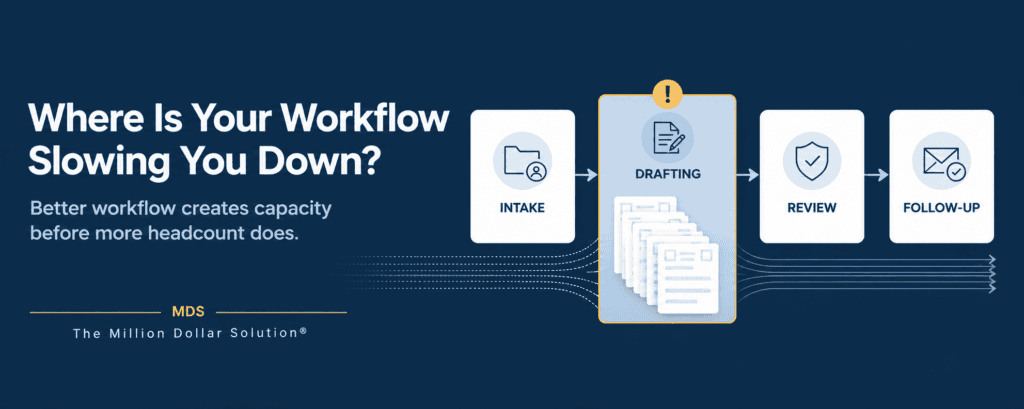
Many small elder law firms begin looking for workflow help when work feels slower than it should. Matters sit waiting for approvals, attorneys become involved in routine coordination, and follow-through depends more on individual effort than a consistent process. Effective workflow and operations consulting for elder law firms helps address how work moves through the practice so client service, efficiency, and profitability can improve together.

Why Firms Seek Workflow Support

Many firms reach a point where everyone is busy, yet progress feels uneven.

Common symptoms include:

  • Matters moving slowly between team members
  • Attorneys becoming the default solution for operational questions
  • Repeated follow-up tasks falling through the cracks
  • Inconsistent intake and case readiness standards
  • Staff working hard without increasing overall capacity

These challenges often develop gradually as a firm grows. Processes that worked when the practice was smaller become difficult to manage when volume increases.

Not All Workflow Help Solves the Same Problem

When evaluating workflow and operations consulting for elder law firms, it helps to distinguish between staffing advice and operational improvement.

Additional hiring may increase capacity. However, law firm workflow optimization focuses on improving how existing work moves through the firm.

Strong consulting support should examine:

  • Process design
  • Role clarity
  • Delegation opportunities
  • Workflow handoffs
  • Technology utilization
  • Accountability systems

If bottlenecks remain unclear, adding staff can simply move inefficiency to another part of the workflow.

Look for a Focus on Workflow Visibility

One of the most valuable outcomes of legal operations consulting is greater visibility.

Firm leaders should be able to answer questions such as:

  • Where does work typically slow down?
  • What defines a matter as ready for the next stage?
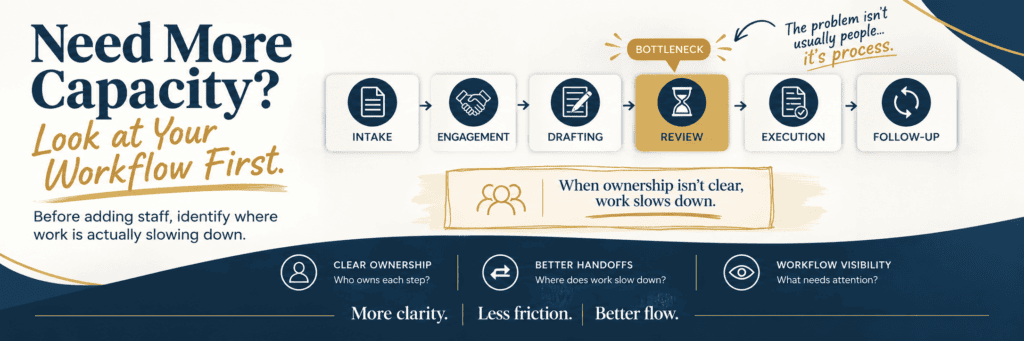
  • Who owns each step?
  • When is attorney involvement truly required?
  • How are deadlines and follow-through tracked?

Without visibility, workflow problems often appear to be staffing problems when they are actually process problems.

Effective Consultants Clarify Ownership

Many operational issues stem from unclear responsibility.

When ownership is not defined:

  • Tasks get duplicated
  • Decisions get escalated unnecessarily
  • Follow-up becomes inconsistent
  • Attorneys spend time coordinating instead of advising

The most effective workflow consultants help firms create clear accountability at every stage of the client journey.

For elder law practice management, ownership clarity is often one of the fastest ways to reduce friction without increasing payroll expense.

Workflow Help Should Improve Handoffs

Client work rarely breaks down within individual tasks.

More often, delays occur between tasks.

Examples include:

  • Intake to engagement
  • Engagement to drafting
  • Drafting to review
  • Review to execution
  • Execution to ongoing follow-up

Strong client work process improvement efforts focus on these transition points. When handoffs become predictable, matters move more consistently and clients experience better communication.

Technology Matters, But Process Matters More

Many firms already own capable software.

The challenge is not always the platform itself. The challenge is ensuring that technology supports the workflow rather than relying on memory and individual habits.

Good consultants evaluate:

  • Whether workflows are clearly defined
  • Whether systems support required actions
  • Whether reporting reveals bottlenecks
  • Whether tasks and deadlines are consistently tracked

Technology becomes valuable when it reinforces process clarity.

Signs You’ve Found the Right Operational Support

As you evaluate options, look for advisors who spend more time discussing workflows than software features.

Strong workflow help typically focuses on:

  • How work flows from intake through completion
  • Where bottlenecks occur
  • How delegation can improve
  • How attorney workload can be reduced appropriately
  • How systems support accountability
  • How efficiency affects profitability

The goal is not simply to become busier. The goal is to create a firm where work moves predictably, clients receive timely service, and growth does not create operational strain.

Closing Thought

Many firms assume they need more capacity when what they actually need is more clarity. The most effective workflow improvements rarely begin with hiring. They begin by understanding how work moves, where it slows down, and what prevents teams from following through consistently.

Firms that learn to improve flow often discover that efficiency, client experience, and profitability are closely connected outcomes of the same operational design decisions.

The Million Dollar Solution® (MDS) provides consulting, coaching, and educational services only. The information, recommendations, tools, templates, and examples contained in these materials are for informational purposes and should not be construed as legal, accounting, tax, financial, or other professional advice. Attorneys, CPAs, and other professionals are responsible for complying with the laws, regulations, ethical requirements, licensing obligations, and professional standards applicable to their own jurisdictions and professions. Users should consult qualified professional advisors regarding their specific circumstances before implementing any recommendation.

What Are the Top Marketing Coaching Services for Growing Small Law Firms?

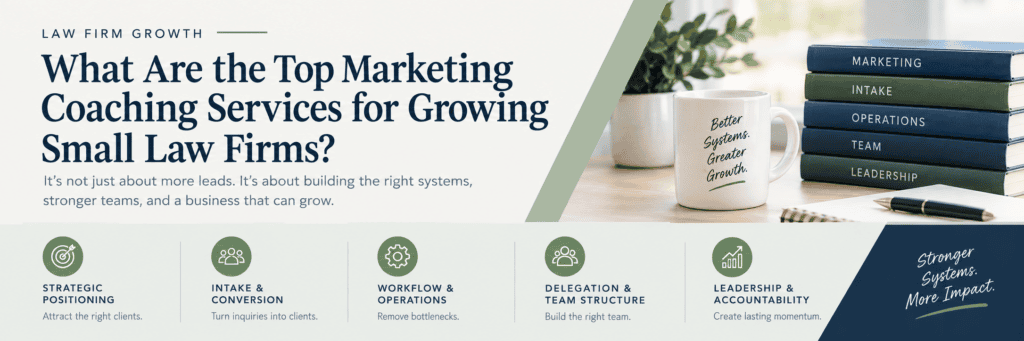
For small estate planning and elder law firms, the most valuable marketing coaching services are rarely focused on marketing alone. The strongest coaching programs help firms align client acquisition with operational capacity, improve intake performance, clarify ideal client positioning, strengthen team accountability, and build workflows that support sustainable growth. Firms that grow successfully tend to view marketing as part of a larger business system rather than a standalone activity.

Marketing Growth Starts Before Marketing

Many law firm owners assume growth challenges originate from a lack of leads. In reality, firms often experience friction because marketing, intake, staffing, and operations are not working together.

A firm may increase inquiries while still struggling with profitability. Consultations get delayed. Attorneys remain heavily involved in administrative work. Team members lack clear ownership. Bottlenecks appear throughout the client journey.

In these situations, more marketing simply introduces more pressure into an already strained system.

The most effective marketing coaching services help firms evaluate growth through a broader operational lens.

1. Strategic Positioning Coaching

Positioning coaching helps firms clarify:

  • Who they serve
  • Which matters are the best fit
  • How they communicate value
  • What makes them distinct

Many successful firms are not attracting more prospects. They are attracting better-aligned prospects.

When marketing targets everyone, intake teams spend valuable time filtering poor-fit inquiries. Clear positioning improves efficiency by helping ideal clients self-select earlier in the process. Firms often discover that growth comes from alignment rather than volume.

2. Intake and Conversion Coaching

Marketing success is heavily influenced by what happens after a prospective client makes contact.

Many firms invest considerable resources into generating inquiries while overlooking intake processes that determine whether those inquiries become clients.

Effective intake coaching focuses on:

  • Response consistency
  • Client communication
  • Qualification processes
  • Consultation readiness
  • Expectation setting

Improving intake frequently produces stronger results than increasing marketing activity because it improves performance within the firm’s existing demand.

3. Workflow and Operations Coaching

One of the most overlooked growth disciplines in small law firms is workflow design.

As firms grow, problems often emerge in the form of:

  • Attorney overload
  • Delayed client communication
  • Rework
  • Missed handoffs
  • Staff confusion

These issues are commonly mistaken for staffing shortages.

In reality, the underlying challenge is often workflow ownership.

Operations-focused coaching helps firms identify where work slows down, where decisions become trapped with attorneys, and where responsibilities lack clarity. When workflows improve, marketing becomes more effective because the organization can support increased demand without creating additional strain.

4. Delegation and Team Structure Coaching

Growing firms eventually reach a point where attorney involvement becomes the primary bottleneck.

Marketing coaching that includes delegation strategy can help leaders determine:

  • Which responsibilities require attorney involvement
  • Which tasks can be delegated
  • How authority should be distributed
  • How accountability should be measured

Without delegation, growth often creates complexity rather than profitability.

A fully booked attorney is not always evidence of success. Sometimes it signals a system that relies too heavily on one person.

5. Leadership and Accountability Coaching

Many operational challenges surface as leadership challenges.

As teams expand, firm owners must shift from doing the work to managing outcomes.

Leadership coaching often focuses on:

  • Performance expectations
  • Communication rhythms
  • Team development
  • Decision-making frameworks
  • Goal alignment

The objective is not simply managing people better. It is creating a structure where work moves efficiently without requiring constant oversight.

Why Busy Does Not Always Mean Profitable

One of the most common myths in professional services is that growth automatically improves profitability.

Many firms become busier while experiencing:

  • Increased staffing costs
  • More interruptions
  • Longer work hours
  • Reduced efficiency
  • Greater complexity

The result is revenue growth without corresponding operational improvement.

This is where high-quality coaching creates value.

Rather than asking how to generate more leads, firms begin asking:

  • Which work should we pursue?
  • Where are our bottlenecks?
  • How much attorney time is consumed by preventable issues?
  • Which processes create unnecessary friction?

These questions frequently unlock more sustainable growth than marketing campaigns alone.

Why Hiring Alone Rarely Solves Growth Problems

When work begins piling up, hiring feels like the logical next step.

However, hiring into unclear systems often amplifies existing challenges.

New employees inherit:

  • Undefined responsibilities
  • Inconsistent processes
  • Confusing handoffs
  • Unclear expectations

As a result, firms gain headcount without gaining capacity.

Strong coaching helps firms improve workflow clarity before expanding the team. This ensures new hires support growth instead of increasing complexity.

What Growing Firms Should Evaluate When Selecting Coaching Services

The strongest coaching relationships typically address multiple business components rather than focusing exclusively on marketing metrics.

Consider whether a coaching provider helps with:

  • Positioning and ideal client clarity
  • Intake effectiveness
  • Workflow efficiency
  • Team structure
  • Delegation systems
  • Leadership development
  • Operational scalability

Marketing performs best when these areas support one another.

Final Thoughts

For small estate planning and elder law firms, marketing coaching is most effective when it extends beyond marketing itself. Sustainable growth usually comes from the intersection of positioning, intake, workflow design, delegation, and leadership development.

The firms that scale most effectively are not necessarily the firms generating the most activity. They are often the firms that create the clearest systems, remove bottlenecks, and ensure operational capacity keeps pace with growth. Marketing then becomes a multiplier of an already healthy business rather than a solution for operational strain.

Best Talent Management Consulting for Small Law Firms

Small estate planning and elder law firms rarely struggle because people are unwilling to work hard. More often, growth becomes difficult because talent, workflows, technology, and role clarity have not evolved together. The best talent management consulting for small law firms helps firms align people with processes, define accountability, improve delegation, and create a structure that scales without increasing operational chaos.

For firms using Actionstep, talent management should extend beyond hiring and retention. It should address how work moves through the firm, who owns each step, and whether the system supports consistent execution. As many growing firms discover, busy teams are not automatically productive teams, and hiring alone does not solve workflow challenges.

What Talent Management Consulting Means for a Small Law Firm

In larger organizations, talent management often focuses on recruiting, performance systems, leadership development, and succession planning.

For owner-led estate planning and elder law firms, the challenge is usually more practical:

  • Attorneys remain involved in too many operational decisions
  • Staff are busy but responsibilities overlap
  • Important work depends on individual memory
  • New hires require constant supervision
  • Workflow slows as case volume increases

Effective talent management consulting addresses these realities by improving how people, processes, and systems work together.

Rather than asking, “Who should we hire next?”, firms should often begin with a different question:

“How should work move through the organization?”

That distinction has major implications for profitability and scalability.

Why Hiring Alone Often Fails to Solve Growth Problems

Many firms reach a point where intake slows, drafting takes longer, communication becomes inconsistent, and attorneys feel overwhelmed.

The natural response is often to add staff.

Sometimes additional capacity is necessary. However, staffing and workflow improvement solve different problems. Staffing increases capacity. Workflow improvement increases clarity, efficiency, accountability, and profitability.

When firms hire into an unclear environment:

  • Responsibilities become blurred
  • Escalations increase
  • Training becomes inconsistent
  • Existing bottlenecks remain

The result is often more payroll without meaningful operational improvement.

For growing law firms, talent strategy works best when structure comes before expansion.

Evaluating Talent Management Services for Small Law Firms

Not every consulting provider approaches talent management the same way.

When comparing talent management services, consider five criteria.

1. Workflow Alignment

The strongest consultants connect staffing decisions to workflow design.

They evaluate:

  • How matters enter the firm
  • How work is assigned
  • How responsibilities transfer between team members
  • Where delays consistently occur

Without understanding workflow, talent recommendations are often incomplete.

2. Role Clarity

Many operational issues stem from unclear ownership.

Strong consulting engagements help firms define:

  • Decision authority
  • Communication responsibilities
  • Escalation paths
  • Expected outcomes for each role

When ownership is clear, delegation becomes more effective.

3. Technology Integration

Many firms already invest heavily in systems like Actionstep.

Yet technology frequently becomes a repository rather than an operational guide.

Consultants should evaluate whether workflows are actually being supported by the platform and whether team members are using technology consistently.

Technology should reinforce behavior, not merely document activity.

4. Leadership Development

Owner-led firms often depend heavily on attorneys to solve daily operational issues.

A strong legal talent strategy develops managers and team leaders who can:

  • Resolve issues independently
  • Make informed decisions
  • Support team accountability
  • Reduce reliance on attorney intervention

This creates leverage throughout the organization.

5. Long-Term Scalability

The best consulting engagements build systems that continue functioning as the firm grows.

Scalable firms rely less on heroic effort and more on predictable execution.

Talent Management Consulting vs. Traditional HR Consulting

The distinction matters.

Traditional HR consulting often focuses on:

  • Recruiting
  • Employee relations
  • Compliance support
  • Compensation planning

Talent management consulting typically addresses broader operational questions:

  • Are the right people in the right roles?
  • Is work distributed appropriately?
  • Can responsibilities be delegated effectively?
  • Are leaders creating accountability?
  • Can the firm scale without creating bottlenecks?

For estate planning and elder law firms, these questions frequently have a greater impact on profitability than recruiting alone.

Special Considerations for Firms Using Actionstep

Actionstep provides significant process management capabilities, but software alone does not create operational consistency.

Many firms experience challenges because:

  • Processes exist but are not standardized
  • Workflows are incomplete
  • Staff interpret procedures differently
  • Attorneys remain heavily involved in operational decisions

Talent management consulting can help align:

  • Role expectations
  • Workflow ownership
  • Task accountability
  • System utilization

When people and technology work together, firms often experience smoother handoffs, more predictable timelines, and reduced administrative burden.

Signs Your Firm May Benefit from Talent Management Consulting

Several indicators appear repeatedly among growing firms:

Attorney Dependency

If most operational questions ultimately return to an attorney, the system is likely creating unnecessary escalation.

Recurring Bottlenecks

Intake, drafting readiness, approvals, and follow-up frequently become workflow constraints when ownership is unclear.

New Hires Struggle to Integrate

When onboarding requires excessive supervision, process documentation and role expectations may be insufficient.

Workload Feels Heavier Than Volume Suggests

Many firms are not overwhelmed by volume itself.

They are overwhelmed by rework, interruptions, and unclear processes.

Growth Creates More Stress Than Opportunity

When every new matter increases organizational strain, operational systems may need attention before additional hiring.

Questions to Ask Before Selecting a Consulting Partner

Before choosing a provider, firm owners should ask:

  • Do they evaluate workflows alongside staffing?
  • Do they understand owner-led professional service firms?
  • Can they connect operational improvements to profitability?
  • Do they address delegation and accountability?
  • Do they understand legal practice management systems such as Actionstep?
  • Will they help clarify roles rather than simply recommend additional hiring?

The answers often reveal whether the engagement is focused on sustainable growth or short-term staffing solutions.

The Most Important Talent Strategy Question

Many firms begin their search asking who they should hire next.

The more valuable question is often:

“Is the current team operating within a system designed for growth?”

If workflows remain unclear, adding talent frequently adds complexity rather than capacity. Conversely, when roles, systems, ownership, and processes work together, talent can perform at a much higher level.

This is why effective talent management consulting for small law firms extends beyond recruiting. It focuses on creating an operating environment where people can succeed consistently, delegation becomes practical, and growth feels deliberate rather than reactive. Operational clarity is often the difference between a firm that stays busy and a firm that becomes sustainably profitable.

The Million Dollar Solution® (MDS) provides consulting, coaching, and educational services only. The information, recommendations, tools, templates, and examples contained in these materials are for informational purposes and should not be construed as legal, accounting, tax, financial, or other professional advice. Attorneys, CPAs, and other professionals are responsible for complying with the laws, regulations, ethical requirements, licensing obligations, and professional standards applicable to their own jurisdictions and professions. Users should consult qualified professional advisors regarding their specific circumstances before implementing any recommendation.

How to Choose the Right-Sized Law Firm Consulting

Many small law firms begin looking for consulting support when growth feels harder than it should. The challenge is not finding help. It is finding the right level of help for the firm’s current stage, operational reality, and priorities.

The most effective law firm management consulting engagements are focused, practical, and aligned with the firm’s actual constraints. Firms that choose thoughtfully often improve profitability, workflow efficiency, staffing alignment, and leadership capacity without investing in services they do not yet need.

Why the Wrong Consulting Fit Creates New Problems

Law firm owners often assume they need a comprehensive transformation when they are really facing one or two operational bottlenecks.

A firm experiencing delayed matter completion may immediately assume it needs more staff. Another may believe marketing is the issue because revenue has plateaued.

In reality, the underlying challenge may be:

  • Unclear workflow ownership
  • Inconsistent intake processes
  • Attorney bottlenecks
  • Poor delegation
  • Lack of standardized systems
  • Leadership capacity constraints

A consulting engagement that is too broad can overwhelm a small firm. One that is too narrow can miss a critical root cause.

The goal is not to buy the biggest solution. The goal is to solve the most important problem.

Start With Your Firm’s Current Stage

Different growth stages require different forms of strategic practice management support.

Early Growth Firms

Firms in the early growth stage often experience:

  • Increasing referral volume
  • Attorney overload
  • Informal workflows
  • Reliance on a few key employees

At this stage, consulting often focuses on:

  • Workflow design
  • Delegation structure
  • Intake consistency
  • Operational clarity

The objective is creating stability before adding complexity.

Growing Firms

As firms grow, coordination becomes more difficult.

Common symptoms include:

  • Work sitting between departments
  • Communication gaps
  • Uneven client experiences
  • Growing management demands

Small law firm consulting at this stage often centers on:

  • Team accountability
  • Process documentation
  • Leadership development
  • Capacity planning
  • Performance visibility

Growth requires more than additional work coming in. It requires systems capable of handling that work consistently.

Mature Small Firms

More established firms frequently face a different challenge.

They are busy. Revenue may be strong. Yet owners remain heavily involved in daily operations.

Consulting support often focuses on:

  • Strategic planning
  • Succession preparation
  • Organizational design
  • Profitability analysis
  • Long-term sustainability

The objective shifts from growth to scalability.

Evaluate Problems Before Evaluating Consultants

Many firms begin by researching consultants.

A better first step is researching the problem.

For example:

Workflow Problems

Signs include:

  • Frequent status questions
  • Repeated handoffs
  • Missed deadlines
  • Excessive attorney involvement

The consulting focus should emphasize legal practice management systems, workflow design, and process improvement.

Staffing Problems

Signs include:

  • Constant hiring
  • Turnover concerns
  • Role confusion
  • Training inconsistency

The consulting focus should emphasize role clarity, organizational structure, hiring alignment, and employee development.

Profitability Problems

Signs include:

  • Growing revenue but stagnant profit
  • Rising overhead
  • Staff utilization concerns
  • Capacity limitations

The consulting focus should emphasize operational efficiency, alignment, and strategic decision-making.

Hiring is often assumed to be the solution. In many firms, staffing challenges are symptoms of larger workflow issues rather than the root cause. This is particularly true when bottlenecks and ownership gaps are already present.

Questions to Ask Before Hiring a Consultant

A consultant’s expertise matters, but so does their fit.

Before engaging a law firm strategy consultant, consider:

Do They Understand Small Law Firms?

Advice that works for a 100-attorney firm may be unrealistic for a small estate planning or elder law practice.

Recommendations should fit:

  • Team size
  • Resources
  • Management capacity
  • Growth objectives

Are They Focused on Operations or Just Growth?

Growth without operational readiness creates strain.

Consulting should address:

  • Capacity
  • Workflow
  • Client experience
  • Team effectiveness

Not simply lead generation.

Can They Identify Root Causes?

Strong consultants investigate system issues before recommending solutions.

If every challenge leads directly to:

  • More hiring
  • More technology
  • More meetings

The analysis may be incomplete.

Do Their Recommendations Feel Practical?

Effective consulting should create clarity.

You should be able to understand:

  • What needs attention
  • Why it matters
  • What success looks like

Complexity is not a measure of expertise.

The Most Valuable Consulting Delivers Clarity

The highest-value consulting engagements often produce something simple:

Better decisions.

When firms understand:

  • Where work slows down
  • Who owns each responsibility
  • Which activities create profitability
  • Which activities create friction

Leaders can make more confident decisions regarding staffing, systems, growth, and client service.

This clarity frequently creates more impact than adding another software platform or expanding headcount.

How to Avoid Overbuying Services

Many firm owners worry about choosing too little support.

A more common issue is choosing too much.

Consulting is most effective when it matches the firm’s immediate needs while creating a foundation for future improvement.

Before signing any engagement, ask:

  • What specific problem are we solving?
  • How will we measure improvement?
  • What capability should our team gain?
  • What happens if we do nothing?

The clearer these answers become, the easier the decision usually gets.

Final Thought

The best law firm management consulting engagements are not defined by their size. They are defined by their fit.

A small estate planning or elder law firm rarely benefits from adopting every possible improvement at once. Sustainable progress usually comes from identifying the constraint that matters most, improving it intentionally, and building from there.

Firms that understand this distinction tend to grow with greater predictability, stronger margins, and less operational stress. That approach is often what separates being consistently busy from becoming consistently profitable.

The Million Dollar Solution® (MDS) provides consulting, coaching, and educational services only. The information, recommendations, tools, templates, and examples contained in these materials are for informational purposes and should not be construed as legal, accounting, tax, financial, or other professional advice. Attorneys, CPAs, and other professionals are responsible for complying with the laws, regulations, ethical requirements, licensing obligations, and professional standards applicable to their own jurisdictions and professions. Users should consult qualified professional advisors regarding their specific circumstances before implementing any recommendation.
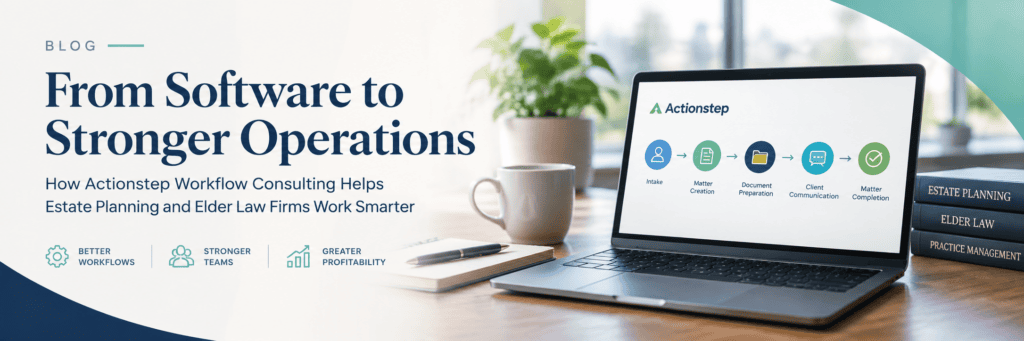
Actionstep Workflow Consulting for Elder Law Firms

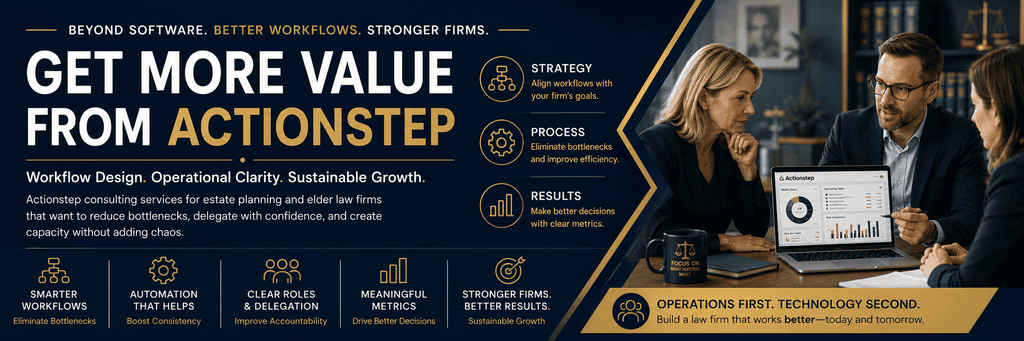
Small estate planning and elder law firms often invest in technology with the expectation that efficiency will follow. In practice, software alone rarely solves operational challenges. The firms that gain the most value from platforms like Actionstep are the ones that align technology with workflow design, staffing structure, delegation, and accountability.

Actionstep workflow consulting is ultimately about helping a law firm use its practice management system as an operational framework rather than simply a place to store information. When workflows, roles, and systems work together, firms gain greater consistency, stronger capacity, and improved profitability. This aligns closely with broader principles of law firm practice management consulting, particularly for owner-led firms seeking sustainable growth.

Why Workflow Problems Persist Even After Implementing Practice Management Software

Many firms purchase new technology because they are experiencing operational strain:

  • Matters feel difficult to track
  • Staff members constantly ask questions about next steps
  • Attorneys remain involved in routine administrative decisions
  • Deadlines require excessive oversight
  • Growth creates more complexity instead of more efficiency

The software itself is rarely the problem.

More often, the issue is that workflows evolved informally over time. Processes live inside people’s heads instead of inside the system. New employees learn through repetition rather than structured procedures. As a result, firms stay busy without becoming more efficient.

What Actionstep Workflow Consulting Actually Addresses

Effective workflow and operations consulting focuses on how work moves through the firm from beginning to end.

Rather than viewing Actionstep as a collection of features, consulting evaluates the operational path behind every matter:

  • Intake
  • Matter creation
  • Document preparation
  • Client communication
  • Task ownership
  • Internal approvals
  • Follow-up activities
  • Matter completion

The objective is not simply automation. The objective is creating predictable operational flow.

When properly configured, practice management systems can:

  • Assign responsibilities automatically
  • Trigger appropriate next steps
  • Improve visibility into workload
  • Reduce unnecessary attorney involvement
  • Strengthen accountability across the team

This allows the system to actively guide work instead of simply recording activity.

Busy Does Not Always Mean Profitable

One of the most common misconceptions among small law firms is that a full calendar automatically signals operational success.

Many estate planning firms remain extremely busy while experiencing:

  • Uneven workload distribution
  • Frequent interruptions
  • Repetitive work
  • Excessive partner involvement
  • Staff confusion around ownership

A practice can operate at full capacity while still losing efficiency every day.

Strategic practice management focuses on removing friction from the system. The goal is not to make people work harder. It is to ensure that work moves smoothly through the firm. When processes become more consistent, profitability often improves because less time is lost to rework, confusion, and bottlenecks.

Why Hiring Is Not Always the Right Next Step

When work begins backing up, many firms assume they need additional staff.

Sometimes they do.

Often, however, the underlying issue is workflow design.

Adding employees to unclear processes can increase complexity rather than reduce it. New team members require guidance, training, and oversight. If ownership and procedures remain undefined, the firm simply creates more moving parts within an already strained system.

Before adding headcount, firms should evaluate:

  • Where matters slow down
  • Which decisions unnecessarily escalate to attorneys
  • Where handoffs become inconsistent
  • Which tasks lack clear ownership

These operational signals often reveal opportunities for improvement that hiring alone cannot solve.

The Relationship Between Workflow Optimization and Talent Management

Technology and staffing are deeply connected.

Many firms assume employee performance challenges originate with the individual. In reality, unclear systems frequently create inconsistent outcomes even among capable team members.

Talent management consulting becomes more effective when workflows are clearly defined because employees understand:

  • What they own
  • When tasks should occur
  • How work moves between roles
  • What success looks like

When systems provide clarity, employees spend less time seeking direction and more time executing meaningful work.

This creates a stronger workplace experience while reducing management burden on attorneys and firm leaders.

Actionstep as an Operational Platform

For owner-led elder law firms, Actionstep works best when it reflects how the firm actually operates.

A well-designed environment can help:

Standardize Client Experience

Clients receive a more consistent experience because critical steps occur regardless of who is handling the matter.

Improve Delegation

Tasks move to the appropriate role instead of automatically routing back to attorneys.

Increase Visibility

Leadership gains clearer insight into workload, capacity, and bottlenecks.

Support Growth

The firm becomes less dependent on individual memory and more dependent on repeatable systems.

When these elements are in place, technology strengthens operations rather than adding another layer of complexity.

Why Elder Law Firms Benefit From Strategic Practice Management

Elder law and estate planning practices face unique operational demands.

Clients often need reassurance, education, follow-up communication, and long-term engagement. Matter lifecycles can extend beyond the initial representation. Emotional urgency frequently interrupts planned work.

Without intentional workflows, complexity accumulates quickly.

Strategic practice management helps firms create the structure necessary to deliver excellent service without relying on constant attorney intervention. It creates systems that support both the client experience and operational sustainability.

A Better Question Than “How Can We Work Faster?”

The most effective firms rarely focus on speed alone.

Instead, they ask:

“How can work move through the firm more consistently?”

That shift changes everything.

Workflow consulting, practice management refinement, and thoughtful technology configuration help firms create capacity by removing friction rather than increasing effort. For many small elder law and estate planning firms, sustainable growth begins not with working harder, but with designing operations that support the work they are already doing.

As firms mature, operational complexity is not a sign of failure. It is often a sign that systems need to evolve alongside the practice. Thoughtful workflow design allows technology, people, and processes to work together more effectively, creating a stronger foundation for the years ahead.

The Million Dollar Solution® (MDS) provides consulting, coaching, and educational services only. The information, recommendations, tools, templates, and examples contained in these materials are for informational purposes and should not be construed as legal, accounting, tax, financial, or other professional advice. Attorneys, CPAs, and other professionals are responsible for complying with the laws, regulations, ethical requirements, licensing obligations, and professional standards applicable to their own jurisdictions and professions. Users should consult qualified professional advisors regarding their specific circumstances before implementing any recommendation.

Leadership Development for Small Law Firms: Building a Firm That Can Grow Without Constant Owner Oversight

Many owner-led estate planning and elder law firms reach a point where growth creates new operational challenges. Strong attorneys often become firm leaders by necessity, yet leadership requires a different set of skills than legal work. Leadership development for small law firms helps owners build management capacity, improve team performance, and create the operational structure necessary for sustainable growth.

As firms become busier, the issue is rarely a lack of effort. More often, the challenge is that leadership systems have not evolved at the same pace as the practice. Strong leadership creates clarity, accountability, delegation, and decision-making structures that allow the firm to grow without increasing owner dependence.


Why Leadership Becomes a Growth Constraint

Many small law firms are built around the owner’s expertise.

In the early years, that model works well. The owner reviews files, solves problems, answers questions, handles difficult client situations, and keeps operations moving.

Over time, however, growth changes the demands placed on leadership.

The owner becomes:

  • The decision-maker for every issue
  • The escalation point for every problem
  • The trainer for every employee
  • The reviewer for every workflow
  • The bottleneck for every major project

At that stage, busyness may increase while profitability stalls.

This is one reason busy does not always mean productive. When leadership remains centralized, firms often experience slower execution, inconsistent delegation, and growing operational friction.


Leadership Development Is Operational Development

Many firms view leadership training as a professional development initiative.

In reality, leadership development is often an operational improvement strategy.

Strong leaders create systems that reduce unnecessary dependency. They establish expectations, improve communication, and create workflows that function without constant intervention.

The most effective law firm leadership training programs focus on practical skills such as:

  • Delegation
  • Accountability
  • Communication
  • Team development
  • Performance coaching
  • Decision-making consistency
  • Process ownership

These capabilities influence nearly every operational outcome inside a firm.

When leadership improves, workflow often improves as well.


The Hidden Cost of Weak Leadership Structures

Leadership gaps rarely appear as obvious management failures.

Instead, they show up as persistent operational symptoms:

Repeated Questions

Team members regularly seek approval for routine decisions.

Workflow Delays

Work waits for the owner instead of moving through defined processes.

Inconsistent Client Experiences

Different employees handle situations differently because standards are unclear.

Employee Frustration

High performers often struggle when expectations, responsibilities, or authority levels are not clearly defined.

Hiring Dependency

New hires require extensive oversight because managers have not been equipped to coach and develop them effectively.

Many firms respond by hiring additional staff.

Unfortunately, adding people rarely solves leadership issues. Additional team members can actually increase complexity when management systems remain underdeveloped.

Hiring fills capacity gaps.

Leadership development addresses structural gaps.


Developing Managers Instead of Creating More Dependence

One of the most important transitions inside a growing law firm is shifting from individual contributors to effective managers.

This transition is often challenging because strong legal or administrative performance does not automatically translate into leadership effectiveness.

Attorney leadership development should help emerging leaders learn how to:

  • Set expectations clearly
  • Conduct productive conversations
  • Deliver constructive feedback
  • Resolve conflicts
  • Develop team members
  • Support accountability without micromanagement

The goal is not simply creating supervisors.

The goal is creating leaders who help others perform well without creating additional layers of bottlenecks.


Leadership Coaching Creates Clarity

Many owners know leadership needs improvement but struggle to identify where breakdowns occur.

Leadership coaching helps uncover patterns that are often difficult to see from inside the organization.

For example:

A workflow issue may appear to be a process problem.

In reality, the underlying issue may be unclear ownership.

A hiring challenge may seem like a staffing problem.

The real issue may be inconsistent management expectations.

A productivity concern may appear to be an employee issue.

The root cause may be inadequate delegation or communication systems.

Legal coaching programs often create value because they help firms identify the operational factors influencing performance, rather than simply treating symptoms.


Building a Leadership Culture Instead of Heroics

Owner-led firms often succeed because a few key individuals consistently step in to solve problems.

While this approach can work temporarily, it becomes increasingly difficult to sustain.

Healthy firms rely less on heroics and more on clarity.

Strong leadership cultures typically emphasize:

Defined Responsibilities

Employees understand ownership and decision authority.

Consistent Communication

Information flows predictably instead of reactively.

Coaching and Development

Managers help team members grow before problems become crises.

Process Accountability

Work moves through systems rather than individual memory.

Continuous Improvement

Teams regularly identify and address inefficiencies.

These habits create resilience and scalability.

When leadership becomes structural rather than personal, operations become more predictable.


Leadership Development Supports Long-Term Firm Growth

Many conversations about growth focus on marketing, hiring, and revenue.

Those areas matter.

Yet operational capacity ultimately determines how much growth a firm can handle.

Leadership development for small law firms supports growth by helping firms:

  • Reduce owner dependency
  • Improve delegation effectiveness
  • Develop future leaders
  • Strengthen team accountability
  • Improve workflow consistency
  • Support retention and engagement
  • Create capacity without immediately adding headcount

In many cases, the next stage of growth is less about doing more work and more about leading differently.


A Thoughtful Closing Reflection

Most operational challenges do not begin as workflow problems. They often begin as leadership problems that gradually influence communication, delegation, decision-making, and accountability.

As firms mature, leadership becomes part of the operating system itself. The firms that scale most effectively are often those that intentionally develop managers, build clear expectations, and create structures that allow good work to flow without constant oversight.

Leadership development is not simply about becoming a better manager. It is about creating an organization that can perform consistently, sustainably, and profitably as it grows.

The Million Dollar Solution® (MDS) provides consulting, coaching, and educational services only. The information, recommendations, tools, templates, and examples contained in these materials are for informational purposes and should not be construed as legal, accounting, tax, financial, or other professional advice. Attorneys, CPAs, and other professionals are responsible for complying with the laws, regulations, ethical requirements, licensing obligations, and professional standards applicable to their own jurisdictions and professions. Users should consult qualified professional advisors regarding their specific circumstances before implementing any recommendation.
How Intake Coaching Helps Elder Law Conversion

In many elder law firms, conversion challenges begin long before the attorney enters the room. The quality of the intake conversation often determines whether a prospective client arrives prepared, confident, and ready to move forward. When intake teams receive coaching and attorneys develop stronger consultation skills, the entire client journey becomes more consistent, more efficient, and more effective.

For small firms, improving conversion is rarely about applying more pressure or generating more leads. More often, it involves creating a client intake process that builds trust, clarifies expectations, and reduces uncertainty before the consultation begins.

Why Intake Has Such a Large Impact on Conversion

Many firms still treat intake as an administrative function. In reality, intake is the first stage of the consultation.

Prospective clients often contact an elder law firm during periods of stress, confusion, urgency, or family transition. Before they decide whether to hire an attorney, they are evaluating something much simpler:

Can this firm guide me through what comes next?

Strong intake processes answer that question early. Poor intake processes leave prospects uncertain, forcing attorneys to spend valuable consultation time rebuilding trust and clarity.

Common symptoms of weak intake include:

  • Unclear next steps
  • Missing documents
  • Decision-makers not present
  • Uncertain expectations about fees, timing, or outcomes
  • Consultations that feel reactive instead of strategic

When these issues appear during the consultation, conversion becomes more difficult regardless of the attorney’s expertise.

What Sales Coaching for Elder Law Firms Actually Improves

The phrase “sales coaching” can create the wrong impression in legal services.

Effective sales coaching for elder law firms is not about persuasion tactics. It is about improving conversations that help families gain clarity, confidence, and readiness to make decisions.

Coaching typically helps attorneys and intake teams develop stronger skills in four areas:

1. Asking Better Questions

High-performing intake teams avoid jumping directly to scheduling.

Instead, they uncover:

  • Why the prospect is reaching out now
  • What urgency exists
  • Who will participate in the decision
  • Whether the client is prepared for the consultation

This information allows the firm to tailor the consultation appropriately while preventing misalignment later in the process.

2. Identifying Hidden Friction

Families frequently say they need to “think about it.”

The underlying issue is often not lack of interest.

It may be:

  • Fear of making the wrong decision
  • Concern about family dynamics
  • Financial uncertainty
  • Information overload
  • Anxiety around future care planning

Coaching helps attorneys recognize and address these concerns constructively rather than treating them as objections.

3. Creating Consistent Experiences

Conversion often improves when firms reduce variability.

Without coaching, each intake coordinator and attorney may communicate differently. Expectations change. Messaging changes. Follow-up varies.

A coached team follows a consistent process that delivers the same level of clarity regardless of who answers the phone or conducts the consultation. Consistency builds confidence for both clients and staff.

4. Guiding Instead of Selling

Families facing elder law decisions rarely need more pressure.

They need more certainty.

The most effective consultations create a logical, emotional, ethical, and practical path forward. Rather than “closing,” attorneys help clients understand options, reduce uncertainty, and confidently take the next step.

Why Better Conversion Is Really an Operations Issue

Many firms assume low conversion is a marketing problem.

Often, it is a workflow problem.

When intake lacks structure:

  • Attorneys spend time gathering basic information
  • Staff conduct redundant follow-up
  • Consultations start unprepared
  • File handoffs become inconsistent
  • Bottlenecks develop throughout the client journey

Improving conversion frequently begins by improving the operational systems surrounding the consultation.

This is one reason busy firms do not always become more profitable.

Activity can increase while efficiency declines.

More inquiries do not automatically create more revenue if the firm’s intake process allows confusion to enter the workflow from the beginning.

The Three Intake Questions That Matter Most

Strong intake coaching often centers on three foundational questions.

Why Now?

Understanding urgency reveals what is driving the inquiry and helps prioritize the consultation appropriately.

Who Decides?

Many stalled matters occur because key decision-makers are absent from the consultation. Identifying decision authority early prevents delays and repeated conversations.

Are They Ready?

Readiness includes documents, expectations, emotional preparedness, and understanding of next steps. Better preparation creates more productive consultations.

Together, these questions create a more predictable intake process and a smoother client experience.

Why Hiring More Staff Usually Doesn’t Solve Conversion Problems

When conversion rates decline, many firms consider adding personnel.

But staffing rarely fixes unclear systems.

New hires entering an inconsistent intake process often inherit the same problems:

  • Unclear responsibilities
  • Different communication styles
  • Inconsistent qualification standards
  • Variable client preparation

The result is greater complexity without greater efficiency. Improving the process first usually creates more sustainable growth than simply increasing headcount.

Building a Conversion-Friendly Intake Process

The strongest intake systems share several characteristics:

  • Defined intake standards
  • Clear question sequences
  • Consistent follow-up procedures
  • Client preparation checklists
  • Strong attorney handoff processes
  • Ongoing coaching and refinement

These systems reduce friction for clients while helping attorneys focus on higher-value conversations.

Final Thoughts

The firms that convert more consultations are not necessarily the firms with the most leads. Often, they are the firms that create the most clarity before the consultation begins.

When intake coaching improves questioning, preparation, communication, and consistency, conversion becomes a natural outcome of a better process. The result is not only stronger client acquisition, but also smoother workflows, improved staff alignment, and more sustainable small law firm growth.

7 Talent Challenges for Elder Law Firms in 2026

Growing estate planning and elder law firms are facing a talent problem, but not always the one they think. In many cases, the challenge is not finding people. It is creating an operating environment where the right people can succeed, stay productive, and contribute to firm growth.

As firms expand, talent management becomes increasingly tied to workflow design, leadership clarity, delegation, and operational structure. Before engaging in talent management consulting or adding more staff, firm leaders often benefit from understanding which underlying challenges are creating strain in the first place.

Many firms assume hiring will solve operational pressure. In reality, unresolved workflow issues, unclear ownership, and inconsistent systems frequently create the very staffing challenges firms are trying to fix.

Why Talent Challenges Are Different in Elder Law and Estate Planning Firms

Unlike many professional services businesses, elder law firms and estate planning firms manage highly personal matters, emotionally complex client situations, extensive documentation, and long client relationships.

As firms grow, increasing demand often exposes weaknesses that were manageable when the firm was smaller.

Work that once moved informally through the organization begins to stall.

Communication gaps become more visible.

Attorneys become involved in too many operational decisions.

The result is a firm that remains busy without necessarily becoming more profitable.

1. Unclear Role Ownership

One of the most common talent challenges in growing law firms is uncertainty around who owns what.

Team members may perform similar tasks, share responsibilities, or continually defer decisions upward. When ownership is vague:

  • Work slows down
  • Accountability decreases
  • Attorneys become bottlenecks
  • Employee frustration increases

Before adding staff, firms should examine where decisions repeatedly escalate and where ownership becomes unclear.

Many hiring problems are actually role clarity problems.

2. Hiring Before Defining the Need

Growing firms often feel pressure to hire quickly.

The problem is that urgency can lead firms to recruit for titles rather than outcomes.

A common pattern looks like this:

“We need another paralegal.”

“We need another coordinator.”

“We need another assistant.”

But the more important question is:

What responsibility needs ownership?

When firms define the work first, hiring decisions become significantly more effective.

3. Attorney Dependency

In many small law firms, attorneys become the default solution for every problem.

Questions rise upward.

Approvals pile up.

Staff wait for direction.

Clients expect attorney involvement for routine matters.

Over time, this creates a capacity ceiling.

The challenge is not employee capability. It is often a lack of defined authority, documented processes, and confidence around decision-making boundaries.

As workload grows, attorney dependency becomes one of the biggest barriers to scalability.

4. Inconsistent Onboarding and Training

Many firms focus tremendous effort on recruiting and relatively little energy on integration.

Without a clear onboarding process, new employees often learn through observation and trial-and-error.

This creates:

  • Longer ramp-up periods
  • Uneven client experiences
  • Increased management demands
  • Greater employee stress

Strong legal talent management requires more than successful recruitment.

It requires repeatable methods for helping people understand expectations, workflows, systems, and performance standards.

5. Retention Problems Caused by Misalignment

Employee turnover is often viewed as an individual issue.

Frequently, it is a systems issue.

Employees are more likely to leave when:

  • The role differs from what was expected
  • Responsibilities are unclear
  • Career growth is uncertain
  • Communication feels inconsistent
  • Strengths are not aligned with responsibilities

Retention improves when role expectations, workflow design, and performance expectations work together.

The goal is not simply keeping employees longer.

The goal is creating an environment where employees can perform effectively while supporting firm objectives.

6. Leadership Bottlenecks

As firms grow, leadership responsibilities become more complex.

Many owners continue operating as:

  • Lead attorney
  • HR manager
  • Operations manager
  • Trainer
  • Problem solver

Simultaneously.

At some point, this becomes unsustainable.

A leadership bottleneck develops when too many decisions depend on one individual.

The firm remains productive, but growth slows because leadership capacity cannot expand at the same rate as client demand.

This challenge frequently appears before staffing capacity becomes the true issue.

7. Confusing Activity with Progress

One of the most costly talent challenges in growing law firms is mistaking busyness for effectiveness.

A fully occupied team can still experience:

  • Delayed turnaround times
  • Missed follow-ups
  • Client communication gaps
  • Rework
  • Workflow congestion

Being busy is not the same as operating efficiently.

Many firms discover that adding staff without addressing workflow issues simply creates more people navigating the same bottlenecks.

Before investing in outside talent management consulting, firms often benefit from asking:

  • Where does work slow down?
  • Where does ownership become unclear?
  • What repeatedly requires attorney intervention?
  • Which processes depend on specific individuals?

The answers frequently reveal opportunities that have little to do with headcount.

What Firm Leaders Should Address Before Seeking Talent Management Consulting

Talent management consulting can be extremely valuable.

However, firms generally gain the greatest benefit when they first understand the operational challenges influencing staffing performance.

A useful starting point is evaluating:

  • Role ownership
  • Workflow consistency
  • Delegation structures
  • Onboarding processes
  • Leadership capacity
  • Decision-making authority

When those foundations are clear, hiring becomes more strategic, retention improves, and growth becomes easier to sustain.

Final Thought

The most effective elder law firms rarely solve talent challenges through hiring alone.

They understand that people operate within systems.

When workflows are unclear, ownership is inconsistent, and leadership becomes overloaded, even excellent employees struggle.

When operational foundations are strengthened, staffing decisions become easier, employee performance improves, and growth occurs with far less friction.

Often, the most important talent management question is not “Who should we hire next?” but “What in our operating system needs attention first?”

How to Choose Actionstep Consulting for Small Firms

Many small law firms invest in Actionstep expecting immediate efficiency gains, only to discover that software alone rarely solves operational bottlenecks. The firms that get the most value from Actionstep consulting services are usually not looking for technical setup alone. They are looking for a way to improve how work moves through the firm, how responsibilities are delegated, and how capacity is created without increasing chaos.

For estate planning and elder law firms, the right consulting engagement should focus as much on workflow design and operational clarity as it does on technology configuration. Firms often remain overloaded not because they lack software, but because the software has not been aligned with how the firm actually operates.

Why Small Firms Seek Actionstep Consulting

As firms grow, processes often develop informally.

A team member creates a workaround.

A paralegal develops a personal tracking system.

An attorney becomes the default problem solver.

Over time, these adjustments create hidden complexity.

Actionstep is capable of supporting structured workflows, but successful implementation requires firms to define:

  • How matters should move through the firm
  • Who owns each stage
  • Which tasks require attorney involvement
  • Which tasks can be automated or delegated
  • What metrics indicate workflow health

Without these answers, even a well-configured system can become little more than a digital filing cabinet.

Start With Workflow, Not Technology

One of the most common mistakes firms make is treating Actionstep as an IT project.

In reality, it is an operations project.

Before evaluating Actionstep consulting services, firms should understand:

Where Work Gets Stuck

Look for recurring delays such as:

  • Intake bottlenecks
  • Draft review queues
  • Missing document follow-up
  • Attorney approval dependencies
  • Matter closing delays

Technology can help solve these problems, but only after they have been clearly identified.

Who Owns Each Process

A surprising amount of inefficiency comes from unclear ownership rather than inadequate staffing.

When responsibilities overlap, work stalls.

When ownership is clear, delegation improves, accountability increases, and attorneys spend more time on high-value work.

This is particularly important for firms that feel perpetually busy but struggle to increase profitability. Activity and profitability are not the same thing.

What Good Actionstep Consulting Should Include

Not all consulting engagements are structured the same way.

Strong Actionstep consulting services typically address five interconnected areas.

1. Workflow Mapping

The consultant should begin by understanding how work currently moves through the firm.

Questions should include:

  • How does a matter enter the system?
  • What triggers the next action?
  • Where do delays occur?
  • Which tasks repeat consistently?

The objective is not to force a generic process onto the firm.

The objective is to create workflows that reflect how the firm serves clients while removing avoidable friction.

2. Legal Workflow Automation

Automation should eliminate routine administrative work, not create complexity.

Examples may include:

  • Task generation by matter stage
  • Automated reminders
  • Document workflows
  • Status tracking
  • Internal handoffs

The goal is consistency.

When routine activities happen automatically, staff can focus on client service and case progression.

3. Practice Management Alignment

Many firms use only a fraction of their law firm practice management software’s capabilities.

A consultant should help align:

  • Matter stages
  • Task structures
  • Reporting
  • Team responsibilities
  • Capacity management

The software should support the firm’s workflow rather than forcing the workflow to adapt to the software.

4. Role and Delegation Design

Some firms pursue hiring when the larger issue is workflow design.

Additional headcount can temporarily reduce pressure, but unclear systems often create additional management complexity.

Before expanding the team, effective consultants examine:

  • Attorney task utilization
  • Administrative workload
  • Delegation opportunities
  • Staff capacity
  • Process consistency

Hiring may still be necessary, but it should follow operational clarity rather than attempt to replace it.

5. Visibility Through Meaningful Metrics

Actionstep contains valuable operational data.

Consulting should help firms determine:

  • Average matter completion time
  • Intake conversion performance
  • Task backlog levels
  • Capacity utilization
  • Workflow bottlenecks

Visibility allows leadership to make decisions based on operational reality rather than assumptions.

Questions to Ask Before Hiring an Actionstep Consultant

A productive evaluation process often includes questions such as:

  • How do you approach workflow analysis before technology configuration?
  • How do you identify bottlenecks?
  • How do you align technology with delegation and staffing?
  • How do you measure implementation success?
  • How do you help firms maintain improvements after implementation?

The answers reveal whether the consultant focuses primarily on software or understands the broader operational system.

Signs a Firm May Need Actionstep Optimization

Many firms postpone optimization because they assume their challenges stem from growth.

Sometimes the issue is growth.

Often it is workflow design.

Potential indicators include:

  • Attorneys regularly handling administrative tasks
  • Repeated bottlenecks in the same process stages
  • Difficulty tracking matter status
  • Inconsistent client experiences
  • Team members relying on spreadsheets outside the system
  • Overflow work despite recent hiring

These symptoms usually point toward process alignment opportunities rather than effort deficiencies.

The Technology Should Support the Firm, Not Define It

The strongest Actionstep consulting engagements help firms build operational structure first and software structure second.

When workflow design, role clarity, automation, and accountability work together, technology becomes significantly more valuable.

Small estate planning and elder law firms rarely suffer from a lack of effort. More often, they have outgrown the systems that once worked. Actionstep can become a powerful operational platform when it is configured to support intentional workflows, clear ownership, and sustainable growth rather than simply storing information. That distinction is often what separates a busy firm from an efficient one.

The Million Dollar Solution® (MDS) provides consulting, coaching, and educational services only. The information presented is for general informational purposes and does not constitute legal, accounting, tax, or other professional advice. Attorneys, CPAs, and other professionals are responsible for complying with the laws, regulations, ethical requirements, and professional standards applicable to their own jurisdictions and professions.