
When Should a Law Firm Hire a Practice Management Consultant?

Most law firms don’t hire a practice management consultant because business is slow. They do it when the firm is busy, revenue is coming in, and the internal systems are starting to strain under the weight of growth. If work is piling up, decisions feel reactive, and small issues keep disrupting the day, that’s often the right moment to step back and examine how the firm actually runs.

A consultant becomes valuable when effort no longer translates cleanly into profit, clarity, or control.

Busy Isn’t the Same as Profitable

Many estate planning and elder law firms reach a point where calendars are full, staff feels stretched, and partners are still deeply involved in daily problem-solving. The firm appears successful from the outside, but internally:

  • Matters take longer than they should
  • Work is unevenly distributed
  • Revenue growth requires constant personal involvement

This is usually not a talent issue. It’s a systems issue. Without intentional workflows, even strong teams spend too much time compensating for inefficiencies.

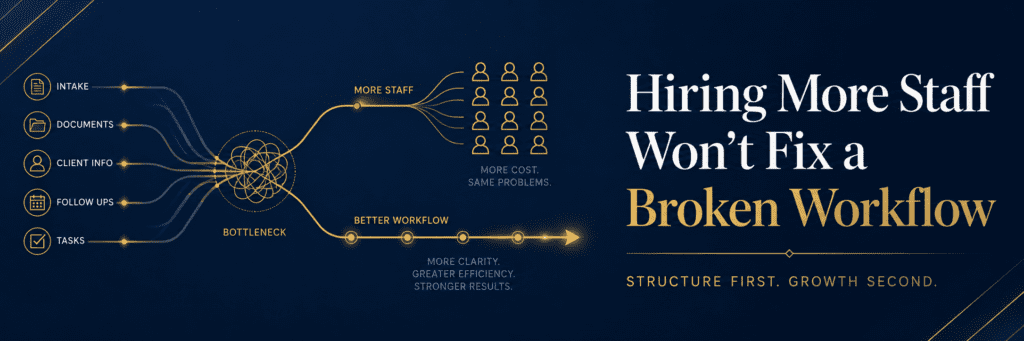
When Hiring More People Isn’t Fixing the Problem

A common response to overload is to add staff. Sometimes that’s necessary—but often it simply adds complexity. New hires need training, oversight, and clarity. If processes aren’t stable, growth amplifies the friction.

Signs this is happening include:

  • Senior staff answering basic operational questions
  • Partners acting as default problem-solvers
  • Work being redone or corrected late in the process

A practice management consultant helps firms stabilize operations before adding headcount, so growth doesn’t create burnout.

Process Breakage Is a Signal, Not a Failure

Firms often say, “Our processes keep breaking.” That usually means the firm has outgrown informal systems that once worked. What used to live in someone’s head now needs to be documented, delegated, and measured.

This is where consulting work focuses:

  • Clarifying who owns what
  • Designing repeatable workflows
  • Creating visibility into capacity and bottlenecks

The goal isn’t bureaucracy. It’s reliability.

Scaling Without Burning Out the Team

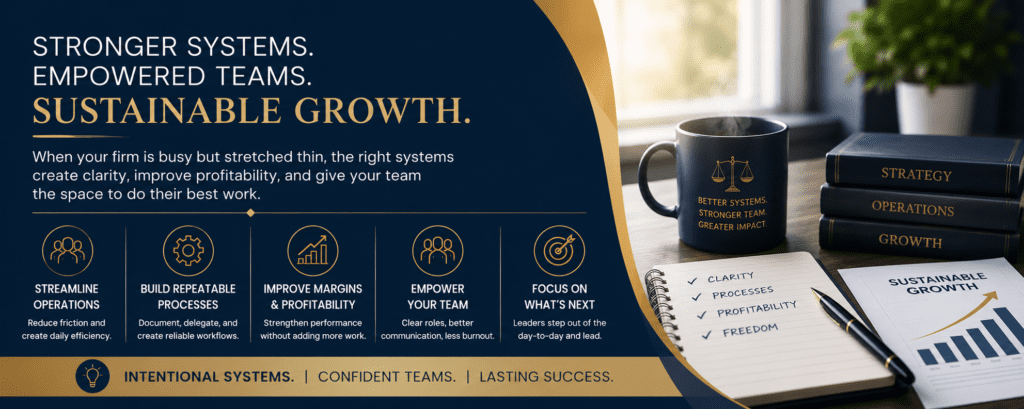
Sustainable growth requires separating strategy from execution. When leadership is stuck inside day-to-day operations, long-term planning disappears. Consultants help create space by building systems that allow:

  • Work to move without constant supervision
  • Decisions to be made at the right level
  • Leaders to focus on direction, not triage

This is how firms scale without exhausting their people—or themselves.

Improving Margins Without Adding More Work

In elder law and estate planning, margin improvement often comes from refinement, not expansion. Small operational changes—better intake, clearer delegation, tighter timelines—can significantly improve profitability without increasing volume.

A consultant’s role is to identify where effort is leaking and help the firm keep more of what it already earns.

A Thoughtful Pause

Hiring a practice management consultant isn’t an admission that something is wrong. It’s recognition that the firm has reached a level of complexity where intentional design matters. When operations are stable, teams work with confidence, clients receive consistent service, and leadership can focus on what comes next.
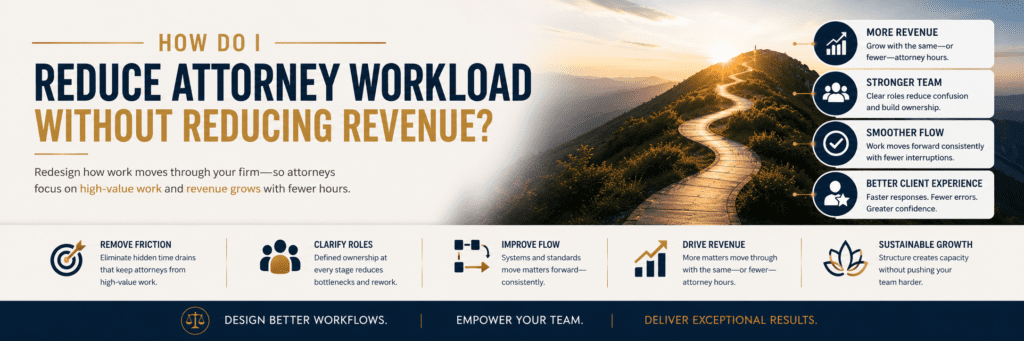
How Do I Reduce Attorney Workload Without Reducing Revenue?

You reduce attorney workload without reducing revenue by redesigning how work moves through the firm—not by asking attorneys to work harder or by immediately hiring more people. When workflows, roles, and handoffs are clear, attorney time shifts back to high‑value work, and revenue becomes easier to sustain with fewer hours.

Busy Hours Don’t Equal Profitable Hours

Many estate planning and elder law firms experience the same pattern: attorneys are logging more hours, yet revenue plateaus. This usually isn’t a demand problem. It’s a workflow problem.

When attorneys spend time:

  • Chasing intake details
  • Managing file status
  • Correcting avoidable errors
  • Answering routine client questions

The firm is using its most expensive resource on work that doesn’t increase margin. Effort goes up. Output does not.

Why Hiring Often Fails to Fix the Problem

Hiring feels like the logical response to overload. In practice, it often adds friction.

Without clear workflows:

  • New staff escalate decisions instead of owning outcomes
  • Training and supervision pull attorneys deeper into operations
  • More people create more coordination—not more capacity

This is why firms can grow headcount and still feel stretched. Hiring redistributes pressure when structure is missing.

The Real Issue: Attorneys as the Default Solution

In many firms, anything unclear eventually lands on an attorney’s desk. Not because attorneys want it there—but because the system pushes it there.

This happens when:

  • Intake standards are inconsistent
  • “Ready for drafting” isn’t defined
  • Ownership between roles is unclear
  • Decisions aren’t standardized

Reducing attorney workload requires separating legal judgment from administrative execution—and designing the handoff intentionally.

How Workload Drops Without Revenue Dropping

Revenue grows when more matters move through the firm with the same—or fewer—attorney hours. That only happens when the workflow supports flow.

Operationally stable firms focus on:

  • Clear intake and readiness standards
  • Defined role ownership at each stage
  • Structured review and approval steps
  • Fewer informal check‑ins and interruptions

When these pieces are in place, attorneys spend more time on strategy, counsel, and review—the work clients value and pay for.

Scaling Without Burnout

Scaling doesn’t require pushing the team harder. It requires removing friction that quietly consumes time.

Firms that scale sustainably tend to:

  • Design workflows around roles, not people
  • Let systems guide work instead of relying on memory
  • Measure capacity by flow, not by hours worked

Often, the firm already has enough people. It simply doesn’t have enough structure.

A Different Definition of Capacity

Capacity isn’t how many hours your attorneys can work. It’s how smoothly work moves when they’re not involved.

When workflow design catches up to growth, attorney workload drops naturally—and revenue becomes more predictable, not more fragile.

How Do I Scale a Law Firm Without Burning Out My Team?

Scaling a law firm without burning out your team requires changing how work moves through the firm—not simply adding more work or more people. Sustainable growth happens when systems, roles, and decision-making are designed to absorb demand without increasing stress.

Many estate planning and elder law firms reach a point where they are busy, profitable on paper, and still overwhelmed. Calendars are full. Revenue is coming in. Yet attorneys remain deeply involved in administrative work, staff feel stretched, and growth feels fragile rather than freeing.

Busy Is Not the Same as Scalable

A full pipeline can mask operational strain. When every new matter requires custom handling, constant attorney oversight, or reactive problem-solving, growth increases pressure instead of capacity.

Common signals include:

  • Attorneys acting as default problem-solvers
  • Files stalling while waiting for decisions
  • Staff escalating issues instead of owning outcomes
  • Revenue rising without corresponding margin or time freedom

These are not people problems. They are workflow design problems.

Why Hiring Often Feels Necessary—but Disappoints

Hiring is frequently the first response to overload. Sometimes it is appropriate. Often, it simply spreads confusion across more people.

When processes are unclear:

  • New hires rely heavily on attorneys for direction
  • Training consumes already-limited leadership time
  • Responsibility becomes diffused instead of clarified

Hiring into an undefined system increases payroll without reducing strain. Growth feels more expensive, not more stable.

Scaling Starts With How Work Moves

Efficient firms focus less on volume and more on flow. That means intentionally designing how work enters, progresses, and exits the firm.

Operationally strong firms tend to:

  • Define what truly requires attorney judgment
  • Delegate preparatory and administrative work with clarity
  • Standardize repeatable decisions
  • Assign clear ownership at each stage of a matter

When expectations are defined, work moves predictably. Attorneys spend more time on high-value work, and staff can operate with confidence.

Reducing Attorney Workload Without Reducing Revenue

Workload reduction does not require fewer clients. It requires fewer interruptions, fewer bottlenecks, and fewer decisions that default back to the attorney.

This often involves:

  • Clear intake standards
  • Defined “ready” criteria before drafting or review
  • Structured review and approval workflows
  • Explicit handoffs instead of informal check-ins

Each improvement reduces friction. Collectively, they change how heavy the work feels.

When Outside Perspective Becomes Valuable

Many firms attempt incremental fixes—new software, more checklists, another hire—without stepping back to evaluate the operating model as a whole.

A practice management consultant becomes useful when:

  • Growth creates complexity faster than clarity
  • Owners are pulled back into daily operations
  • Revenue increases without corresponding freedom

At that stage, the issue is not effort. It is structure.

A Different Definition of Scale

True scale is not about doing more. It is about doing work in a way that protects energy, time, and margin.

A firm does not need to slow down to stabilize. It needs systems that match the level of success it has already achieved.

Growth should create capacity. When it doesn’t, the operating model—not the market—is asking for attention.

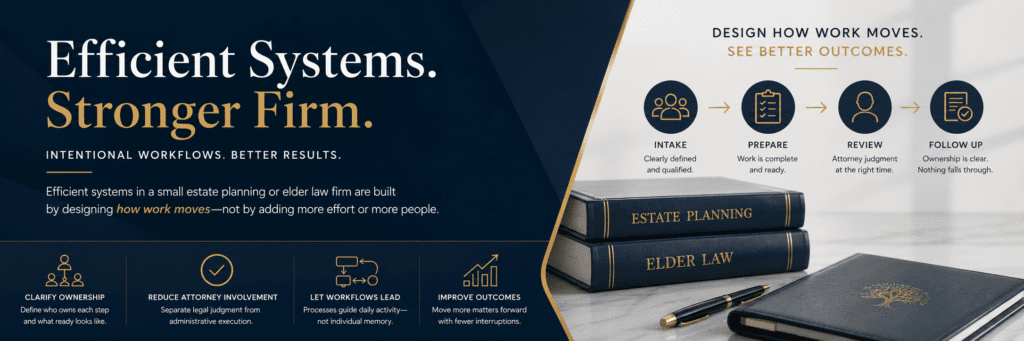
How Do I Build Efficient Systems in a Small Law Firm?

Efficient systems in a small estate planning or elder law firm are built by designing how work moves—not by adding more effort or more people. Firms stabilize operations when they clarify ownership, reduce attorney involvement in non‑legal tasks, and let workflows guide daily activity instead of individual memory.

Why Small Law Firms Feel Busy but Unstable

Many estate planning and elder law firms reach a stage where everyone is working hard, yet progress feels uneven. Files stall. Attorneys stay deeply involved. Hiring feels tempting—but relief is short‑lived. This pattern is rarely about commitment or competence. It’s about workflow design. When processes evolve informally, effort increases without improving throughput or profitability.

Workflow vs. Hiring: A Critical Distinction

Hiring adds capacity. Workflow improvement adds clarity and leverage. When firms hire into unclear systems, new staff often escalate decisions rather than own outcomes—pulling attorneys further into operations. This is why many firms feel overwhelmed even after expanding headcount. Stabilization comes from defining how work should flow first, then hiring into that structure.

What Efficient Systems Actually Do

Efficient systems answer practical questions at every stage of a matter:

  • Who owns this step?
  • What does “ready” mean before it moves forward?
  • When is attorney judgment truly required?

When these answers are clear, work stops looping backward. Bottlenecks become visible. Attorneys spend more time on strategy and review instead of coordination and cleanup. Busy days begin to translate into meaningful progress.

Where to Start When Processes Keep Breaking

Firms with “too many processes breaking” often discover the same pressure points:

  • Intake that allows poorly defined work into the system
  • Drafting readiness without clear standards
  • Reviews that depend on availability instead of sequence
  • Follow‑up with unclear ownership

Mapping what actually happens—rather than what’s intended—reveals where structure is missing. Improvement starts by redesigning those handoffs, not by adding new tools or roles.

Reducing Attorney Workload Without Cutting Revenue

Reducing workload doesn’t mean reducing volume. It means separating legal judgment from administrative execution. When non‑attorney roles are empowered by clear processes, attorneys stop being the default solution. Revenue grows when the same team can move more matters through the firm with fewer interruptions and less rework.

A Steadier Way Forward

Overwhelm is often a signal that a firm’s operating system has outgrown its original design. Firms that step back to build intentional workflows discover something surprising: they often don’t need to work harder or hire faster. They need clearer systems that allow good work to flow predictably—and sustainably.

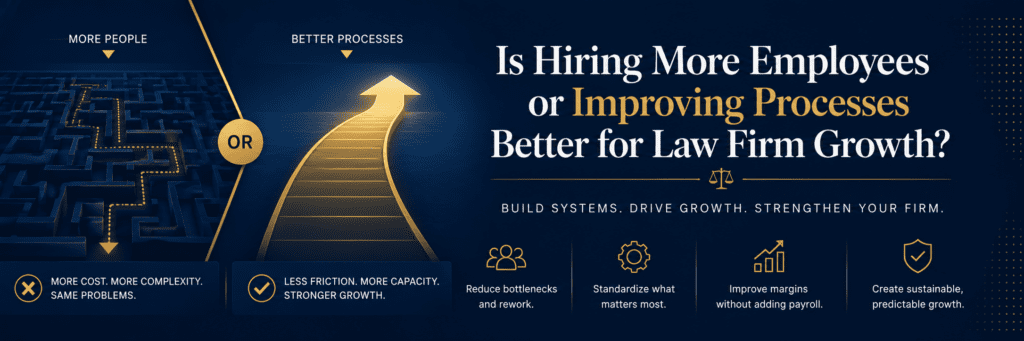
Is Hiring More Employees or Improving Processes Better for Law Firm Growth?

Most law firms don’t hit a growth ceiling because they lack people. They stall because their processes can’t support more volume. In many estate planning and elder law practices, improving workflow produces more sustainable growth than adding staff—especially when margins are tight and teams are already stretched.

Growth Pressure Shows Up as Staffing Pain

When intake is backed up, documents move slowly, or attorneys stay buried in follow-up, hiring feels like the obvious fix. But those symptoms usually point to workflow gaps, unclear delegation, or systems that rely too heavily on memory instead of structure.

Busy teams are not automatically productive teams. Without consistent processes, more staff often means more coordination costs, more training time, and more room for error.

Hiring Solves Capacity. Processes Solve Scale.

Hiring adds capacity in a linear way: more people, more payroll, more management. Workflow improvements scale differently. They remove friction, reduce rework, and allow the same team to handle more matters with less stress.

This is the core difference between staffing up and building systems. One absorbs pressure. The other reduces it.

For small firms, especially in elder law where cases are emotionally complex and administratively dense, process clarity matters more than headcount.

What Efficient Systems Actually Look Like

Efficient law firm systems are not about rigid scripts. They create consistency where it matters and flexibility where it counts. Common examples include:

  • Defined intake and handoff steps so cases don’t stall
  • Clear role ownership for client communication, documents, and follow-up
  • Standard timelines for drafting, review, and execution
  • Technology used intentionally, not as a patchwork of tools

These systems make delegation safer and hiring less risky when the time does come.

Scaling Without Burning Out the Team

Burnout rarely comes from volume alone. It comes from constant exception-handling, unclear expectations, and work that loops back unnecessarily. Process improvement removes those drains.

When workflows are visible and repeatable, attorneys focus on judgment, not chasing details. Staff spend less time reacting and more time completing work cleanly the first time.

That is how firms grow without exhausting their people.

Profitability Without Adding Payroll

Improving processes often increases profit margins faster than hiring. Fewer write-offs, faster billing cycles, and better capacity utilization all contribute—without adding fixed costs.

For many elder law firms, the smartest growth move is not the next hire, but the next system.

Growth becomes predictable when operations stop being improvised.

Operational discipline isn’t restrictive. It’s what makes growth sustainable.

What Is the Difference Between Hiring Staff vs. Improving Workflow in a Law Firm?

Hiring more people and improving workflow solve very different problems in a law firm. Staffing increases capacity; workflow improvement increases clarity, efficiency, and profitability. One adds cost. The other changes how work actually moves through the firm.

In small estate planning and elder law practices, the distinction matters more than most owners realize.


Why “Busy” Firms Still Feel Stuck

Many firms reach a point where everyone is busy, yet nothing feels under control. Attorneys handle admin work. Files stall. Follow‑ups get missed. The instinctive response is to hire—another assistant, another paralegal, another coordinator.

But when work is unclear, adding people often amplifies the problem:

  • Tasks remain poorly defined
  • Responsibility stays ambiguous
  • Bottlenecks simply move downstream

The firm becomes larger, not more stable.


What Hiring Actually Solves (and What It Doesn’t)

Hiring staff can be the right move when:

  • Volume has increased within a stable system
  • Roles are clearly defined
  • Training expectations are documented
  • Workflows already exist

What hiring does not fix is structural inefficiency. Without clear processes, new hires either guess—or rely on attorneys for direction—pulling lawyers further into administrative work instead of relieving them.

This is why firms often say, “We hired, but it didn’t help.”


What Workflow Improvement Actually Does

Improving workflow addresses how work flows from intake to completion—regardless of who performs it.

Effective workflows:

  • Clarify who owns each step
  • Standardize repeatable decisions
  • Reduce attorney involvement in non‑legal tasks
  • Create predictable outcomes for clients

When workflows are strong, attorneys stop being default problem‑solvers for operational issues. That’s when delegation becomes possible—and sustainable.

This is also how firms stabilize operations when “too many processes keep breaking.” The issue is rarely effort; it’s structure.


Admin Overload Is a System Problem, Not a Staffing One

If attorneys are doing admin work, it’s not because staff are unwilling. It’s because the system requires attorney judgment where it shouldn’t—or hasn’t defined expectations clearly enough for staff to act independently.

Process clarity gives staff confidence. It also protects attorney time.


The Real Growth Question

The most profitable firms don’t choose between hiring or improving workflow. They sequence them.

They stabilize operations first. Then they hire into clarity.

That’s how growth becomes intentional instead of reactive—and how firms stop confusing motion with progress.

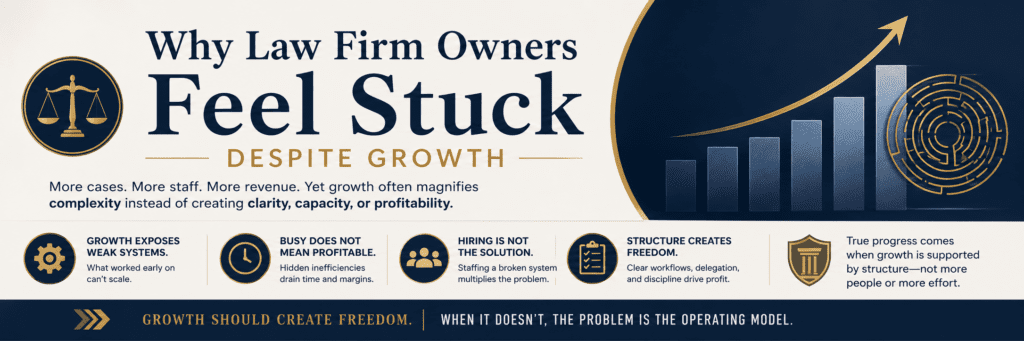
Why do law firm owners feel stuck despite growth?

Many estate planning and elder law firm owners feel stuck because growth often magnifies operational strain instead of relieving it. More cases, more staff, and more revenue do not automatically create clarity, capacity, or profitability—and without intentional workflow design, expansion can quietly lock a firm into complexity.

Growth exposes systems that were never built to scale.

When growth adds pressure instead of progress

In early stages, owners compensate for weak systems with personal effort. They answer questions, fix errors, and keep work moving through sheer involvement. As the firm grows, that same approach becomes unsustainable. Decisions bottleneck at the top, work slows down, and everyone feels busy—yet outcomes plateau.

This is why firms often feel overwhelmed even after hiring more staff. New team members increase coordination demands. Without standardized workflows, the firm adds people but not leverage.

Busy does not mean profitable

Many elder law firms are full—calendars packed, phones ringing, teams stretched—yet margins remain thin. This disconnect usually comes from hidden inefficiencies:

  • Work being redone or corrected downstream
  • Attorneys handling tasks that could be delegated
  • Cases stalling between handoffs
  • Inconsistent intake, drafting, or funding processes

When these friction points compound, adding cases simply creates more chaos. The firm appears successful from the outside, while internally it feels reactive and exhausting.

Hiring is not the same as improving workflow

Staffing is often treated as the solution to overload. In reality, hiring into a broken system multiplies the problem. New hires need guidance, clarity, and repeatable processes. Without them, they rely heavily on owners—reinforcing dependence instead of reducing it.

Improving workflow means defining how work moves through the firm:

  • Who owns each stage
  • What “done” actually means
  • Where decisions should happen
  • What can be standardized versus customized

This work is less visible than hiring, but far more impactful.

Why owners feel stuck

The feeling of being stuck rarely comes from lack of effort or ambition. It comes from operating inside systems that no longer match the size or complexity of the firm. Owners are pulled back into daily operations, even as the firm grows, because the business cannot yet run without them.

True progress comes when growth is supported by structure—clear delegation, consistent workflows, and operational discipline that protects time and profit.

Growth should create freedom. When it doesn’t, the problem is rarely the market. It’s the operating model underneath the success.

Why Does Adding More Cases Create More Chaos in a Law Firm?

Adding more cases creates more chaos when a firm’s workflow hasn’t been designed to absorb growth. Volume increases, but the way work moves stays informal—so pressure multiplies instead of stabilizing. What feels like a capacity problem is usually a structural one.

For many estate planning and elder law firms, this moment arrives quietly. The phones ring. Calendars fill. Staff stay busy. Yet the firm feels heavier, not healthier.

Growth Exposes Workflow Design

Early in a firm’s life, flexibility works. Attorneys stay close to every matter. Questions are answered quickly. Decisions are made on the fly. As case volume increases, those same habits begin to strain.

Work still depends on individual memory rather than defined steps. Intake varies by person. Files move forward when someone remembers to move them. Reviews wait on availability instead of following a predictable sequence. Each new case adds motion—but not clarity.

This is why estate planning firms often struggle with workflow bottlenecks as they grow. The work expands faster than the systems meant to support it.

Busy Doesn’t Mean Profitable

A full schedule can hide inefficiency. Attorneys log longer hours, staff stays active, and revenue may even rise modestly. But profit doesn’t scale with effort when work loops backward, stalls, or lands on the wrong desk.

Common signs include:

  • Attorneys spending time on intake clarification or follow-up
  • Drafts cycling through multiple revisions due to unclear readiness standards
  • Files waiting because ownership isn’t defined
  • Clients requiring repeated reassurance because next steps aren’t clear

In this environment, busyness produces exhaustion rather than leverage. This is why many elder law firms feel busy but not profitable.

Why Hiring Often Makes Things Worse

When pressure builds, hiring feels like the logical response. Sometimes it’s necessary. Often, it’s premature.

Adding staff to an unclear workflow increases coordination, training, and decision-making demands—usually on the same attorneys who are already overloaded. Without clear ownership, new hires escalate questions instead of resolving them. The firm gains payroll but not capacity.

This is why law firm owners frequently feel overwhelmed even after hiring more staff. The bottleneck wasn’t headcount. It was how work flowed.

Where Chaos Typically Forms

In estate planning and elder law firms, bottlenecks tend to concentrate in predictable places:

  • Intake that allows incomplete or premature matters into the system
  • Drafting readiness that isn’t clearly defined
  • Reviews and approvals that depend on availability instead of sequence
  • Follow-up without clear responsibility

Individually manageable, these issues compound. Adding more cases amplifies the friction already there.

The Shift That Calms Growth

Firms that grow without chaos don’t rely on effort to keep up. They redesign how work moves.

That means mapping what actually happens, designing around roles rather than people, clarifying ownership at each stage, and using systems to guide behavior—not just store information.

When structure catches up to growth, capacity appears without adding cases, hours, or staff. The firm begins to feel steady again.

A closing reflection:
If your firm had to operate smoothly for two weeks without extra effort from you, where would work slow down first? That answer usually points directly to the workflow constraint that matters most.

Why Is My Elder Law Firm Busy but Not Profitable?

Many elder law firms reach a frustrating stage where calendars are full, attorneys are exhausted, and revenue still feels tight. This usually isn’t a demand problem. It’s an operational one. When workflow design, delegation, and systems don’t scale with case volume, busyness quietly erodes profitability.

Busy Work vs. Productive Work

In many estate planning and elder law firms, attorneys spend increasing hours on tasks that don’t directly generate revenue: chasing documents, clarifying intake notes, answering routine client questions, or reworking files that stalled earlier. The firm looks busy, but much of that activity isn’t moving cases efficiently toward completion.

This is why attorneys can work longer hours without seeing income rise. The firm is producing effort, not leverage.

Where Workflow Bottlenecks Begin

Workflow bottlenecks often form long before drafting or signing. Common pressure points include:

  • Intake processes that rely too heavily on attorney involvement
  • Inconsistent handoffs between team members
  • Undefined ownership for follow-up tasks
  • Files waiting on decisions because no one is clearly responsible

When each new case enters an already strained system, delays compound. Adding more cases doesn’t fix the problem; it amplifies it.

Why Hiring Doesn’t Automatically Solve the Problem

When firms feel overwhelmed, the instinct is often to hire. But adding staff to a broken workflow usually increases complexity rather than capacity. New team members require training, supervision, and clarification—often from the same attorneys who are already overloaded.

Without standardized processes and clear role boundaries, more people can mean more interruptions, more rework, and more confusion. The result is higher payroll without meaningful margin improvement.

The Real Driver of Profitability: Operational Design

Profitable firms focus on how work moves, not just how much work exists. That means:

  • Defining which tasks truly require attorney expertise
  • Delegating preparatory and administrative work intentionally
  • Creating repeatable processes that don’t rely on memory
  • Designing workflows that prevent files from stalling

When systems are designed to support flow, attorneys spend more time on high-value work, cases move faster, and revenue becomes more predictable—without increasing headcount.

Scaling Without Chaos

Growth only becomes profitable when the firm’s infrastructure can absorb it. This requires stepping back from daily urgency to examine where time is being lost, where decisions get delayed, and where responsibility is unclear.

Firms that make this shift often discover that profitability doesn’t require working harder or adding staff. It requires clearer systems, better delegation, and fewer friction points in how work actually gets done.

A busy firm isn’t broken. But without operational alignment, it will stay busy without becoming meaningfully more profitable.

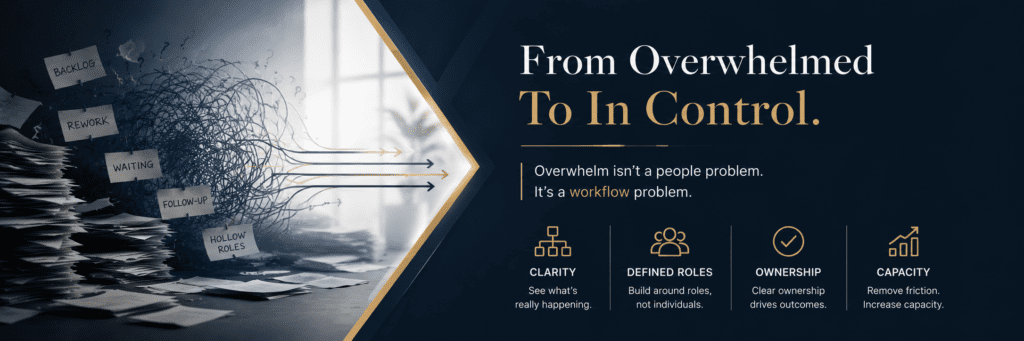
Why Does My Law Firm Feel Overwhelmed Even After Hiring More Staff?

Many estate planning and elder law firms feel overwhelmed after hiring because the underlying workflow hasn’t changed. When work still depends on individual effort instead of clear processes, adding people increases coordination and complexity—often making the firm feel heavier, not calmer.

Growth Exposes Structure—It Doesn’t Create It

As firms grow, informal systems that once worked begin to strain. Intake varies by person. Drafting readiness isn’t clearly defined. Reviews happen out of sequence. The result is a team that stays busy while progress feels uneven. Effort increases, but efficiency does not.

This is why many owners feel stuck despite growth. More cases create motion, but not leverage. Busy days don’t reliably translate into profitability.

Hiring Without Workflow Design Redistributes Pressure

Hiring is often a response to strain. Attorneys are still involved in everything. Files back up. Communication slips. Without defined ownership, new hires escalate decisions instead of owning outcomes, pulling attorneys deeper into operations. Pressure shifts—it doesn’t disappear.

In estate planning and elder law, hiring is a workflow decision first. When roles are defined by titles instead of outcomes, capable staff wait, rework, or defer—while attorneys become the default solution.

Where Bottlenecks Commonly Form

Firms that feel busy but not profitable usually share a few structural constraints:

  • Intake: Unstructured intake allows poorly defined work into the system, creating downstream rework.
  • Drafting readiness: “Ready” isn’t standardized, so files loop backward.
  • Reviews and approvals: Work waits on availability instead of moving predictably.
  • Follow-up: Ownership is unclear, so next steps become reactive.

Individually manageable, these bottlenecks compound. Adding cases adds chaos.

Busy ≠ Profitable

When attorneys compensate for workflow gaps by working longer hours, output often stays flat. High-value professionals end up doing low-value tasks because the handoffs aren’t designed. Profitability stalls not from lack of demand, but from operational friction.

The Shift That Creates Capacity

Firms that regain control redesign how work flows:

  • Map what actually happens, not what’s intended.
  • Design around roles, not individuals.
  • Clarify ownership and decision authority.
  • Let practice management systems guide behavior, not just store information.

Capacity appears not by working faster, but by removing unnecessary work. Many firms discover relief without adding headcount.

A Thoughtful Close

Overwhelm is rarely a people problem. It’s a signal that the operating system has outgrown its original design. When structure catches up to growth, effort finally converts into progress—and the firm begins to feel steady again.