
How to Optimize Law Firm Workflows in 2026

Small law firms rarely struggle because they lack effort. More often, they struggle because work moves through the firm inconsistently. In 2026, workflow optimization is less about working harder and more about creating clear systems that allow attorneys, staff, and clients to move through predictable processes with less friction and greater profitability. Insights throughout this article align with operational themes found in The Million Dollar Solution’s workflow and practice management resources, particularly the distinction between adding staff and improving workflow structure.

Why Workflow Optimization Matters More Than Growth Alone

Many owner-led estate planning and elder law firms reach a frustrating stage of growth:

  • Phones are busy.
  • Calendars are full.
  • Staff are overwhelmed.
  • Attorneys remain the default solution for operational problems.

From the outside, the firm appears successful. Internally, however, profitability often lags behind activity.

The issue is that growth and operational efficiency are not the same thing. When workflows are unclear, every new matter creates additional complexity. Bottlenecks become normal. Follow-up tasks slip through the cracks. Attorneys spend valuable time managing process failures instead of practicing law.

This is why many firms discover that being busy does not automatically translate into higher profits. A firm’s operating system must evolve alongside its growth.


The Most Common Workflow Bottlenecks in Small Law Firms

While every firm operates differently, several patterns appear repeatedly.

Intake Without Clear Standards

Many workflow issues begin before a client ever signs an engagement agreement.

When intake procedures vary between team members, firms experience:

  • Incomplete information
  • Poor matter qualification
  • Unrealistic client expectations
  • Increased attorney involvement early in the process

Strong intake systems establish clarity before work begins. They help clients understand next steps while giving attorneys the information they need to make better decisions.

Undefined Handoffs

Work frequently stalls between departments.

Files move from intake to drafting. Drafting moves to review. Review moves to signing. Yet responsibility is often assumed rather than assigned.

When ownership is unclear:

  • Delays increase
  • Accountability decreases
  • Attorneys become escalation points

Workflow optimization requires clearly defined ownership at every stage.

Attorney-Centered Operations

Many firms unintentionally design workflows that require attorneys to answer every question.

This creates a hidden ceiling on growth.

If every decision, approval, update, or clarification must flow through one attorney, the firm becomes dependent on a single bottleneck. Sustainable growth requires separating legal judgment from administrative execution whenever appropriate.


Why Hiring Alone Rarely Solves Workflow Problems

One of the biggest misconceptions in small law firm growth is that more staff automatically creates more capacity.

Sometimes hiring is necessary.

Often, however, the firm has not yet identified the underlying operational issue.

Adding employees to an inefficient system commonly results in:

  • More training demands
  • More communication complexity
  • More interruptions
  • Higher payroll expenses

The workflow challenges remain.

A useful way to think about it is this:

Staffing increases capacity. Workflow optimization increases efficiency.

Both matter, but they solve different problems.

The firms that scale most effectively typically improve workflow first and hire into a stable system second.


Building a More Efficient Practice Management System

Workflow optimization should be approached systematically rather than reactively.

1. Map the Entire Client Journey

Begin by documenting how work actually moves through the firm.

Not how it is supposed to move.

How it truly moves today.

Review:

  • Initial inquiry
  • Intake
  • Consultation
  • Engagement
  • Drafting
  • Review
  • Signing
  • Follow-up

This process often reveals hidden delays, duplicated effort, and unclear ownership.

2. Clarify Role Expectations

Operational efficiency depends on role clarity.

Every team member should understand:

  • What they own
  • What requires escalation
  • What success looks like
  • Who receives work next

When roles are clearly defined, delegation becomes significantly easier. Staff gain confidence because expectations become predictable.

3. Standardize Repeatable Decisions

Many law firms recreate the same decisions daily.

Whenever possible, build systems around recurring choices:

  • Matter readiness standards
  • Client communication protocols
  • File review processes
  • Meeting preparation procedures

Standardization reduces friction without reducing quality.

4. Measure Workflow Performance

What gets measured gets improved.

Consider tracking:

  • Matter completion times
  • Intake conversion rates
  • Draft turnaround time
  • Revision frequency
  • Client response delays

Even a few operational metrics can reveal significant opportunities for improvement.


Leadership Coaching and Workflow Optimization

Many workflow challenges are actually leadership challenges.

Firm owners often carry institutional knowledge that never becomes operational knowledge.

As a result:

  • Staff wait for direction.
  • Processes depend on memory.
  • Growth creates stress rather than leverage.

Leadership coaching helps owners transition from being the primary problem-solver to becoming the architect of the firm’s systems.

The goal is not to remove leadership involvement.

The goal is to eliminate unnecessary dependency.

When processes are documented and expectations are clear, staff members can make more decisions independently while maintaining quality and consistency.


What Law Firm Consulting Should Focus on in 2026

The strongest law firm consulting engagements increasingly focus on operational design rather than simply marketing or staffing.

Key areas typically include:

  • Workflow optimization
  • Practice management systems
  • Team structure
  • Delegation strategies
  • Operational accountability
  • Leadership development
  • Capacity planning

The objective is not faster growth at any cost.

The objective is controlled growth that protects profitability, client experience, and attorney capacity simultaneously.

For estate planning and elder law firms, this often means creating systems that allow high-value legal work to remain in attorney hands while routine operational tasks move through clearly defined processes.


Signs Your Firm Has Outgrown Its Current Workflow

Your workflow may need redesign if:

  • Attorneys spend significant time on administrative tasks.
  • Files regularly stall without a clear reason.
  • Staff frequently seek clarification on routine decisions.
  • Hiring has not reduced workload.
  • Revenue growth feels harder than it should.
  • Client communication becomes inconsistent during busy periods.

These are not necessarily staffing problems.

They are often signals that the firm’s operating system needs refinement.


A More Sustainable Approach to Small Law Firm Growth

Successful firms rarely scale because they become busier.

They scale because they become clearer.

Clear roles. Clear workflows. Clear expectations. Clear ownership.

When work moves predictably through the firm, profitability becomes less dependent on heroics and more dependent on design.

That shift creates something many owner-led firms ultimately seek: operational control.

And in 2026, operational control may be one of the most valuable growth assets a law firm can build.


How to Improve Client Intake for Elder Law Firms

Client intake is one of the most influential—and most overlooked—operational systems inside an estate planning or elder law firm. The quality of the intake process often determines whether a consultation begins with clarity and trust or starts with confusion, missing information, and uncertainty.

For firms focused on sustainable growth, improving intake is not just about scheduling appointments more efficiently. It is about creating a structured pathway that helps the right clients move forward while reducing internal friction, bottlenecks, and wasted time.

Why Intake Matters More Than Most Firms Realize

Many law firms treat intake as an administrative function.

In reality, intake is the first stage of the client experience. It shapes expectations, establishes confidence, identifies fit, and gives attorneys the information necessary to have productive consultations. When intake is handled inconsistently, attorneys often spend valuable consultation time rebuilding clarity that should have been established earlier.

This is especially important in elder law and estate planning, where clients are often making complex and emotionally significant decisions.

The strongest firms understand that consultations do not begin when the client walks into the meeting. They begin during intake.


Signs Your Intake Process Is Creating Growth Problems

Many firms assume conversion challenges are marketing problems.

Often, they are intake problems.

Common warning signs include:

  • Frequent no-shows
  • Consultations with missing decision-makers
  • Incomplete documentation
  • Repeated pricing confusion
  • Attorneys answering the same preliminary questions repeatedly
  • Long follow-up cycles before engagement decisions
  • Staff uncertainty about qualification standards

These issues create more work without necessarily creating more revenue.

This is where many firms become trapped in a common growth misconception:

Being busy does not automatically mean the firm is profitable.

A calendar filled with low-quality consultations, incomplete matters, and operational rework can keep everyone occupied while limiting profitability.


Build Intake Around Qualification, Not Scheduling

Many intake teams move immediately to appointment scheduling.

That approach misses critical information.

A more effective model focuses on understanding three factors before selecting a consultation date:

1. Urgency

Why is the client reaching out now?

Understanding the triggering event helps staff identify timing realities and prioritize appropriately. Urgency provides important context that influences the entire consultation process.

2. Decision Authority

Who will ultimately make the decision?

Many consultations fail simply because the necessary people are not present. Identifying decision-makers early reduces delays and follow-up cycles.

3. Readiness

Is the prospective client prepared to move forward?

Readiness includes documentation, financial understanding, emotional preparedness, and practical expectations about the next steps.

Firms that consistently assess these three elements often experience stronger consultations and smoother conversions because conversations become more focused and productive from the beginning.


Create Clear Expectations Before the Consultation

Uncertainty is one of the primary reasons consultations stall.

Prospective clients often arrive with questions they are hesitant to ask:

  • What will happen during the meeting?
  • What documents should I bring?
  • Who should attend?
  • What decisions may need to be made?
  • What happens afterward?

When these expectations remain unclear, clients often become overwhelmed or postpone action.

A structured intake system proactively answers these questions before the consultation.

The result is a client who feels prepared rather than pressured.


Use Intake to Reduce Operational Bottlenecks

Many firms attempt to solve growth challenges by adding staff.

Sometimes additional hiring is necessary.

However, hiring rarely fixes a broken intake process. In fact, unclear systems often create more complexity because new team members inherit inconsistent procedures.

A better approach is to examine where information slows down.

Consider:

  • Who owns each intake stage?
  • Where does information get lost?
  • Which questions vary by team member?
  • What decisions require attorney involvement?
  • What can be standardized?

Intake improvements often produce faster operational gains than additional hiring because they remove friction from every future matter.


Turn Intake Into a Repeatable Workflow

Growing firms tend to view intake as a system rather than an event.

Instead of treating every inquiry differently, they create a predictable workflow:

Inquiry → Qualification → Preparation → Consultation → Follow-Up → Engagement Decision

Each stage has ownership, accountability, and defined expectations.

This does not make the client experience feel impersonal.

It makes it reliable.

Consistency allows the team to spend more energy helping clients and less energy managing preventable confusion.


The Often-Ignored Role of Follow-Up

Many firms invest significant effort in consultations but little effort in what happens afterward.

Not every prospective client is ready to make a decision immediately.

In elder law and estate planning, hesitation often reflects uncertainty, family dynamics, timing concerns, or fear of making the wrong decision rather than a lack of interest.

A deliberate follow-up process helps firms:

  • Maintain continuity
  • Reduce decision friction
  • Create client confidence
  • Improve conversion consistency

The objective is not pressure.

It is providing enough structure that clients can move forward when they are ready.


Why Intake Is Really a Practice Management Issue

Many firms view intake separately from operations.

The strongest firms do not.

Intake influences:

  • Workflow efficiency
  • Attorney utilization
  • Staff capacity
  • Client experience
  • Conversion rates
  • Profitability

When intake is inconsistent, operational problems appear throughout the practice.

When intake is structured, work moves more predictably across the firm.

This is one reason law firm practice management consulting, estate planning consulting, and law firm sales coaching increasingly focus on intake systems before addressing larger growth initiatives.

The intake process often reveals where the firm’s processes, communication, and delegation systems need attention.


A Final Thought

Many estate planning and elder law firms assume growth requires more leads, more staff, or more hours.

Often, sustainable growth begins somewhere much simpler.

It begins by creating clarity before the consultation ever starts.

When intake becomes intentional, consultations improve. When consultations improve, operational strain decreases. And when operations become more predictable, the firm gains something many growing practices struggle to maintain: control.

How Estate Planning Firms Win More Clients in 2026

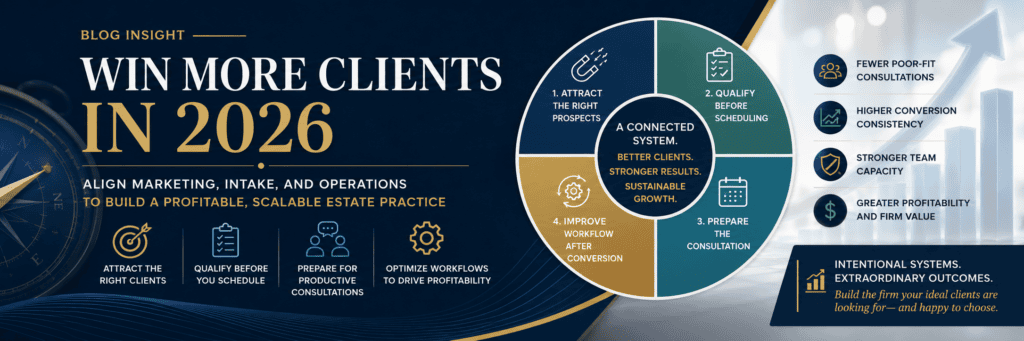
Estate planning firms that consistently win more clients in 2026 are not relying on better marketing alone. They are aligning estate planning marketing, client intake, and operational workflows into a system that attracts the right prospects, prepares them for productive consultations, and moves matters through the firm efficiently. Firms that treat marketing and intake as separate functions often become busier. Firms that integrate them tend to become more profitable. Based on internal growth and intake frameworks emphasizing ideal-client alignment, intake qualification, and operational clarity, sustainable growth comes from attracting better-fit matters rather than simply increasing inquiry volume.

The Shift Happening in Estate Planning Marketing

Many estate planning firms still evaluate marketing success by lead volume.

More website inquiries. More consultation requests. More phone calls.

Yet many firms discover that increased activity does not automatically improve profitability.

Prospective clients are arriving more informed, more selective, and often more overwhelmed than ever before. They are researching providers, comparing options, and looking for clarity before they ever contact a law firm. Strong firms recognize that growth is no longer about generating the highest volume of inquiries. It is about becoming the obvious choice for the right people.

This distinction matters because poor-fit matters create operational strain:

  • Excessive follow-up
  • Low-quality consultations
  • Scheduling congestion
  • Attorney bottlenecks
  • Staff frustration

In other words, busy does not necessarily mean healthy.

Why Marketing Coaching Alone Is Not Enough

Many law firm marketing initiatives focus primarily on visibility:

  • Search rankings
  • Content marketing
  • Referral development
  • Social media presence
  • Community education

These activities are important. But they only solve the first half of the client acquisition equation.

Marketing answers:

“How do people find us?”

It does not answer:

“What happens after they do?”

Without operational alignment, marketing improvements can expose weaknesses rather than create growth. Additional inquiries simply place more pressure on an intake process that was never designed to scale. Internal growth frameworks consistently emphasize that lead generation creates demand, but growth requires design.

This is where marketing coaching services and client intake coaching intersect.

The Missing Link: Client Intake Coaching

Many estate planning firms underestimate the influence of intake.

It is often viewed as an administrative task when it is actually the first stage of the consultation process.

Before a prospective client ever speaks with an attorney, intake determines:

  • Expectations
  • Preparedness
  • Confidence
  • Fit
  • Decision readiness

Effective intake coaching teaches teams to move beyond scheduling and begin facilitating informed decision-making. Firms that strengthen intake often discover improvements in:

  • Consultation quality
  • Attorney utilization
  • Conversion consistency
  • Workflow efficiency
  • Client experience

Intake is not administrative overhead. It is a growth function.

How Marketing and Intake Create a Repeatable Client Acquisition System

The most effective client acquisition systems follow a predictable sequence.

Step 1: Attract the Right Prospects

Strong estate planning marketing starts with clarity.

Firms that grow intentionally define:

  • Their ideal client
  • Preferred case types
  • Desired complexity levels
  • Values alignment
  • Decision readiness indicators

Clear positioning helps the right prospects identify themselves before they call while encouraging poor-fit prospects to self-select elsewhere. This reduces wasted consultations and preserves team capacity.

Step 2: Qualify Before Scheduling

Many firms move immediately from inquiry to calendar.

High-performing firms do not.

Instead, intake professionals gather information related to:

  • Urgency
  • Decision authority
  • Readiness

This structure helps determine whether the consultation is likely to move forward productively. It also helps prepare both the client and attorney for a more meaningful conversation.

Step 3: Prepare the Consultation

Preparation reduces friction.

Clients should understand:

  • What will happen
  • What documents are needed
  • Who should attend
  • What decisions may need to be made

When expectations are established early, attorneys spend less time rebuilding clarity and more time providing value.

Step 4: Improve Workflow After Conversion

A new client should enter the firm through a structured process.

Otherwise, growth creates operational stress.

Many firms assume hiring additional staff will solve growth challenges. In reality, bottlenecks often originate from unclear processes rather than insufficient personnel. Workflow, onboarding, delegation, and training systems frequently create more leverage than additional headcount. Operational development frameworks repeatedly emphasize systematic training, process clarity, and role alignment as key drivers of scalability.

Why Hiring Is Not Always the Answer

A common pattern appears in growing estate planning firms.

Demand increases. Capacity feels constrained. Leadership decides to hire.

Sometimes that works.

Often it does not.

Additional employees entering an inefficient system simply increase complexity.

Before adding staff, firm leaders should evaluate:

  • Intake consistency
  • Task ownership
  • Consultation preparation
  • Workflow handoffs
  • Process documentation
  • Delegation clarity

Many bottlenecks stem from work moving unpredictably rather than from insufficient staffing levels. Firms frequently discover that process improvement produces greater capacity than another hire.

What Practice Management Consulting Often Reveals

This reality connects directly to broader conversations around legal practice management consulting.

When firms investigate profitability challenges, the root cause is often not marketing.

Nor is it always staffing.

Instead, consultants frequently uncover operational friction between:

  • Marketing and intake
  • Intake and attorneys
  • Attorneys and staff
  • Staff and systems

The result is hidden inefficiency.

Work flows into the firm faster than it can move through the firm.

That is why the most successful growth strategies focus on the entire client journey rather than isolated departments.

Fixing Estate Planning Workflow Bottlenecks

Workflow bottlenecks rarely announce themselves clearly.

They often appear as:

  • Backlogged consultations
  • Repeated follow-up requests
  • Attorney interruptions
  • Delayed matter completion
  • Burnout among high performers

The solution is not simply to work harder.

It is to create clearer systems.

The strongest firms build repeatable processes around:

  • Client qualification
  • Intake standards
  • Consultation preparation
  • Matter onboarding
  • Delegation
  • Training and development

Structure reduces overload. Clarity reduces rework. Predictability improves profitability.

The Firms That Will Grow Most Effectively in 2026

The firms that win more clients in 2026 will not necessarily have the largest advertising budgets.

They will be the firms that connect:

  • Estate planning marketing
  • Client intake coaching
  • Workflow optimization
  • Team development
  • Operational clarity

When those elements work together, marketing becomes more efficient, consultations become more productive, and clients move through the firm with less friction.

Growth becomes repeatable rather than reactive.

And that often marks the transition from simply getting more clients to building a firm that can consistently serve them well.

How Do Estate Planning Firms Learn Which Clients Actually Help Them Grow?

Estate planning firms learn which clients help them grow by paying closer attention to fit, readiness, complexity, and profitability — not just conversion volume. The matters that help a firm grow are usually the ones that align with the firm’s strengths, move through its systems more predictably, and support healthy margins without excessive friction.

Growth clients are not always the most obvious clients

A firm may assume its best clients are the easiest to sign or the most frequent referrals. But over time, stronger firms usually learn to evaluate matters through a broader lens:

  • Does this matter match our strengths?
  • Does it require the kind of strategic guidance we do well?
  • Does it move with reasonable clarity through intake, consult, and completion?

This is an important distinction. Some matters generate revenue while quietly creating strain. Others create less friction, better outcomes, and more dependable growth.

The client signals that matter most

Internal materials on ideal client definition emphasize four useful dimensions:

  • urgency
  • complexity
  • values alignment
  • decision readiness

These factors help firms identify which matters are likely to move forward well and which are more likely to stall, loop backward, or require repeated reassurance without forward progress.

Intake is where firms start learning this

Most firms do not learn which clients help them grow by intuition alone. They learn through better qualification. Intake is where the firm gathers the first real evidence:

  • why now
  • what outcome is needed
  • who decides
  • what level of readiness exists

When intake teams resist jumping straight to scheduling and instead clarify urgency, decision authority, and readiness, the firm gets a much clearer sense of whether the inquiry is a true growth opportunity or simply more activity.

Which matters usually create drag

The cases that tend to weigh a firm down are often not “bad” matters. They are simply misaligned matters:

  • low urgency with high indecision
  • limited readiness but high demand for reassurance
  • work that does not fit the firm’s strengths
  • expectations that exceed what the system is designed to support

Over time, these patterns affect morale, scheduling, throughput, and profitability.

What strong firms do differently

More intentional firms define not only the clients they want more of, but also the cases that consistently create friction, burnout, or stalled conversions. That kind of clarity changes:

  • marketing
  • intake scripts
  • consultation preparation
  • internal workflow planning

Once the firm names those patterns, client selection becomes more disciplined and less reactive.

Close

Estate planning firms learn which clients help them grow when they stop measuring demand by volume alone. The better question is not, “Who contacted us?” It is, “Which matters strengthen the firm as they move through it?” That shift usually marks the beginning of more intentional growth.

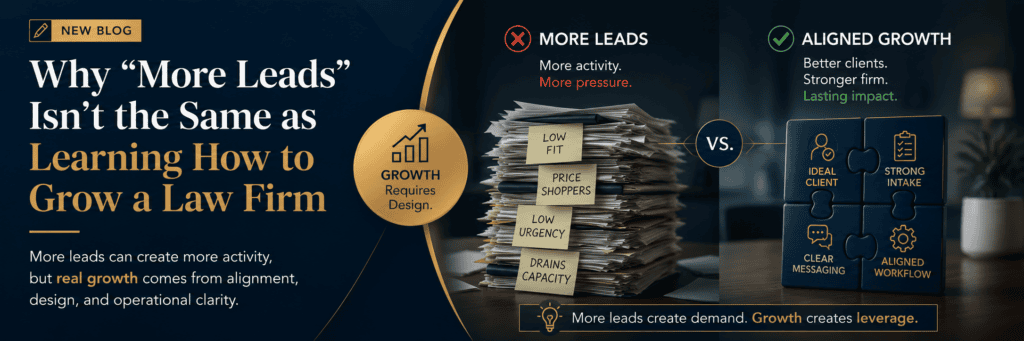
Why “More Leads” Isn’t the Same as Learning How to Grow a Law Firm

More leads can create more activity, but they do not automatically create better growth. In elder law and estate planning firms, volume-based marketing often produces mismatched expectations, price shoppers, and low-urgency or low-complexity matters that drain team capacity. Growth, by contrast, requires alignment — operationally, financially, and strategically.

Why this confusion happens so often

When a firm feels pressure, “more leads” sounds like progress. More calls, more consultations, more visibility. But firms can become busier without becoming healthier. That pattern shows up repeatedly in workflow-focused content: full calendars and active teams do not necessarily produce more clarity, capacity, or profitability.

Leads create demand. Growth requires design.

Lead generation answers one question:
How do more people find the firm?

Growth answers a different one:
What happens when they do?

If the answer includes vague intake, poor qualification, unclear ownership, or too much attorney involvement, then more demand simply puts more pressure on a weak operating model. That is why some firms feel heavier after marketing improves.

What volume-based growth gets wrong

A higher lead count can look encouraging on paper. But if those leads produce:

  • low-quality consultations
  • wrong-fit matters
  • repeated hesitation
  • more follow-up than forward movement

then the true effect is often hidden complexity. Intake teams spend more time sorting. Attorneys step in earlier than they should. The firm adds motion without adding leverage.

What real growth looks like instead

Real growth tends to look quieter and more intentional. It usually includes:

  • clearer definition of the ideal client
  • better intake qualification
  • messaging that helps the wrong matters opt out
  • stronger workflow alignment after the consult begins

This kind of growth protects team capacity because it improves the quality of work entering the system — not just the quantity.

Why this matters financially

Wrong-fit matters do not just hurt morale. They consume time in ways firms often underestimate:

  • more explanation
  • more uncertainty
  • more handoffs
  • more rework

That is why “more leads” and “more profitable” are not interchangeable ideas. If demand increases but friction increases with it, margins rarely improve the way owners expect.

Close

A law firm does not learn how to grow by increasing inquiry volume alone. It learns by understanding which demand creates leverage — and which demand creates drag. More leads may create momentum, but only aligned growth creates stability.

What Should Elder Law Firms Learn About Attracting the Right Clients?

Attracting the right clients starts with understanding who you actually enjoy working with. Many elder law firms focus heavily on getting more leads, more consultations, and more visibility. But long-term growth often comes from something much simpler: attracting people who align with how the firm works best.

Not every potential client is the right fit for every firm. The firms that grow sustainably tend to be clear about the types of clients they serve exceptionally well and enjoy serving the most. When a firm’s messaging, intake process, and client experience reflect that clarity, growth becomes far more intentional.

Define Your Ideal Client Before You Market

Many firms spend significant time thinking about how to attract more inquiries but very little time defining who they actually want those inquiries to come from.

Every firm has clients they enjoy working with and clients who make every interaction feel more difficult than it needs to be. The goal is not to fill the calendar with every possible appointment. The goal is to fill it with people who value your guidance, fit your process, and appreciate the work you do.

The clearer you are about your ideal client, the easier it becomes to attract more people like them.

What Makes an Ideal Client?

An ideal client will look different for every firm, but common characteristics often include:

  • Values professional guidance and expertise
  • Understands the importance of planning ahead
  • Is ready to make decisions and take action
  • Respects the firm’s process and recommendations
  • Has legal needs that align with the firm’s strengths

These clients tend to create better experiences for everyone involved. Consultations are more productive, expectations are easier to manage, and matters move through the firm more smoothly.

Why Firms Sometimes Attract the Wrong Clients

Firms often attract the wrong types of matters because their messaging is too broad.

When marketing speaks to everyone, it becomes difficult for ideal clients to recognize that they are in the right place. Meanwhile, the firm may attract people who are not aligned with its services, expectations, or approach.

This can lead to:

  • Frustrating consultations
  • Mismatched expectations
  • Increased intake workload
  • More operational friction
  • Lower overall team satisfaction

Over time, these matters consume valuable resources and can make growth feel exhausting rather than rewarding.

The Role of Intake

Marketing helps attract prospective clients, but intake helps confirm whether the relationship is the right fit.

An effective intake process helps firms identify whether a prospective client aligns with the firm’s services, process, and expectations before valuable attorney time is invested.

When intake supports the firm’s ideal client profile, the entire workflow benefits.

Growth Should Feel Better, Not Just Bigger

One of the most important lessons for elder law firms is that not all growth is good growth.

A full calendar is not necessarily a successful calendar if it is packed with clients who create stress, resist guidance, or consistently fall outside the firm’s ideal practice model.

The goal is to build a practice around the work and clients you enjoy serving most. When firms attract more of those people, growth becomes more fulfilling, more predictable, and more sustainable.

Close

The most successful elder law firms are often the ones that clearly understand who they want to serve. Rather than trying to appeal to everyone, they focus on attracting the clients who align with their values, appreciate their expertise, and make the work rewarding. That’s the difference between simply being busy and building a practice you genuinely enjoy running.

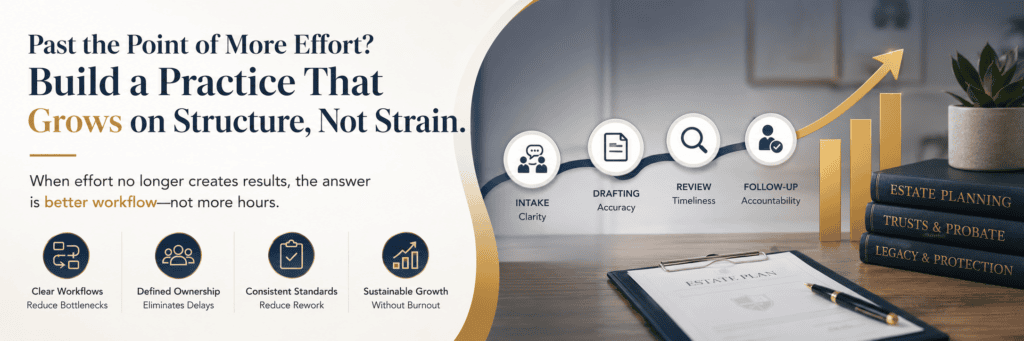
How Do Estate Planning Firms Grow Once “Working Harder” Stops Working?

There is a point in most estate planning firms where additional effort no longer produces better outcomes. At that stage, growth requires changing how work is structured—not how hard the team works.

Recognizing the Limit of Effort-Based Growth

Early on, growth often comes from:

  • Faster responses
  • Longer hours
  • Personal attention to every detail

But over time:

  • Work increases faster than capacity
  • Complexity begins to compound
  • Results plateau despite continued effort

This is where many firms feel stuck.

The Shift: From Output to Flow

When effort stops working, the focus changes:

  • From “how much we do”
  • To “how work moves”

This introduces questions like:

  • Where does work slow down?
  • Where does it repeat?
  • Where does it depend on one person?

These are workflow questions—not productivity questions.

Where Bottlenecks Typically Appear

In estate planning firms, friction often appears in:

  • Intake → unclear readiness or expectations
  • Drafting → incomplete or inconsistent inputs
  • Review → work waiting on availability
  • Follow-up → undefined ownership

Each bottleneck reduces the firm’s effective capacity.

Why More Hiring Doesn’t Sustain Growth

Without addressing bottlenecks:

  • New staff inherit the same inefficiencies
  • Training becomes reactive
  • Attorneys remain involved in routine work

Hiring increases volume—but not necessarily throughput.

What Actually Changes the Growth Trajectory

Firms that move past this stage focus on:

  • Defining clear workflow stages
  • Assigning ownership at each step
  • Reducing repeated decisions through standards

This transforms growth from effort-dependent to system-supported.

The Result: Capacity Without Burnout

When workflows are clear:

  • Files move predictably
  • Staff operate with confidence
  • Attorneys focus on high-value decisions

Growth begins to feel steadier instead of heavier.

A Closing Thought

If your firm feels like every additional file adds pressure, the solution is rarely doing more.

It is usually: making the work itself easier to move.

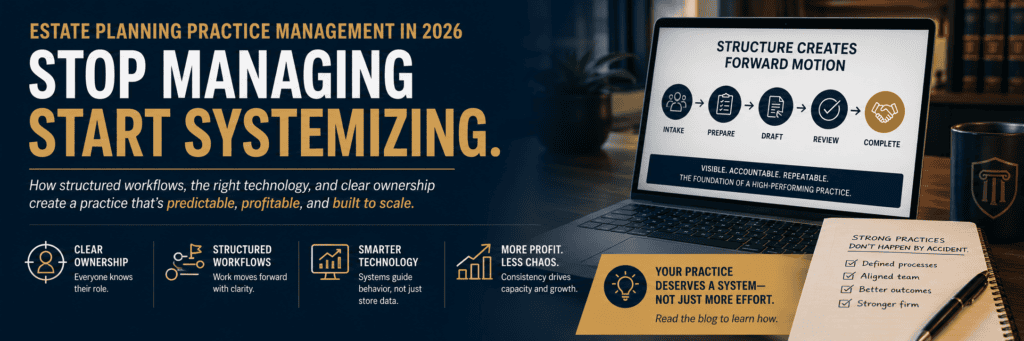
Estate Planning Practice Management in 2026

Effective estate planning practice management in 2026 comes down to one core shift: firms that treat workflows as structured systems—not individual effort—operate with more clarity, consistency, and profitability. When processes, technology, and team roles are aligned, the practice becomes easier to manage without sacrificing client experience.


Why Practice Management Feels Harder Than It Should

Most small estate planning and elder law firms are not underperforming because of legal skill or commitment. They are under strain because their operations evolved informally while demand increased.

This creates a familiar pattern:

  • The team is consistently busy
  • Attorneys stay deeply involved in day-to-day work
  • Progress feels slower than effort suggests

Over time, busy becomes the default—but profitability does not follow.

The underlying issue is not capacity. It is structure.


Diagnosing Inefficient Estate Planning Operations

Before improving systems, firms need to understand where breakdowns typically occur.

1. Work Depends on People, Not Process

When workflows live in memory instead of systems, progress becomes inconsistent and fragile.

  • Intake varies depending on who answers the phone
  • Drafting readiness is subjective
  • Follow-up depends on individual tracking

This creates rework and delays that compound over time.

2. Technology Exists—but Doesn’t Guide Behavior

Many firms already use elder law software or practice management systems. But those systems often function as storage, not workflow drivers.

Without structured workflows:

  • Tasks are manual instead of automated
  • Visibility into workload is limited
  • Accountability is unclear

Technology alone does not improve operations—configuration does.

3. Attorneys Become the Default Solution

When roles and handoffs are unclear, everything escalates upward.

  • Staff defer decisions
  • Bottlenecks form at review and approval stages
  • Attorneys spend time on administrative coordination

This is where many firms feel stuck: hiring increases headcount, but not efficiency.


Legal Process Optimization: Where to Focus First

Not all improvements carry equal weight. In most estate planning operations, bottlenecks cluster in a few areas.

Intake and Qualification

Unstructured intake introduces unclear or incomplete matters into the workflow, leading to downstream inefficiencies.

Drafting Readiness

If “ready for drafting” is loosely defined, files stall or cycle backward.

Review and Approval

Work waits on availability instead of moving predictably through defined stages.

Follow-Up Ownership

Without clear responsibility, next steps become reactive rather than scheduled.

Individually, these are manageable. Collectively, they create the sense that adding more work only adds more pressure.


Reframing Practice Management: Systems Over Effort

Improving estate planning practice management is not about increasing pace—it is about reducing unnecessary work.

A well-designed system does three things:

Defines Ownership

Every stage has a clear owner, reducing escalation and ambiguity.

Standardizes Handoffs

Work moves forward based on triggers—not memory.

Aligns the Team to the System

Processes are followed because they are embedded in the workflow, not because they are remembered.

When this alignment happens:

  • Interruptions decrease
  • Rework declines
  • Work becomes more predictable

Firms often find capacity without adding staff, simply by redesigning how work flows.


Getting More Value from Practice Management Software

Practice management tools (including many elder law software platforms) are most effective when they actively guide how work moves—not just where it’s stored.

Configured properly, systems can:

  • Assign tasks automatically based on matter stage
  • Enforce sequence and accountability
  • Provide visibility into workload and capacity

This is where legal technology services and law firm consulting intersect.

Technology should reflect your firm’s actual operations—not force your team into generic structures.


Why Hiring Isn’t the First Solution

When workloads increase, hiring feels like the logical next step.

But without structured workflows:

  • New hires escalate decisions instead of owning them
  • Attorneys remain involved by default
  • Responsibility becomes more diffused

This is why many firms grow in size—but not in efficiency.

Hiring into unclear systems often amplifies inefficiency rather than resolving it.


The Role of Law Firm Consulting in 2026

As estate planning practices become more complex, operational clarity becomes harder to build internally.

Workflow and practice management consulting provides:

  • External perspective on blind spots
  • Proven frameworks for process design
  • Faster implementation than trial-and-error internally

Importantly, operational improvements are interconnected:

  • Workflow affects staffing
  • Staffing affects profitability
  • Profitability affects growth decisions

Effective consulting addresses the system—not isolated symptoms.


A More Sustainable Model for Estate Planning Practice Management

A busy firm can still feel controlled when systems are clear.

A growing firm can scale without strain when workflows are structured.

And a small firm can operate at a high level without constant oversight when:

  • Roles are defined
  • processes are consistent
  • systems actively guide the work

A nonstop workflow is not a failure—it is a signal that your practice has outgrown its original design.

The opportunity is not to work harder, but to operate more intentionally.

Why the Next Level of Law Firm Growth Usually Requires a New Way of Thinking

Growth does not stall in law firms because effort runs out. It stalls because the thinking that built the current level no longer supports the next one.

The Plateau Most Firms Eventually Reach

At some point, a firm becomes consistently busy:

  • Clients are coming in
  • Work is getting done
  • The team is active

But something changes beneath the surface:

  • Margins stop improving
  • Owner involvement increases
  • Operations feel heavier, not easier

This is not a capacity problem. It is a thinking problem.

What Worked Before Starts to Work Against You

Early growth often comes from:

  • Personal responsiveness
  • Owner-driven problem solving
  • Flexibility in how work gets done

These traits create momentum at the beginning—but they don’t scale.

As volume increases:

  • Flexibility becomes inconsistency
  • Responsiveness becomes constant interruption
  • Problem-solving becomes dependency

The Shift: From Execution to Design

The next level of growth requires a reframing of the owner’s role.

Instead of asking:

  • “How do we get this done?”

The question becomes:

  • “How should this get done every time?”

That small shift changes everything.

It introduces:

  • Defined workflows instead of ad hoc processes
  • Role clarity instead of shared responsibility
  • Systems that guide behavior instead of relying on memory

Why Growth Feels Harder Before It Feels Better

Firms often experience resistance at this stage:

  • Standardization feels restrictive
  • Delegation feels risky
  • Letting go of control feels uncomfortable

But without these changes, growth adds complexity instead of stability.

This is why some firms remain stuck in the “busy but constrained” phase—despite strong demand.

How This Connects to Other Growth Challenges

This mindset shift directly impacts:

  • Hiring decisions
  • Intake consistency
  • Client selection

For example, firms that haven’t made this shift often believe they need more leads or more staff—when in reality, they need clearer structure.

A Closing Perspective

Growth does not come from doing more of what already works.

It comes from changing how the firm operates as a system.

And that always begins with how the owner thinks about control, clarity, and repetition.

What Should Estate Planning Firm Owners Learn Before Trying to Scale?

Scaling an estate planning firm without first stabilizing how work flows tends to magnify existing problems. What looks like growth opportunity can quickly become operational strain.

Scaling Exposes What Already Isn’t Working

Many firms attempt to scale when:

  • Demand increases
  • Referral sources grow
  • Marketing improves

But scaling does not create stability—it tests it.

If intake is inconsistent, more leads create more confusion.
If workflows are unclear, more files create more delays.

The First Lesson: Clarity Precedes Growth

Before scaling, owners benefit from answering a few foundational questions:

  • What defines a “ready” matter?
  • Who owns each stage of the process?
  • Where do files typically stall?

Without these answers, scaling introduces volume without control.

The Risk of Scaling Too Early

Firms that scale prematurely often experience:

  • Increased attorney involvement in routine tasks
  • Higher error and rework rates
  • Strained client experience

The firm becomes busier—but less predictable.

This is why many firms feel like growth makes things harder, not better.

Why “More Leads” Is Not the Goal

A common assumption is that growth equals more clients.

But scaling works differently:

  • The right clients improve efficiency
  • The wrong clients increase friction

Firms that scale well tend to define:

  • Ideal client characteristics
  • Matter complexity thresholds
  • Readiness expectations

This prevents intake from becoming a bottleneck.

Systems Create Capacity—Not Just People

Scaling is often mistaken for a staffing decision.

But systems create the foundation:

  • Defined workflows reduce handoff confusion
  • Standardized decision points reduce escalation
  • Technology reinforces consistency

Only after this does hiring truly expand capacity.

The Leadership Shift Required

Scaling also requires a change in how owners think:

From:

  • Solving daily problems

To:

  • Designing how problems get solved

This is the difference between managing growth and enabling it.

A Closing Reflection

If your firm doubled its volume tomorrow, would your current systems support it—or strain under it?

The answer often reveals whether it’s time to scale—or time to redesign.