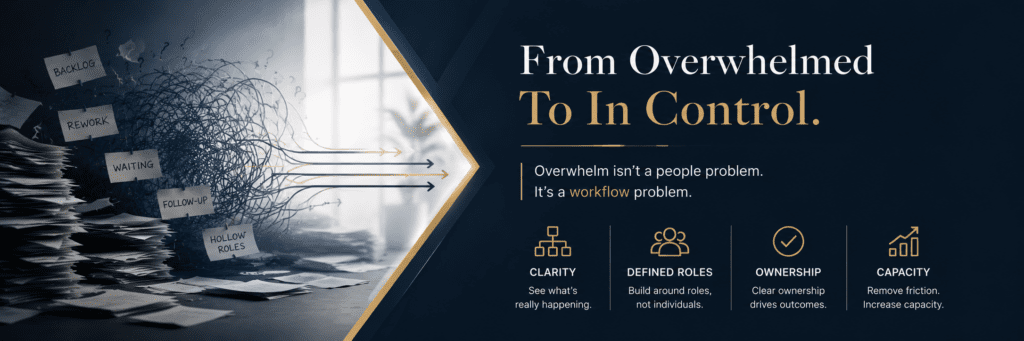

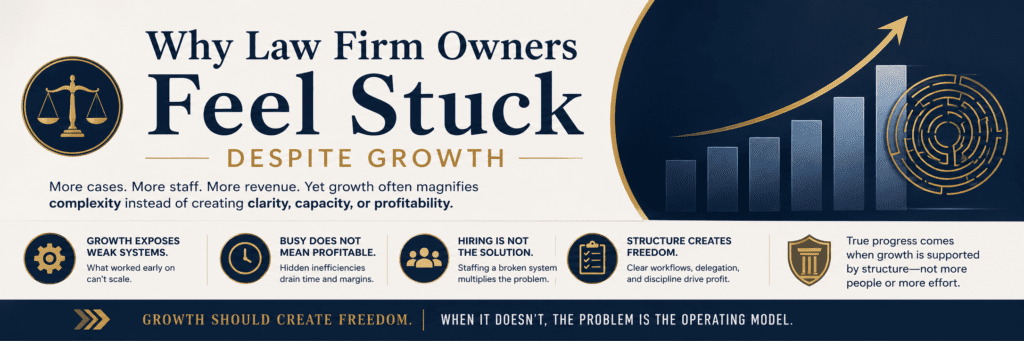
Why do law firm owners feel stuck despite growth?

Many estate planning and elder law firm owners feel stuck because growth often magnifies operational strain instead of relieving it. More cases, more staff, and more revenue do not automatically create clarity, capacity, or profitability—and without intentional workflow design, expansion can quietly lock a firm into complexity.

Growth exposes systems that were never built to scale.

When growth adds pressure instead of progress

In early stages, owners compensate for weak systems with personal effort. They answer questions, fix errors, and keep work moving through sheer involvement. As the firm grows, that same approach becomes unsustainable. Decisions bottleneck at the top, work slows down, and everyone feels busy—yet outcomes plateau.

This is why firms often feel overwhelmed even after hiring more staff. New team members increase coordination demands. Without standardized workflows, the firm adds people but not leverage.

Busy does not mean profitable

Many elder law firms are full—calendars packed, phones ringing, teams stretched—yet margins remain thin. This disconnect usually comes from hidden inefficiencies:

  • Work being redone or corrected downstream
  • Attorneys handling tasks that could be delegated
  • Cases stalling between handoffs
  • Inconsistent intake, drafting, or funding processes

When these friction points compound, adding cases simply creates more chaos. The firm appears successful from the outside, while internally it feels reactive and exhausting.

Hiring is not the same as improving workflow

Staffing is often treated as the solution to overload. In reality, hiring into a broken system multiplies the problem. New hires need guidance, clarity, and repeatable processes. Without them, they rely heavily on owners—reinforcing dependence instead of reducing it.

Improving workflow means defining how work moves through the firm:

  • Who owns each stage
  • What “done” actually means
  • Where decisions should happen
  • What can be standardized versus customized

This work is less visible than hiring, but far more impactful.

Why owners feel stuck

The feeling of being stuck rarely comes from lack of effort or ambition. It comes from operating inside systems that no longer match the size or complexity of the firm. Owners are pulled back into daily operations, even as the firm grows, because the business cannot yet run without them.

True progress comes when growth is supported by structure—clear delegation, consistent workflows, and operational discipline that protects time and profit.

Growth should create freedom. When it doesn’t, the problem is rarely the market. It’s the operating model underneath the success.

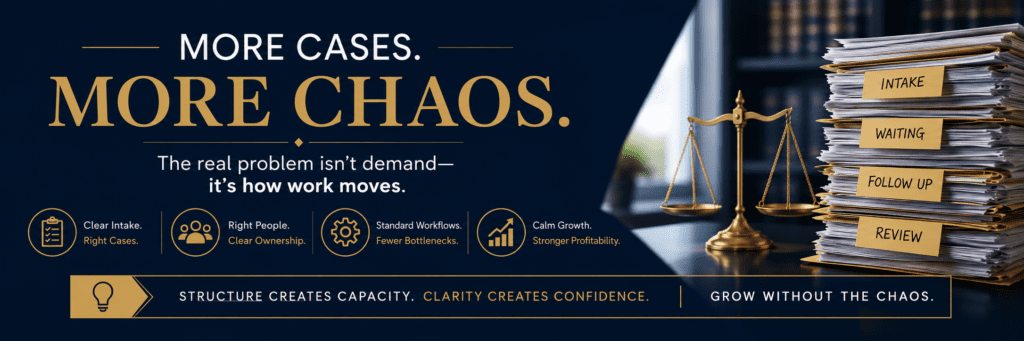
Why Does Adding More Cases Create More Chaos in a Law Firm?

Adding more cases creates more chaos when a firm’s workflow hasn’t been designed to absorb growth. Volume increases, but the way work moves stays informal—so pressure multiplies instead of stabilizing. What feels like a capacity problem is usually a structural one.

For many estate planning and elder law firms, this moment arrives quietly. The phones ring. Calendars fill. Staff stay busy. Yet the firm feels heavier, not healthier.

Growth Exposes Workflow Design

Early in a firm’s life, flexibility works. Attorneys stay close to every matter. Questions are answered quickly. Decisions are made on the fly. As case volume increases, those same habits begin to strain.

Work still depends on individual memory rather than defined steps. Intake varies by person. Files move forward when someone remembers to move them. Reviews wait on availability instead of following a predictable sequence. Each new case adds motion—but not clarity.

This is why estate planning firms often struggle with workflow bottlenecks as they grow. The work expands faster than the systems meant to support it.

Busy Doesn’t Mean Profitable

A full schedule can hide inefficiency. Attorneys log longer hours, staff stays active, and revenue may even rise modestly. But profit doesn’t scale with effort when work loops backward, stalls, or lands on the wrong desk.

Common signs include:

  • Attorneys spending time on intake clarification or follow-up
  • Drafts cycling through multiple revisions due to unclear readiness standards
  • Files waiting because ownership isn’t defined
  • Clients requiring repeated reassurance because next steps aren’t clear

In this environment, busyness produces exhaustion rather than leverage. This is why many elder law firms feel busy but not profitable.

Why Hiring Often Makes Things Worse

When pressure builds, hiring feels like the logical response. Sometimes it’s necessary. Often, it’s premature.

Adding staff to an unclear workflow increases coordination, training, and decision-making demands—usually on the same attorneys who are already overloaded. Without clear ownership, new hires escalate questions instead of resolving them. The firm gains payroll but not capacity.

This is why law firm owners frequently feel overwhelmed even after hiring more staff. The bottleneck wasn’t headcount. It was how work flowed.

Where Chaos Typically Forms

In estate planning and elder law firms, bottlenecks tend to concentrate in predictable places:

  • Intake that allows incomplete or premature matters into the system
  • Drafting readiness that isn’t clearly defined
  • Reviews and approvals that depend on availability instead of sequence
  • Follow-up without clear responsibility

Individually manageable, these issues compound. Adding more cases amplifies the friction already there.

The Shift That Calms Growth

Firms that grow without chaos don’t rely on effort to keep up. They redesign how work moves.

That means mapping what actually happens, designing around roles rather than people, clarifying ownership at each stage, and using systems to guide behavior—not just store information.

When structure catches up to growth, capacity appears without adding cases, hours, or staff. The firm begins to feel steady again.

A closing reflection:
If your firm had to operate smoothly for two weeks without extra effort from you, where would work slow down first? That answer usually points directly to the workflow constraint that matters most.

Why Is My Elder Law Firm Busy but Not Profitable?

Many elder law firms reach a frustrating stage where calendars are full, attorneys are exhausted, and revenue still feels tight. This usually isn’t a demand problem. It’s an operational one. When workflow design, delegation, and systems don’t scale with case volume, busyness quietly erodes profitability.

Busy Work vs. Productive Work

In many estate planning and elder law firms, attorneys spend increasing hours on tasks that don’t directly generate revenue: chasing documents, clarifying intake notes, answering routine client questions, or reworking files that stalled earlier. The firm looks busy, but much of that activity isn’t moving cases efficiently toward completion.

This is why attorneys can work longer hours without seeing income rise. The firm is producing effort, not leverage.

Where Workflow Bottlenecks Begin

Workflow bottlenecks often form long before drafting or signing. Common pressure points include:

  • Intake processes that rely too heavily on attorney involvement
  • Inconsistent handoffs between team members
  • Undefined ownership for follow-up tasks
  • Files waiting on decisions because no one is clearly responsible

When each new case enters an already strained system, delays compound. Adding more cases doesn’t fix the problem; it amplifies it.

Why Hiring Doesn’t Automatically Solve the Problem

When firms feel overwhelmed, the instinct is often to hire. But adding staff to a broken workflow usually increases complexity rather than capacity. New team members require training, supervision, and clarification—often from the same attorneys who are already overloaded.

Without standardized processes and clear role boundaries, more people can mean more interruptions, more rework, and more confusion. The result is higher payroll without meaningful margin improvement.

The Real Driver of Profitability: Operational Design

Profitable firms focus on how work moves, not just how much work exists. That means:

  • Defining which tasks truly require attorney expertise
  • Delegating preparatory and administrative work intentionally
  • Creating repeatable processes that don’t rely on memory
  • Designing workflows that prevent files from stalling

When systems are designed to support flow, attorneys spend more time on high-value work, cases move faster, and revenue becomes more predictable—without increasing headcount.

Scaling Without Chaos

Growth only becomes profitable when the firm’s infrastructure can absorb it. This requires stepping back from daily urgency to examine where time is being lost, where decisions get delayed, and where responsibility is unclear.

Firms that make this shift often discover that profitability doesn’t require working harder or adding staff. It requires clearer systems, better delegation, and fewer friction points in how work actually gets done.

A busy firm isn’t broken. But without operational alignment, it will stay busy without becoming meaningfully more profitable.

Why Does My Law Firm Feel Overwhelmed Even After Hiring More Staff?

Many estate planning and elder law firms feel overwhelmed after hiring because the underlying workflow hasn’t changed. When work still depends on individual effort instead of clear processes, adding people increases coordination and complexity—often making the firm feel heavier, not calmer.

Growth Exposes Structure—It Doesn’t Create It

As firms grow, informal systems that once worked begin to strain. Intake varies by person. Drafting readiness isn’t clearly defined. Reviews happen out of sequence. The result is a team that stays busy while progress feels uneven. Effort increases, but efficiency does not.

This is why many owners feel stuck despite growth. More cases create motion, but not leverage. Busy days don’t reliably translate into profitability.

Hiring Without Workflow Design Redistributes Pressure

Hiring is often a response to strain. Attorneys are still involved in everything. Files back up. Communication slips. Without defined ownership, new hires escalate decisions instead of owning outcomes, pulling attorneys deeper into operations. Pressure shifts—it doesn’t disappear.

In estate planning and elder law, hiring is a workflow decision first. When roles are defined by titles instead of outcomes, capable staff wait, rework, or defer—while attorneys become the default solution.

Where Bottlenecks Commonly Form

Firms that feel busy but not profitable usually share a few structural constraints:

  • Intake: Unstructured intake allows poorly defined work into the system, creating downstream rework.
  • Drafting readiness: “Ready” isn’t standardized, so files loop backward.
  • Reviews and approvals: Work waits on availability instead of moving predictably.
  • Follow-up: Ownership is unclear, so next steps become reactive.

Individually manageable, these bottlenecks compound. Adding cases adds chaos.

Busy ≠ Profitable

When attorneys compensate for workflow gaps by working longer hours, output often stays flat. High-value professionals end up doing low-value tasks because the handoffs aren’t designed. Profitability stalls not from lack of demand, but from operational friction.

The Shift That Creates Capacity

Firms that regain control redesign how work flows:

  • Map what actually happens, not what’s intended.
  • Design around roles, not individuals.
  • Clarify ownership and decision authority.
  • Let practice management systems guide behavior, not just store information.

Capacity appears not by working faster, but by removing unnecessary work. Many firms discover relief without adding headcount.

A Thoughtful Close

Overwhelm is rarely a people problem. It’s a signal that the operating system has outgrown its original design. When structure catches up to growth, effort finally converts into progress—and the firm begins to feel steady again.

Why Are My Attorneys Working More Hours but Not Increasing Revenue?

When attorneys are logging longer days without a corresponding rise in revenue, the issue is rarely effort. It is usually structure. In many estate planning and elder law firms, time is being consumed by operational friction—work moving slowly, repeating itself, or landing on the wrong desks—rather than by billable, value‑driven activity.

Busy does not equal profitable. And more hours do not automatically translate into more revenue when the workflow itself is misaligned.


The Hidden Cost of Workflow Bottlenecks

Estate planning firms often struggle with bottlenecks that are subtle but persistent. Files stall waiting for reviews. Drafts move back and forth without clear standards. Intake information arrives incomplete and requires follow‑up by attorneys.

These slowdowns compound. Attorneys compensate by working longer hours, but the firm’s output stays flat because the constraint is the process, not the people.

Common bottleneck patterns include:

  • Work entering the system without defined readiness standards
  • Too many handoffs with unclear ownership
  • Decisions escalated to attorneys that could be handled earlier or elsewhere

When bottlenecks go unresolved, productivity feels high while throughput remains low.


Why Hiring More Staff Often Makes the Firm Feel More Overwhelmed

Many firms respond to overload by adding people. The expectation is relief. The result is often more coordination, more questions, and more management work for attorneys.

Without clear workflows, new hires increase complexity instead of capacity. Attorneys spend additional time training, correcting, and supervising—often absorbing even more administrative work than before.

Hiring without process design rarely fixes overload. It simply spreads inefficiency across more people.


When Attorneys Are Doing Administrative Work

If attorneys are routinely scheduling, chasing documents, correcting basic errors, or managing file status, revenue growth will stall. High‑value professionals doing low‑value tasks is one of the most expensive operational leaks in a law firm.

This usually happens because:

  • Roles are defined by people, not by work type
  • Tasks are not clearly delegated or standardized
  • Systems are built around individual habits instead of firmwide flow

Reducing attorney workload without reducing revenue requires separating legal judgment from administrative execution—and designing the handoff intentionally.


The Real Path to Revenue Growth

Revenue increases when the firm can move more matters through the system with the same—or fewer—attorney hours. That only happens when:

  • Work is clearly staged and sequenced
  • Non‑attorney tasks are consistently handled by the right roles
  • Attorneys focus primarily on client strategy, counsel, and review

This is not about pushing people harder. It is about removing friction so effort converts into output.


A Different Way to Look at “Capacity”

Capacity is not measured by how many hours your attorneys can work. It is measured by how smoothly work moves through your firm.

When workflow is aligned, firms often discover they already have enough people. They simply did not have enough structure.

The firms that grow sustainably do not rely on heroic effort. They rely on systems that allow good work to flow predictably, efficiently, and profitably.

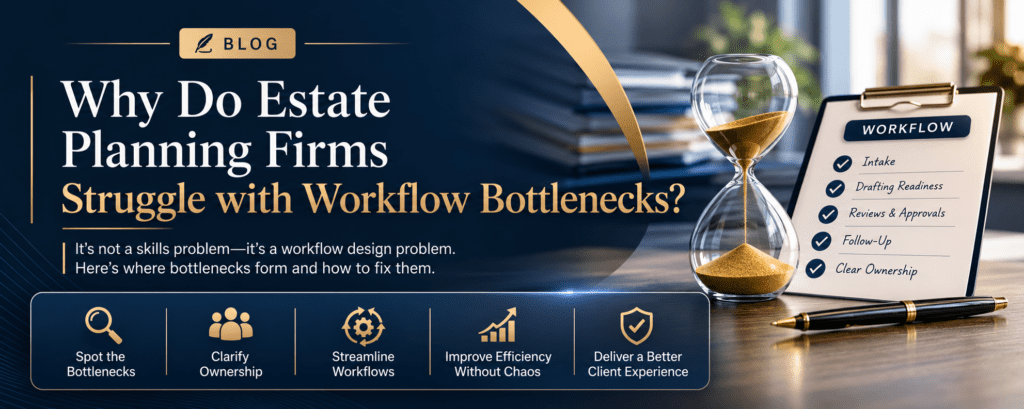
Why Do Estate Planning Firms Struggle with Workflow Bottlenecks?

Estate planning and elder law firms struggle with workflow bottlenecks because their operations often grow informally while demand increases. The work expands faster than the systems designed to support it, leaving firms busy, stretched, and frustrated—without seeing proportional gains in profitability or capacity.

This is rarely a problem of legal skill or effort. It is a problem of workflow design.


When growth outpaces structure

Most firms begin with flexible, founder-driven processes. Early on, this works well. Attorneys oversee most decisions, communication is direct, and volume is manageable.

As the firm grows, however, the workflow often stays the same. Intake varies by person. Files move when someone remembers to move them. Review standards live in someone’s head. Over time, these small inconsistencies compound.

The result is a firm that looks successful on paper but feels increasingly reactive day to day.


Why working more hours doesn’t fix the problem

Many firm owners respond to pressure by working longer hours. Some even see revenue increase—yet the firm still feels heavy.

That’s because effort is being used to compensate for structural gaps:

  • Attorneys fill in for unclear roles
  • Rework becomes routine
  • Interruptions replace focused work
  • Progress depends on memory instead of systems

In this environment, additional effort maintains momentum but does not create leverage. The firm stays busy without becoming more efficient.


Why hiring often makes things worse

Hiring is often the next logical step—and sometimes it is necessary. But hiring into an unclear workflow rarely solves the root problem.

Without defined ownership:

  • New staff escalate decisions instead of owning outcomes
  • Attorneys remain involved by default
  • Responsibility becomes diffused, not clarified

This is why many estate planning and elder law firms feel overwhelmed even after adding headcount. The bottleneck wasn’t capacity—it was structure.


Where bottlenecks usually form

Workflow constraints in estate planning and elder law firms tend to concentrate in a few predictable areas:

Intake – Unstructured intake allows incomplete or poorly defined matters into the system, creating downstream rework.


Drafting readiness – When “ready for drafting” is unclear, files stall or loop backward.


Review and approvals – Work waits on availability instead of moving predictably.


Follow-up – When ownership is unclear, next steps become reactive.

Individually, these issues are manageable. Together, they create the feeling that adding more cases only adds more chaos.


Bottlenecks are signals, not failures

A strained workflow does not mean a firm is broken. It means the operating system has outgrown its original design.

Sustainable firms redesign how work flows—clarifying ownership, defining handoffs, and using systems to guide behavior. When that happens, efficiency improves without sacrificing client experience, and growth feels steadier instead of heavier.


A closing reflection

If your firm continued operating for two weeks without extra effort from you, where would work slow down first?

That answer usually points directly to the workflow bottleneck that matters most—and where meaningful improvement should begin.

Systemize Owner-Led Law Firm Operations in 2026

A Practical Operating Perspective for Estate Planning and Elder Law Firms

By 2026, most estate planning and elder law firms will not be limited by demand. They will be limited by how tightly the firm still revolves around the owner.

The practices experiencing the most strain are rarely struggling legally. They are struggling operationally. Decisions, approvals, staff confidence, and client experience often bottleneck at one place: the owner’s desk.

Systemization is not about removing the owner from the firm. It is about designing operations that no longer require constant owner intervention to function well.


When “Owner-Led” Quietly Becomes “Owner-Dependent”

In many firms, owner-led operations have become owner-dependent without anyone intending it.

Common signs include:

  • The owner is the default problem solver for routine questions
  • Work quality varies by person rather than by process
  • Files stall when the owner is unavailable
  • Growth increases workload instead of leverage

From the outside, these firms often look successful. Internally, however, operations rely on memory, informal handoffs, and personal judgment rather than repeatable systems. That structure rarely scales calmly.


Systemization Is an Operating Decision, Not a Technology One

Systemizing a firm does not begin with software or templates. It begins with clarity.

Firms that operate smoothly have defined:

  • How work moves from intake through completion
  • Who owns each stage of that work
  • What “done correctly” actually means for recurring tasks

Without this clarity, new tools simply automate confusion. Systemization is the act of designing the firm so that normal operations produce consistent outcomes—even when the owner is not directly involved.


The Owner’s Role Shift in 2026

The most important operational shift for firm owners in 2026 is moving from performer-in-chief to system steward.

That means:

  • Spending less time fixing exceptions and more time defining standards
  • Letting go of being the fastest problem-solver in the room
  • Measuring success by predictability, not personal heroics

This is not disengagement. It is leadership focused on leverage.


Why Predictable Operations Improve Profitability

Profitability is often constrained not by pricing, but by rework, interruptions, and inconsistent throughput.

When workflows are systemized:

  • Staff complete work with fewer clarifications
  • Files move forward without owner checkpoints
  • Capacity becomes visible and manageable
  • Growth feels steadier instead of chaotic

Margins improve because the firm wastes less energy—not because everyone works harder.


A Closing Operational Reflection

If your firm needed to operate smoothly for two weeks without your daily involvement, where would it slow down first?

That question usually reveals exactly where systemization should begin.

How to Hire the Right Staff for an Elder Law and Estate Planning Firm

How to Hire the Right Staff for an Elder Law and Estate Planning Firm

Successful hiring in elder law and estate planning firms starts with defining workflow ownership—not job titles or résumés. When firms clarify outcomes, authority, and handoffs before hiring, they reduce attorney overload and improve profitability. Hiring to compensate for unclear processes usually increases strain instead of relieving it.


Hiring in an estate planning or elder law firm is rarely just about filling a position.

Most firms hire because something feels strained. Attorneys are over‑involved, work backs up, or client communication becomes inconsistent. When pressure builds, hiring feels like the fastest solution.

But hiring without clarity often makes the problem worse. The wrong hire doesn’t reduce pressure—it redistributes it.

For small estate planning and elder law firms, hiring is a workflow decision first, and a people decision second. When roles are designed intentionally, staffing supports stability and profitability. When roles are vague, even capable employees struggle.


Hire Based on Workflow Ownership

Many firms start by posting a familiar title—paralegal, legal assistant, intake coordinator. Titles feel efficient, but they often hide the real issue.

Before hiring, firms should identify:

  • Where work slows down
  • Which tasks escalate to attorneys unnecessarily
  • Where ownership or handoffs are unclear

These are workflow signals, not staffing gaps.

Effective hiring begins by defining the outcome the role must own and the decisions it can make without attorney involvement. When ownership is clear, the role becomes easier to hire for—and easier to succeed in.


Don’t Hire to Compensate for Broken Intake

One of the most common hiring mistakes is adding staff downstream of the real problem.

If intake is unclear, poorly defined work enters the system. That work resurfaces later as rework, interruptions, or unnecessary attorney involvement.

Before hiring, firms should assess whether intake:

  • Qualifies matters consistently
  • Sets expectations clearly
  • Prepares clients and the team for the consult

Improving intake often reduces immediate hiring pressure by preventing unnecessary work from entering the workflow.


The Right Hire Strengthens the System

In estate planning and elder law firms, staffing decisions directly affect attorney capacity, client experience, turnaround time, and long‑term profitability.

The right hire does not simply “help out.” They strengthen the firm’s ability to operate predictably and sustainably.

At The Million Dollar Solution, hiring decisions are viewed as part of a broader operating system—aligned with workflow design, HR strategy, practice management, and financial clarity.

A strained team is not a failure. It is a signal. When firms listen carefully, hiring becomes a strategic move instead of a recurring fix.

Small Estate Planning and Elder Law Firm Workflow Improvement Consulting Guide

For many estate planning and elder law firms, the work never seems to stop.

Files accumulate. Clients need reassurance. Staff stay busy, yet progress feels uneven. Even well‑run firms eventually ask the same question:

Why does our workflow feel nonstop—and how do we fix it?

This guide is written specifically for small estate planning and elder law firms that want to regain control of their operations without sacrificing service quality or burning out their team.


Why Workflow Strain Is So Common in Estate Planning and Elder Law

Estate planning and elder law practices operate under a unique combination of pressure:

  • High‑touch, emotionally sensitive client relationships
  • Extensive documentation and revision cycles
  • Long client lifecycles with ongoing follow‑ups
  • Frequent “urgent” issues that interrupt planned work

When workflows evolve informally—as they often do in growing firms—effort increases, but efficiency does not. The result is a practice that feels constantly busy, yet perpetually behind.

The issue is rarely commitment or competence.
It is almost always workflow design.


What’s Actually Causing the Nonstop Workflow

In consulting engagements, workflow overload usually traces back to three structural issues.

First, work depends on people instead of processes.
Key steps live in someone’s head, making progress fragile and inconsistent.

Second, technology exists but doesn’t drive behavior.
Practice management systems are present, but they don’t actively guide how work moves.

Third, attorneys become the default solution.
When roles and handoffs are unclear, everything escalates to the lawyer—slowing the firm and increasing stress.

Individually, these issues are manageable.
Together, they create a workflow that never truly stops.


Step One: Understand the Workflow You Actually Have

Most firms believe they understand their workflow—until they map it.

A true workflow review looks at what actually happens, not what is intended to happen. It captures:

  • Where work enters the firm
  • How it moves between roles
  • Where it waits
  • Where it loops backward

In estate planning and elder law firms, this process often reveals duplicated data entry, unclear drafting readiness standards, and review steps occurring out of sequence.

Once the workflow is visible, improvement becomes possible.


Step Two: Design Around Roles, Not Individuals

Sustainable firms build workflows around roles, not personalities.

A well‑designed workflow clearly answers questions like:

  • Who owns intake and qualification?
  • Who prepares drafts?
  • Who reviews and finalizes?
  • Who communicates next steps to the client?

This shift reduces bottlenecks, lowers decision fatigue, and makes the firm far less dependent on any single person. It also simplifies onboarding and cross‑training—critical for small firms.


Step Three: Address Intake Before Anything Else

When a firm feels overwhelmed, intake is often the hidden source of the pressure.

Unstructured intake allows incomplete, premature, or poorly defined matters into the system. That work doesn’t disappear—it resurfaces later as rework, interruptions, or attorney involvement that could have been avoided.

A well‑optimized intake process:

  • Qualifies matters consistently
  • Sets expectations early
  • Triggers the right internal steps automatically

For many estate planning and elder law firms, improving intake alone creates noticeable breathing room.


Step Four: Let Your Practice Management System Drive the Workflow

Practice management software should do more than store information.

When properly configured, systems like Actionstep actively guide the work by:

  • Assigning tasks based on matter stage
  • Enforcing sequence and accountability
  • Creating visibility into workload and capacity

Workflow optimization ensures the system reflects how your firm actually operates, rather than forcing staff to work around generic setups.


Step Five: Create Capacity Without Adding Headcount

Workflow optimization is not about working faster.
It is about removing unnecessary work.

When systems are aligned, firms commonly experience:

  • Fewer interruptions
  • Less rework
  • Reduced attorney involvement in administrative tasks
  • More predictable days

Many firms discover meaningful capacity—not by hiring, but by redesigning how work flows through the firm.


Why Workflow Optimization Consulting Works for Small Law Firms

Improving workflows internally is difficult when the firm is already stretched.

Consulting brings an outside perspective, proven frameworks, and faster implementation. At The Million Dollar Solution, workflow optimization connects directly to practice management, HR, financial clarity, Actionstep implementation, and succession planning—because workflows do not exist in isolation.


A Nonstop Workflow Is a Signal, not a Failure

A nonstop workflow does not mean your firm is broken.
It means your systems have outgrown their original design.

With intentional structure, estate planning and elder law firms can operate with clarity, consistency, and confidence—while still delivering the high‑quality client experience their work demands.


Elder law professionals are more than advisors. They are advocates

Recently, headlines of the passing of actor Gene Hackman and his wife dominated headlines. However, the unfortunate circumstances surrounding this news propelled the conversation somewhere deeper than typical celebrity news.

This tragedy shed a light on some of the most difficult, and often ignored, conversations about dementia: It’s immense burden on the family members who provide care while watching their loved one change and disappear behind a fog of Alzheimer’s, or other form of dementia.

And for that awareness, I am thankful. Because this is the reality for millions of Americans and it is on us as elder law attorneys, estate planners, and financial advisors to do more than draft documents. 

We must advocate for those caregivers who devote so much of themselves to supporting their loved one with dementia or Alzheimer’s disease. 

The Financial Cost of Caregiving

Millions of adults in America provide regular, unpaid care for a family member or friend with Alzheimer’s of dementia – for an average of 30 hours every week. One third of those caregivers have been providing that support for at least 5 years.

Nearly half of dementia caregivers have an annual household income below $50,000, but an average of $12,388 for out-of-pocket costs on behalf of the person with dementia.  Of those caregivers who are employed elsewhere, 57% report having to leave early, go in late, or take time off to fulfill their caregiving duties. Nearly- 20% reduced their work hours.

To help cover the cost of caregiving, 48% of caregivers report cutting back on spending, and 43% report reducing their savings. Nearly 40% report food insecurity – running out of food and not having resources to buy more.

The Personal Cost of Caregiving

And the burden obviously goes beyond the financial. Countless blogs and research reports echo what you have heard from you own clients:

– The stress of caregiving impacts their own mental health causing depression and anxiety.
– Social isolation becomes overwhelming because caregiving requires them to be home, often missing out on the things they enjoy – like going out to eat or attending worship.
– Their health often declines, with increasing rates of cardiovascular disease and ulcers – exacerbated by often cancelling, or putting off personal routine health exams.

To put it bluntly: Caregivers are sacrificing their own physical health, mental well-being, and future stability, and they aren’t asking for anything in return. We must do more for them.

We Must Become Connectors.

We have to connect with our clients deeper than the paperwork, by making time and space for questions like “How are you really doing with all of this?” Prepare for these meetings to take a little longer. You’re not making small talk, you’re offering a lifeline.

We have to connect our clients to community resources, whether those are adult day centers, support groups, neurologists, or transportation options. While we certainly cannot fix everything, we can be the person who knows who to call.

And we have to connect our passions to our local leaders and advocate for the Credit For Caring Act.

The Credit For Caring Act is a federal bill introduced to US Congress, with bipartisan support in both the House and the Senate. This bill aims to provide caregivers with a tax credit of up to $5,000 to offset out-of-pocket expenses like medication, home modifications, and more. While this is a modest amount, it is a meaningful step to support caregivers and their incredible burden.

So, I encourage you: Connect with your regional legislators – even if it’s just a phone call or email. Your legislators need to know what is happening in their communities and recognize this work. If you can, do more. Schedule a meeting at their office and share your heart for your clients.

If you need some tools or talking points, the Alzheimer’s Association has toolkits, petitions, and resources you can use (INSERT LINKS), both in your advocacy effort and in your own marketing. Remember, you have a voice in your community with your newsletter, social media, and seminars, so shine a light on the struggle of caregivers.

This is where elder law, estate planning, and financial advising go beyond the conference room.

As those who have committed our professions to supporting older adults, it is time to support caregivers, who make up the invisible backbone of long-term dementia care.  So let’s step up and speak up because we aren’t just advisors. We are advocates. And our clients and their caregivers are counting us to be both.