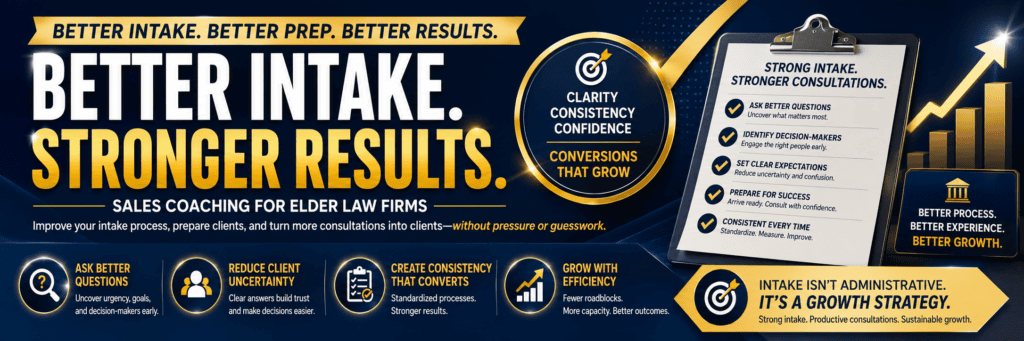

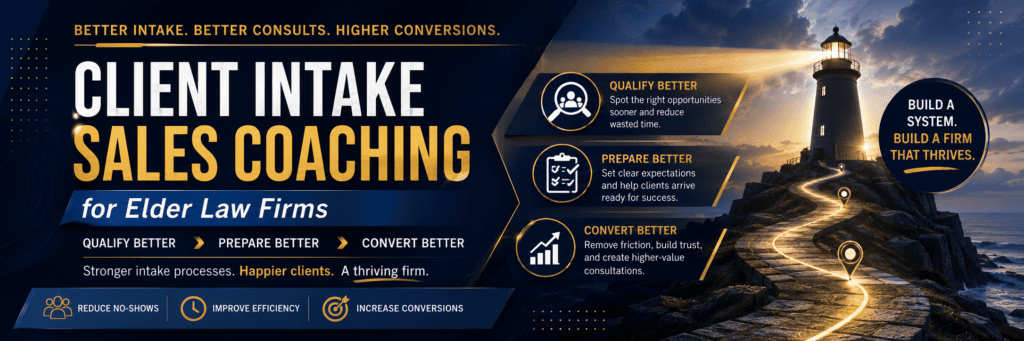
Client Intake Sales Coaching for Elder Law Firms

Client intake sales coaching can help elder law and estate planning firms improve consultation quality, strengthen conversion rates, and create a more consistent client experience. The most effective coaching programs do not focus on persuasion. They focus on improving how prospects move through the firm’s intake process, reducing uncertainty, and preparing both staff and attorneys for higher-quality consultations.

For many firms, conversion challenges begin long before the attorney enters the room. Intake is where expectations are set, urgency is identified, decision-makers are confirmed, and consults are positioned for success. When those steps are inconsistent, firms often experience lower conversion rates, increased no-shows, and operational inefficiencies that ripple throughout the organization.

Why Client Intake Deserves More Attention

Many elder law firms view intake as an administrative function. In reality, intake is one of the most influential stages in the client journey.

Prospective clients are typically navigating stress, uncertainty, family dynamics, and time-sensitive decisions. By the time they contact a firm, trust is already being formed. Coaching programs that improve intake performance help firms create a more structured and reassuring experience from the very first interaction.

Strong intake systems help firms:

  • Improve consult readiness
  • Reduce no-show rates
  • Identify qualified opportunities earlier
  • Create smoother attorney consultations
  • Increase operational consistency
  • Improve resource allocation across the team

The result is often better efficiency, not simply more appointments.


What Effective Client Intake Sales Coaching Actually Teaches

Not all sales coaching programs are designed for elder law and estate planning practices.

The most relevant programs focus on communication, workflow, process improvement, and consultation preparation rather than generic sales tactics.

Core areas typically include:

Understanding Client Psychology

Families rarely delay planning because they do not understand the need.

More often, delays stem from uncertainty, fear of making the wrong decision, competing family opinions, or simple overwhelm. Effective elder law firm coaching helps intake professionals recognize these factors and respond appropriately.

Asking Better Qualification Questions

Strong intake teams learn to uncover:

  • Why the prospect is reaching out now
  • What triggered the inquiry
  • Who will participate in the decision
  • Whether the matter is appropriately aligned with the firm’s services

This creates better consultations and minimizes preventable scheduling errors.

Preparing Clients for Success

The highest-performing firms understand that preparation is a service.

Client intake training often focuses on helping prospects arrive prepared emotionally, financially, and logistically. This reduces friction during consultations and allows attorneys to spend more time providing value rather than gathering missing information.


Signs Your Firm May Benefit from Intake Coaching

Many owners assume conversion challenges indicate a marketing problem.

Frequently, the issue exists further downstream.

Indicators may include:

  • High inquiry volume but inconsistent conversions
  • Frequent no-shows
  • Missing documents before consults
  • Attorneys repeating the same explanations
  • Consults that feel rushed or disorganized
  • Difficulty identifying qualified prospective clients
  • Staff uncertainty during intake calls

These issues often represent workflow breakdowns rather than individual performance concerns.

That distinction matters.

A busy intake department is not necessarily an effective intake department. Just as a busy firm is not automatically a profitable firm, activity alone does not guarantee results. Operational clarity matters more than volume.


How Intake Coaching Supports Consultation Conversion Optimization

Consultation conversion optimization is frequently misunderstood.

The goal is not to make consultations more aggressive.

The goal is to remove obstacles that make decisions harder.

Strong coaching programs help firms create:

Consistent Expectations

Clients understand:

  • What happens next
  • What information is needed
  • Who should attend
  • What outcomes to expect

Clear expectations reduce anxiety and improve engagement.

Better Attorney Preparation

When intake gathers meaningful information upfront, attorneys begin consultations with context.

This allows conversations to move beyond basic fact gathering and focus on higher-value guidance.

Reduced Friction

Many prospective clients hesitate because uncertainty remains unresolved.

Coaching helps firms identify common friction points and address them before they derail the consultation process.


Choosing the Right Sales Coaching Program for Your Firm

The right program depends on your firm’s growth objectives.

When evaluating sales coaching programs, consider these questions:

Does It Address Operations, Not Just Scripts?

A coaching program should improve systems, workflows, handoffs, and consistency.

Teaching staff what to say matters.

Teaching the firm how work moves matters more.

Is It Designed for Estate Planning and Elder Law Practices?

Elder law consultations involve unique emotional, family, and decision-making dynamics.

General business sales training may not address those realities effectively.

Does It Improve Team Alignment?

Successful intake depends on coordination between:

  • Intake staff
  • Attorneys
  • Operations leaders
  • Marketing personnel

Coaching should strengthen communication across the entire intake workflow.

Does It Include Measurement?

Effective programs help firms track:

  • Consultation booking rates
  • Show rates
  • Conversion rates
  • Intake completion metrics
  • Common bottlenecks

Improvement becomes difficult when firms cannot clearly see where prospects disengage.


Why Hiring More Staff Is Not Always the Answer

Many firms reach a point where intake feels overwhelmed.

The instinctive response is to hire.

Sometimes that is appropriate.

Often, however, the underlying issue is workflow design.

When processes remain inconsistent, adding people frequently creates additional complexity rather than better results. New team members inherit unclear expectations, inconsistent procedures, and communication gaps that already existed.

The most sustainable growth usually occurs when firms:

  1. Clarify the intake process.
  2. Standardize key steps.
  3. Define ownership.
  4. Improve coaching and accountability.
  5. Add capacity when the system can support it.

This sequencing creates scalability rather than simply increasing headcount.


Building a Stronger Intake Function

Client intake sales coaching for elder law and estate planning firms is ultimately about creating clarity.

Clarity for prospective clients.

Clarity for intake teams.

Clarity for attorneys.

And clarity for leadership.

When intake operates as a structured business process rather than a scheduling task, consultations become more productive, conversion rates become more predictable, and growth becomes easier to manage. The firms that scale most effectively are rarely the firms doing the most. They are the firms that create the most intentional systems around the work that matters most.

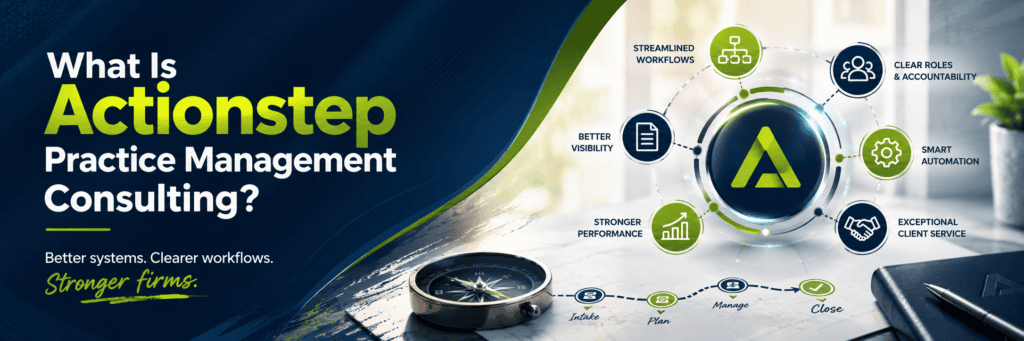
What Is Actionstep Practice Management Consulting?

Actionstep practice management consulting is the process of evaluating, configuring, and optimizing how a law firm uses Actionstep to manage work, people, workflows, data, and client service. Rather than focusing solely on software features, effective consulting focuses on how work actually moves through the firm and whether the system supports efficiency, delegation, accountability, and growth.

For many small estate planning and elder law firms, Actionstep is already capable of supporting stronger operational performance. The challenge is rarely the software itself. More often, firms struggle with inconsistent adoption, workarounds, unclear processes, and workflows that evolved without a clear operational strategy.

Actionstep Is a Practice Management Platform, Not a Business System

Most firms purchase software hoping it will solve operational problems.

In reality, technology only amplifies the systems already in place.

If client intake is inconsistent, deadlines are unclear, or staff responsibilities overlap, those issues typically remain present inside the software. In some cases, they become harder to identify because the firm assumes the technology is managing the process.

Actionstep practice management consulting focuses on aligning the platform with how the firm actually operates.

That includes:

  • Matter workflows
  • Task ownership
  • Intake and onboarding processes
  • Document management
  • Reporting and visibility
  • Staff accountability
  • Automation opportunities

The goal is not simply using more features.

The goal is creating operational clarity.

Why Many Firms Underutilize Actionstep

Actionstep is highly customizable.

That flexibility is valuable, but it can also create complexity.

Many firms gradually encounter challenges such as:

  • Staff using different processes for similar matters
  • Attorneys remaining involved in administrative work
  • Workflows that have never been updated
  • Manual steps replacing available automation
  • Data entry occurring in multiple locations
  • Reporting that fails to support decision-making

These issues often develop slowly.

A firm may remain busy and productive on the surface while underlying inefficiencies continue to grow.

This is similar to a common operational challenge seen across many legal practices: activity increases, yet profitability and capacity do not improve at the same pace. Being busy is not always the same as being efficient.

What Actionstep Optimization Actually Involves

Actionstep optimization looks beyond technology configuration.

It examines how work flows from initial inquiry through matter completion.

Common consulting areas include:

Workflow Mapping

Consultants examine:

  • Where work begins
  • Who owns each step
  • When matters stall
  • Which tasks require attorney involvement
  • Where bottlenecks repeatedly occur

The objective is identifying friction before attempting automation.

Automating a broken process simply allows mistakes to happen faster.

Role Clarification

One of the most common causes of operational overload is unclear ownership.

When responsibilities are not clearly defined:

  • Staff wait for instructions
  • Attorneys become default decision-makers
  • Tasks bounce between team members
  • Follow-ups are missed

Strong practice management systems support clear delegation.

That requires role definition before workflow automation becomes truly effective.

Automation Review

Many firms only use a fraction of Actionstep’s automation capabilities.

Consulting efforts often examine opportunities such as:

  • Automated task generation
  • Workflow triggers
  • Matter stage progression
  • Client communications
  • Document assembly processes
  • Status updates

The objective is reducing repetitive work while preserving quality and consistency.

Reporting Improvement

Law firm leaders frequently struggle to answer simple operational questions:

  • Where are matters getting stuck?
  • Which teams are over capacity?
  • How long do matters remain in specific stages?
  • Which processes create the most delays?

Actionstep optimization helps firms create meaningful operational visibility rather than collecting data without action.

The Relationship Between Actionstep and Law Firm Practice Management

Many firms view practice management as software administration.

Effective law firm practice management is much broader.

It includes:

  • People
  • Processes
  • Systems
  • Technology
  • Accountability
  • Capacity planning

Actionstep becomes significantly more valuable when it supports these operational functions.

For example, if attorneys are spending substantial time on administrative activities, the issue may not be staffing. It may be workflow design, role clarity, or process ownership. Workflow improvement often creates greater operational leverage than simply adding headcount.

This distinction matters because technology should support delegation, not create more dependency on attorneys.

How Small Estate Planning and Elder Law Firms Benefit

Estate planning and elder law firms face unique operational demands.

Cases often involve:

  • Multiple family decision-makers
  • Extensive document collection
  • Benefits coordination
  • Ongoing client communication
  • Highly detailed workflows

As volume grows, inconsistency becomes expensive.

Actionstep consulting helps firms create more predictable systems so work can move efficiently without relying on constant attorney oversight.

Benefits often include:

  • Better staff utilization
  • Reduced bottlenecks
  • Improved client experience
  • Clearer accountability
  • Faster matter progression
  • Greater operational capacity
  • More reliable reporting

Importantly, these improvements are often achieved by improving how work flows rather than simply hiring additional staff.

Adoption Matters More Than Configuration

One of the least discussed areas of Actionstep optimization is adoption.

A perfectly designed workflow has little value if the team does not consistently use it.

Successful consulting efforts often focus on:

  • Training expectations
  • Workflow consistency
  • Change management
  • Leadership accountability
  • Process documentation

Technology adoption is ultimately a people issue.

The most effective systems make the right actions easier and more intuitive for team members.

When Should a Firm Consider Actionstep Practice Management Consulting?

Consulting often becomes valuable when firms notice patterns such as:

  • Attorneys continually handling administrative work
  • Growing case volume without increased profitability
  • Difficulty identifying bottlenecks
  • Staff confusion about responsibilities
  • Inconsistent client experiences
  • Workflow breakdowns during growth
  • Lack of confidence in reporting data

These symptoms rarely indicate a software problem alone.

More often, they reflect a need for stronger operational alignment between people, processes, and technology.

Final Thoughts

Actionstep practice management consulting is not fundamentally about software customization. It is about helping a law firm create operational systems that support consistency, accountability, delegation, and sustainable growth.

For small estate planning and elder law firms, the greatest opportunity often lies not in adding more technology or more people, but in improving how work moves through the organization. When processes are clear and Actionstep is aligned with those processes, the platform becomes far more than a case management tool. It becomes part of a stronger operational foundation.

This perspective reflects a broader operational principle seen across successful firms: sustainable growth comes from system design, workflow clarity, and intentional delegation, not simply increased activity or additional headcount.

Talent Management for Estate Planning Firms in 2026

Sustainable estate planning law firm growth depends less on finding more work and more on building the team capable of handling that work consistently. For many estate planning and elder law firms, growth stalls when attorneys remain the center of every decision, every bottleneck, and every client interaction. The firms that scale most effectively focus on talent management as an operational strategy, not simply an HR function.

Talent management in 2026 is no longer just about hiring. It includes role clarity, coaching, delegation, retention, and creating systems that allow good people to succeed. Firms that approach talent this way often find themselves improving profitability, reducing stress, and creating greater capacity without immediately increasing headcount. These concepts align with operational themes found throughout The Million Dollar Solution’s workflow and hiring guidance.

Why Talent Management Has Become a Growth Issue

Many firm owners assume staffing problems are people problems.

Often, they are workflow problems.

When attorneys feel overwhelmed, intake is inconsistent, turnaround times lengthen, or client communication starts slipping, the instinct is frequently to hire another person. Yet adding employees to an unclear system rarely produces lasting relief.

Busy firms often remain stuck because:

  • Ownership is unclear
  • Work depends on attorney availability
  • Team members lack decision-making authority
  • Training is inconsistent
  • Processes exist in people’s heads instead of documented systems

Adding staff to a strained system may increase activity, but it does not automatically increase capacity.

In many estate planning and elder law firms, the real challenge is not a lack of people. It is a lack of operational clarity.

The Three Components of Effective Talent Management

1. Hiring for Ownership Rather Than Titles

One of the most common mistakes firms make is hiring based on familiar job titles.

Paralegal.

Legal Assistant.

Intake Coordinator.

Administrative Assistant.

Titles feel efficient, but they often hide the firm’s actual needs.

Before posting a job opening, leaders should identify:

  • Where work slows down
  • Which tasks continually return to attorneys
  • Which responsibilities have unclear ownership
  • Where communication breaks down

The best hires are often created by clearly defining outcomes before defining positions.

When ownership is clear, recruiting becomes easier because candidates know exactly what success looks like.

This approach also supports stronger small law firm talent management because expectations are established from the beginning.

2. Development Must Be Systematic

Many firms invest heavily in recruitment but very little in employee development.

The result is predictable:

New employees arrive with enthusiasm but gradually become frustrated by unclear expectations, inconsistent feedback, and reactive management.

Development should include:

  • Structured onboarding
  • Defined learning milestones
  • Regular coaching conversations
  • Skills-based growth opportunities
  • Clear performance expectations

Strong development systems create team members who make decisions confidently rather than constantly escalating questions to attorneys.

This is where concepts from elder law attorney coaching become valuable. Coaching is not reserved for attorneys alone. The same principles of clarity, accountability, and growth can be applied across the organization.

The goal is not simply to train employees.

The goal is to increase independent problem-solving capability throughout the firm.

3. Retention Begins With Alignment

Retention is often discussed as a compensation issue.

Compensation matters.

But many employees leave because they do not understand their role, see a future inside the organization, or feel connected to the firm’s mission.

High-performing estate planning and elder law firms typically focus on:

  • Role alignment
  • Leadership communication
  • Career development
  • Workload balance
  • Recognition of strengths

Retention improves when employees understand how their contributions connect to firm outcomes.

When people know what they own, they generally make better decisions, require less supervision, and remain engaged longer.

Retention is not simply a staffing metric.

It is an operational stability metric.

The Delegation Problem Most Firms Misunderstand

Delegation is frequently framed as a personal productivity skill.

In reality, delegation is a systems issue.

Attorneys often say:

“I would delegate more if I had better people.”

What often happens instead is:

  • Responsibilities are transferred without authority.
  • Expectations are assumed instead of documented.
  • Follow-up systems are absent.
  • Success criteria are unclear.

This creates rework, interruptions, and frustration.

Effective delegation requires:

  • Clear ownership
  • Defined decision boundaries
  • Documented workflows
  • Predictable feedback loops

Without those elements, delegation simply moves tasks around the office.

With them, delegation expands capacity.

That distinction often determines whether a firm grows smoothly or remains dependent on attorney effort.

Talent Management and Profitability

Many owners evaluate talent decisions as expenses.

Leading firms evaluate them as infrastructure.

A well-developed team produces profitability gains through:

  • Faster turnaround times
  • Lower attorney involvement in administrative work
  • Improved client experience
  • Reduced turnover costs
  • Greater consistency

This is similar to the principle seen in broader legal practice management consulting: sustainable growth occurs when systems support people and people support systems.

Profitability rarely improves because individuals are working harder.

It improves because work moves more effectively through the organization.

The Connection Between Marketing and Talent

This may seem surprising, but talent management also affects legal business development and even outcomes from estate planning marketing workshops.

When intake, onboarding, and client communication are inconsistent, marketing success can create additional strain.

More leads entering an overloaded system often produce:

  • Longer response times
  • Lower conversion rates
  • Frustrated staff
  • Increased attorney stress

Growth becomes sustainable when operational capacity grows alongside demand.

The strongest firms align:

  • Marketing
  • Intake
  • Staffing
  • Workflow
  • Leadership

As one operating system rather than separate initiatives.

What Talent Management Looks Like in 2026

The firms likely to achieve meaningful estate planning law firm growth over the next several years will not necessarily be the largest firms.

They will be the firms that:

  • Clarify ownership
  • Build repeatable onboarding systems
  • Develop people intentionally
  • Create strong leadership practices
  • Retain key contributors
  • Reduce dependence on individual attorneys

Growth is rarely constrained by ambition.

More often, it is constrained by capacity.

Talent management, when viewed through an operational lens, increases capacity without requiring firm owners to work longer hours.

Closing Thoughts

Many estate planning and elder law firms reach a point where effort stops producing proportional results. At that stage, growth becomes less about doing more and more about designing a stronger organization.

Talent management is often discussed as an HR initiative. In reality, it is a workflow initiative, a leadership initiative, and ultimately a profitability initiative.

The firms that understand this distinction are often the ones that create sustainable growth long after the excitement of a new hire fades.

Choosing Consulting for Estate Planning Firms

Small estate planning and elder law firms often seek consulting support when growth starts creating operational strain. The right consulting relationship helps a firm improve workflow, delegation, staffing, accountability, and profitability by creating systems that allow work to move more predictably without increasing attorney involvement in every decision.

For many firms, the challenge is not a lack of demand. It is the growing gap between being busy and operating efficiently.

Drawing on operational themes frequently discussed within The Million Dollar Solution’s workflow, hiring, retention, and practice management resources, successful firms tend to focus on systems, ownership, talent development, and process design rather than relying solely on additional staffing.

Why Estate Planning Firms Consider Practice Management Consulting

Growth creates complexity.

As a firm adds clients, staff members, and service offerings, informal processes that once worked begin to show strain. Attorneys become the default problem-solvers. Team members wait for approvals. Matters move inconsistently through the firm.

This is often the point where estate planning practice management becomes a leadership issue rather than simply an administrative one.

Consulting can help firms:

  • Clarify workflow ownership
  • Improve delegation
  • Reduce attorney bottlenecks
  • Create operational visibility
  • Align staffing with firm goals
  • Increase consistency across the client experience

The goal is not to create more procedures. The goal is to create more reliable outcomes.

Busy Does Not Always Mean Profitable

Many owner-led firms assume a full calendar indicates a healthy operation.

In reality, profitability is often constrained by hidden inefficiencies:

  • Frequent interruptions
  • Rework and corrections
  • Unclear handoffs
  • Attorney involvement in administrative decisions
  • Slow intake-to-engagement timelines
  • Lack of role accountability

When these issues accumulate, revenue may grow while margins remain flat.

This is one reason strategic consulting has become increasingly relevant for estate planning firms. The focus shifts from doing more work to improving how work moves through the organization.

What Good Consulting Actually Evaluates

Many firms begin searching for small law firm consulting services expecting recommendations about software, staffing, or marketing.

Those areas matter, but effective consultants usually start somewhere more fundamental: workflow.

A thorough assessment often examines:

Workflow Design

How does work move from intake to matter completion?

Where are matters getting delayed?

Which steps require attorney involvement unnecessarily?

Role Clarity

Do team members know exactly what they own?

Can decisions be made without constant escalation?

Are responsibilities documented and understood?

Capacity and Bottlenecks

What work is creating the most friction?

Where does overload consistently occur?

Are high-value employees spending time on low-value activities?

Leadership Structure

Are partners making strategic decisions or operational decisions?

Can the firm function effectively when key individuals are unavailable?

These questions often reveal opportunities that additional hiring alone would not solve.

Hiring Is Not Always the First Solution

When workload increases, many firms immediately consider adding headcount.

Sometimes that is necessary.

However, hiring into unclear systems often amplifies existing problems.

A new employee entering a disorganized workflow typically requires:

  • More supervision
  • More clarification
  • More attorney involvement
  • More operational coordination

Instead of relieving pressure, the firm may create additional complexity.

This is why talent management coaching is frequently paired with operational consulting. Strong firms define ownership, expectations, and workflows before expanding their teams. Training, onboarding, and role alignment become more effective when the underlying structure is clear.

Selecting the Right Practice Management Provider

Not every consultant serves estate planning firms in the same way.

When evaluating practice management providers, consider the following criteria.

Industry Familiarity

Estate planning and elder law firms operate differently than many other professional service businesses.

Long client relationships, emotionally complex matters, and extensive documentation create unique operational demands.

Consulting recommendations should reflect those realities.

Focus on Systems, Not Quick Fixes

Beware of solutions that depend entirely on hiring, technology, or marketing.

Sustainable improvement usually comes from stronger systems, clearer accountability, and better workflow design.

Operational Measurement

Effective consulting should help leadership answer practical questions:

  • Where are matters slowing down?
  • What is consuming attorney time?
  • Which processes generate the most rework?
  • How is capacity being utilized?

Without measurement, improvement becomes difficult to sustain.

Talent and Organizational Development

Operations and people are interconnected.

The strongest consulting engagements often include guidance around:

  • Hiring strategy
  • Role design
  • Employee development
  • Team communication
  • Leadership growth
  • Retention planning

A well-designed organization supports efficient workflow.

Signs a Firm May Benefit From Strategic Consulting

Most firms do not seek consulting because business is slow.

They seek support because growth is beginning to expose weaknesses.

Common indicators include:

  • Partners constantly solving operational problems
  • Team members waiting on attorney decisions
  • Repeated workflow breakdowns
  • Increased staff without improved productivity
  • Client communication inconsistencies
  • Unclear accountability
  • Difficulty scaling despite strong demand

These signals often suggest the firm has outgrown its informal operating model.

Operational Maturity Creates Scalability

The most sustainable estate planning firms eventually make a shift.

Instead of relying on individual effort, they rely on systems.

Instead of depending on memory, they create repeatable workflows.

Instead of adding people to every problem, they improve ownership and accountability.

That transition does not happen automatically.

It requires intentional design, leadership attention, and often an outside perspective that can identify inefficiencies hidden inside daily operations.

Final Thought

Choosing consulting for an estate planning firm is less about finding answers and more about gaining clarity.

When workflows are aligned, roles are understood, and leadership can focus on direction rather than constant intervention, growth becomes more predictable. Firms often discover that the greatest opportunity is not generating more activity, but improving how existing work flows through the organization.

Law Firm Leadership Development in 2026

Strong law firm management in 2026 depends less on working harder and more on developing leaders who can build systems, delegate effectively, and create accountability across the firm. For small estate planning and elder law practices, leadership development is increasingly tied to operational performance, team capacity, client experience, and long-term profitability. Internal MDS leadership and operations resources consistently emphasize that sustainable growth comes from clearer ownership, stronger training systems, better role alignment, and intentional leadership development rather than simply adding staff.

Why Leadership Has Become an Operational Issue

Many small firms reach a common growth point.

The owner becomes the solution to every problem.

Questions flow upward. Decisions bottleneck. Team members wait for approval. Client matters slow down. Attorneys become involved in work that others should be equipped to own.

At first, this feels like commitment.

Eventually, it becomes a capacity problem.

Firm owners often assume the next step is hiring another employee. In reality, many firms are experiencing a leadership gap rather than a staffing gap. MDS workflow guidance notes that hiring without clear ownership, accountability, and process design often increases strain instead of relieving it.

Leadership development helps firms move from owner-dependent operations to team-driven execution.

What Law Firm Leadership Looks Like in 2026

Today’s effective law firm leadership extends beyond supervision.

It requires creating an environment where work flows predictably without constant intervention.

This includes:

  • Defining ownership clearly
  • Building repeatable workflows
  • Establishing decision-making authority
  • Creating accountability systems
  • Developing future leaders inside the firm
  • Training employees to solve problems independently

Leadership is increasingly less about individual effort and more about organizational clarity.

As firms scale, successful leaders create systems that reduce dependence on themselves rather than increase it. This theme appears repeatedly throughout MDS operational, succession, and talent development materials.

The Role of Legal Education in Leadership Development

Traditional legal education provides essential technical knowledge.

Leadership requires a different skill set.

Many attorneys receive extensive training in substantive law but limited training in:

  • Delegation
  • Team development
  • Communication
  • Coaching
  • Workflow design
  • Performance management
  • Organizational planning

As a result, highly competent attorneys sometimes struggle when transitioning into leadership roles.

Modern leadership development often supplements legal knowledge with business and operational education focused on managing people, improving workflows, and building sustainable organizations. Firms that invest in these skills frequently create stronger team alignment and clearer operational consistency.

Why Professional Coaching for Lawyers Is Becoming More Important

One of the most significant shifts in 2026 is the growing value of professional coaching for lawyers.

Many leadership challenges aren’t knowledge problems.

They’re implementation problems.

Leaders often know what should happen but struggle with:

  • Delegating consistently
  • Holding employees accountable
  • Conducting difficult conversations
  • Managing change
  • Scaling their involvement appropriately

Structured coaching helps bridge the gap between understanding and execution.

MDS leadership development frameworks emphasize coaching systems that encourage employee ownership, goal setting, self-evaluation, and ongoing development rather than relying solely on annual reviews or reactive management conversations.

When coaching becomes part of firm culture, leadership capacity expands beyond the owners and partners.

Talent Management Consulting and Leadership Growth

Many firms approach hiring and leadership as separate initiatives.

In practice, they are closely connected.

Effective talent management consulting focuses on aligning people, roles, responsibilities, and organizational goals.

This often includes:

  • Organizational design
  • Role clarity
  • Succession planning
  • Leadership pipelines
  • Team communication
  • Development planning
  • Employee retention strategies

The objective is not simply hiring more people.

The objective is ensuring the right people are operating in the right roles with the right support.

Leadership development becomes significantly easier when expectations are clear, and team members understand ownership boundaries. MDS talent-management resources consistently emphasize role alignment, accountability structures, training plans, and leadership clarity as key drivers of retention and performance.

Why Busy Does Not Necessarily Mean Profitable

This remains one of the most important lessons for growing firms.

Many owners interpret constant activity as success.

But activity can hide inefficiency.

A firm can be:

  • Busy with interruptions
  • Busy with rework
  • Busy with unnecessary attorney involvement
  • Busy correcting preventable mistakes
  • Busy managing unclear expectations

None of these activities directly improve profitability.

Leadership development helps owners distinguish productive work from reactive work.

Firms that strengthen leadership often discover that reducing bottlenecks improves profitability more than increasing workload volume. MDS growth and workflow materials also note that “more” is not always better, whether discussing leads, hiring, or operational activity. Better alignment frequently creates greater results than greater volume.

Leadership Lessons for the Modern Elder Law Practice

The modern elder law practice operates in an environment of increasing complexity.

Families arrive with more information, more questions, and often more emotional stress.

This places greater demands on firm operations.

Leadership development helps create consistency across:

  • Intake
  • Client communication
  • Matter management
  • Team coordination
  • Workflow ownership
  • Client experience

Strong leaders establish systems that allow the firm to deliver consistent service regardless of which team member is involved.

This is particularly important in elder law, where trust, clarity, and responsiveness significantly influence the client experience.

Leadership Development and Succession Readiness

Many firms think about succession planning later than they should.

Leadership development is often the foundation that makes succession possible.

A useful question appears in MDS succession planning materials:

If the owner stepped away for 90 days, what would be most vulnerable?

The answer frequently reveals leadership gaps.

Succession readiness requires:

  • Documented processes
  • Cross-training
  • Leadership depth
  • Accountability systems
  • Operational consistency

Firms that invest in leadership development early tend to build greater resilience and flexibility over time.

Building a Leadership Development Strategy for 2026

For most small firms, leadership development does not begin with a major organizational change.

It begins with a few practical questions:

  • What decisions still flow through the owner unnecessarily?
  • Where do team members need greater authority?
  • Which leadership skills are missing today?
  • What training systems exist for future leaders?
  • How are managers being developed?
  • Are workflows supporting leadership growth or preventing it?

The goal is not to create more management layers.

The goal is to create clarity.

When leadership development is aligned with workflow design, talent management, and operational systems, firms become more scalable, more predictable, and less dependent on heroic effort.

Final Thoughts

Leadership development is no longer separate from law firm management.

For small estate planning and elder law firms, leadership directly influences workflow efficiency, staffing effectiveness, profitability, client experience, and long-term sustainability.

The firms that grow most successfully in 2026 are unlikely to be the busiest.

They will be the firms that build clear systems, develop capable leaders, create accountability, and reduce unnecessary dependence on owners and partners.

Leadership, ultimately, is not about being involved in everything.

It is about creating an organization that can perform consistently because everyone understands what they are responsible for and how success is measured.

How to Optimize an Elder Law Firm in 2026

Small elder law firms rarely struggle because they lack commitment, expertise, or demand. More often, growth creates operational complexity that existing systems can no longer absorb. Firms improve performance when they intentionally design workflows, clarify team responsibilities, and build operating systems that allow work to move efficiently without constant attorney intervention.

As elder law practices continue to navigate increasing client expectations, staffing challenges, and administrative demands, operational optimization has become a business necessity rather than a growth initiative.

Why Optimization Matters More Than Growth

Many owner-led firms reach a point where the calendar is full, staff members are busy, and revenue appears healthy. Yet partners often feel trapped inside the business.

Common symptoms include:

  • Attorneys solving routine operational problems
  • Work stalling between team members
  • Inconsistent client experiences
  • Delays in drafting, review, or execution
  • Team members waiting for direction before moving matters forward

These issues are rarely caused by a lack of effort.

They are usually signs that the firm’s operational structure has not evolved alongside its growth.

Busy Does Not Automatically Mean Profitable

One of the most common misconceptions in small law firm operations is assuming workload and profitability move together.

In reality, many elder law firms experience growing demand while margins remain stagnant.

Why?

Because profitability is often lost through:

  • Rework
  • Bottlenecks
  • Excessive attorney involvement
  • Poor delegation
  • Slow handoffs between staff

When experienced professionals spend significant time coordinating work rather than advancing client matters, productivity declines without anyone noticing.

Operational efficiency creates leverage. More activity does not.

The First Question: How Does Work Actually Move?

Effective legal workflow optimization begins with visibility.

Before evaluating software, hiring staff, or adjusting compensation, firms should understand exactly how a matter moves from intake to completion.

Key questions include:

  • Who owns each stage?
  • What information is required before work advances?
  • When is attorney judgment truly necessary?
  • Where do files consistently slow down?
  • Which team members become bottlenecks?

Many firms discover that processes have evolved informally over time. Important decisions remain trapped in individual knowledge rather than documented systems.

As complexity increases, reliance on memory becomes increasingly expensive.

Why Hiring Alone Rarely Solves Operational Stress

When workloads increase, hiring often feels like the obvious solution.

Sometimes it is.

Often it is not.

Additional staff create additional communication pathways, training needs, supervision requirements, and handoffs. If underlying workflows remain unclear, firms frequently experience a surprising outcome:

They become busier without becoming more effective.

Hiring adds capacity.

Systems create leverage.

The most successful firms stabilize workflows before expanding headcount, ensuring new team members enter a structured environment that supports ownership and accountability.

Strengthening Talent Management for Lawyers and Legal Teams

Talent management is increasingly becoming an operational discipline rather than a purely HR function.

Many firms focus significant energy on recruitment while underinvesting in development, role clarity, and long-term retention.

Strong teams generally share several characteristics:

Defined Responsibilities

Every role should have clear ownership.

When responsibilities overlap excessively, accountability disappears.

Structured Onboarding

New hires should enter an environment with documented expectations, training plans, and measurable milestones. Structured onboarding accelerates productivity and improves retention.

Ongoing Coaching

High-performing firms treat development as a continuous process rather than an annual event.

Regular conversations about strengths, goals, performance, and career development help maintain engagement and alignment.

Cross-Training

Cross-trained teams reduce operational risk.

When key processes depend entirely on one individual, continuity becomes fragile. Firms gain resiliency when team members can provide coverage during absences, transitions, or growth periods.

The Hidden Bottleneck: Attorney Dependence

A recurring challenge in law firm operations is excessive reliance on attorneys for non-legal decisions.

Many firms unintentionally train staff to escalate routine questions upward.

Over time, partners become:

  • Approval centers
  • Information hubs
  • Problem-solving engines

This creates delays throughout the organization.

Operational maturity occurs when routine decisions are handled at the appropriate level while attorneys remain focused on legal strategy, client guidance, and high-value work.

The goal is not less involvement.

The goal is more intentional involvement.

Building Systems That Support Scale

Effective practice management consulting often focuses on creating repeatable operating systems.

The strongest systems answer practical questions before confusion occurs:

  • What happens next?
  • Who owns it?
  • When is it complete?
  • What triggers the next step?

When these answers exist within the workflow itself, firms experience:

  • Faster matter movement
  • Fewer interruptions
  • Better capacity planning
  • Improved consistency
  • Reduced stress

Optimization is ultimately about creating reliability.

Reliable firms tend to grow more predictably than reactive firms.

How to Evaluate Elder Law Firm Consulting Support

Not all consulting support is designed to solve operational problems.

When evaluating an elder law firm consulting partner, consider whether they focus on tangible operational outcomes.

Useful evaluation criteria include:

Workflow Visibility

Can they identify where matters stall, repeat, or slow down?

Staffing Alignment

Do they assess whether responsibilities match team capabilities and capacity?

Operational Metrics

Do they help establish measurable indicators for productivity, utilization, throughput, or bottlenecks?

Process Design

Can they create repeatable systems that reduce dependence on individual memory?

Leadership Capacity

Do they help firm owners spend less time managing daily friction and more time leading strategically?

Practice management consulting should create clarity, not complexity.

The objective is a firm that functions consistently, even when leadership is not directly involved in every decision.

The Future of Small Law Firm Services

The firms likely to thrive in the coming years will not necessarily be the largest.

They will be the most operationally intentional.

Technology will continue evolving.

Client expectations will continue rising.

Talent challenges will continue affecting the profession.

Firms that build clear systems, develop strong teams, and remove unnecessary friction will be better positioned to adapt regardless of market conditions.

Optimization is not about doing more.

It is about making the work you already do move more effectively.

A Closing Thought

The healthiest elder law firms are not defined by how busy they are.

They are defined by how reliably they convert effort into meaningful results for clients, staff, and leadership.

When workflows are intentional, roles are clear, and operational systems support the work instead of resisting it, growth becomes less stressful and far more sustainable.

How Intake Coaching Helps Elder Law Conversion

For many elder law firms, conversion challenges begin long before the attorney enters the consultation room. Sales coaching for elder law firms helps teams improve the client intake process by creating clarity, consistency, and confidence at every stage of the client journey. When intake conversations are structured well, consultations become more productive, clients arrive better prepared, and attorneys spend less time rebuilding trust or filling information gaps.

Intake Is Not Administrative Work. It Is Part of the Consultation.

Many small firms unintentionally treat intake as a scheduling function. The appointment gets booked, paperwork is requested, and the consultation begins.

In practice, however, intake often determines whether a consultation moves forward smoothly or stalls before it starts.

Strong intake processes help firms:

  • Set expectations clearly
  • Identify decision-makers early
  • Prepare clients for the consultation
  • Reduce attorney rework
  • Improve overall conversion consistency

When these elements are missing, attorneys frequently spend valuable consultation time clarifying next steps, gathering basic information, or addressing confusion that could have been resolved earlier.

Why Elder Law Consultations Often Struggle

Many firm owners assume low conversion rates are primarily a marketing issue.

Often, they are an operations issue.

Prospective clients frequently arrive overwhelmed. In many cases, adult children, spouses, or multiple family members are involved in the decision-making process. By the time they contact an elder law firm, they have already spent considerable time researching options and trying to understand a complex situation.

Common intake-related conversion challenges include:

  • Missing decision-makers
  • Unclear expectations
  • Missing documents
  • Uncertain pricing assumptions
  • Fear of making the wrong decision
  • Information overload

These issues create friction before the attorney ever begins advising the family.

What Sales Coaching for Elder Law Firms Actually Improves

The phrase “sales coaching” can be misunderstood.

In successful elder law firms, coaching is rarely about persuasion. It is about helping staff and attorneys communicate more clearly, identify client concerns earlier, and guide conversations with confidence.

Effective coaching typically focuses on three areas.

1. Asking Better Questions

High-performing intake teams follow a logical conversation flow rather than jumping immediately to scheduling.

They learn how to uncover:

  • Why the client is reaching out now
  • What urgency exists
  • Who will be involved in the decision
  • Whether the client is ready to move forward

These questions provide context that improves both preparation and conversion.

2. Reducing Client Uncertainty

Many clients delay decisions because they are overwhelmed, uncertain, or worried about making a mistake.

Coaching helps staff recognize common forms of hesitation and respond with clarity instead of pressure.

When clients understand what happens next, what information is needed, and what outcomes are realistic, decision-making becomes easier.

3. Creating Consistency

A firm may have talented attorneys, but inconsistent intake creates inconsistent results.

Coaching helps establish:

  • Standardized call flows
  • Intake checklists
  • Consultation preparation processes
  • Communication standards
  • Follow-up expectations

Consistency allows firms to measure performance and improve it over time.

Busy Does Not Always Mean Efficient

One of the more common growth mistakes among small elder law firms is assuming that increased activity automatically translates into stronger performance.

It frequently does not.

Firms become busier because:

  • More inquiries arrive
  • More staff are hired
  • More consultations are scheduled

Yet conversion rates remain unchanged.

The underlying issue is often workflow design.

Without a structured intake process, additional volume simply introduces more confusion into the system. More inquiries create more bottlenecks. More staff increase coordination demands. More consultations consume attorney capacity without improving outcomes.

Why Hiring Alone Rarely Fixes Intake Problems

When firms experience conversion challenges, the instinct is often to hire another intake coordinator, marketing employee, or attorney.

But hiring does not solve unclear processes.

If expectations, scripts, workflows, and responsibilities remain undefined, additional staff frequently inherit the same problems that already exist.

The result is:

  • Inconsistent client experiences
  • Escalating attorney involvement
  • Variable conversion outcomes
  • Training challenges
  • Reduced profitability

Improvement usually starts with process clarity before headcount expansion.

The Connection Between Intake and Law Firm Conversion Optimization

Many conversion discussions focus on sales techniques.

The stronger operational perspective is to focus on preparation.

The best consultations are often not “closed.”

They are prepared.

When clients arrive with:

  • The right information
  • Realistic expectations
  • Appropriate decision-makers
  • Greater confidence

The attorney can spend more time providing value and less time overcoming preventable obstacles.

This is where law firm conversion optimization becomes less about persuasion and more about operational design.

How Better Intake Supports Small Law Firm Growth

Growth becomes easier when work enters the firm with clarity.

A strong intake system creates benefits beyond conversion:

  • Better client experience
  • More predictable workflows
  • Reduced attorney interruptions
  • Improved delegation
  • Higher staff confidence
  • Greater operational scalability

Over time, firms that invest in coaching and intake development often discover that efficiency improvements create more capacity than additional hiring.

Final Thought

The client intake process is often the most overlooked growth lever inside an elder law firm.

While marketing generates opportunities, intake determines how effectively those opportunities move forward. Sales coaching for elder law firms helps teams create consistent client experiences, remove friction from consultations, and build operational systems that support sustainable growth.

The firms that convert more effectively are rarely the firms applying more pressure. They are usually the firms creating more clarity.

7 Things to Know Before Choosing Estate Firm Coaching

Many estate planning and elder law firms begin looking for coaching when growth feels harder than it should. Work is getting done, clients are being served, and revenue may even be increasing—yet attorneys remain deeply involved in daily operations, staff feels stretched, and bottlenecks continue to surface.

The most valuable estate planning firm coaching doesn’t simply help firms get busier. It helps them create systems, workflows, and decision-making structures that allow growth without increasing complexity at the same pace. Insights throughout this article reflect recurring operational themes found in The Million Dollar Solution’s educational materials on workflow design, intake excellence, staffing, growth strategy, and practice management.

1. Coaching Should Address Operations, Not Just Marketing

Many firms initially seek coaching because they want more cases.

The challenge is that more leads often expose existing operational weaknesses.

If intake processes are inconsistent, work depends on individual employees instead of documented systems, or attorneys serve as the default solution to every problem, additional marketing can amplify inefficiencies rather than solve them.

Strong coaching programs examine:

  • Workflow design
  • Team accountability
  • Practice management systems
  • Capacity planning
  • Operational bottlenecks

Marketing matters. But sustainable growth usually requires operational clarity first.

2. Busy Is Not the Same as Profitable

One of the most common misconceptions in small law firm growth is equating activity with success.

Many firms reach a stage where:

  • Calendars are full
  • Staff members are constantly occupied
  • Attorneys feel overwhelmed
  • Revenue increases slowly despite increased effort

In these situations, the issue often isn’t effort.

It’s workflow.

Practice management consulting should help owners understand where work stalls, repeats, waits for approvals, or depends on a single individual. Profitability frequently improves when work flows more predictably—not when everyone simply works harder.

3. Hiring More People May Not Fix the Real Problem

When workloads increase, the natural reaction is hiring.

Sometimes that’s necessary.

However, coaching should help firms determine whether the problem is capacity or process.

Adding staff to inconsistent systems often creates new challenges:

  • More training requirements
  • Increased management complexity
  • Additional communication breakdowns
  • Greater dependency on attorneys

Before expanding headcount, many firms benefit from understanding where workflow friction exists and why.

A coaching program that immediately recommends more hiring without evaluating operational systems may be treating a symptom rather than the cause.

4. Intake Is Often a Bigger Growth Lever Than Marketing

Many firms spend significant resources on elder law marketing while overlooking what happens after a prospect makes contact.

Yet intake frequently determines:

  • Client expectations
  • Consultation quality
  • Conversion rates
  • Team efficiency
  • Workload predictability

High-performing firms recognize that intake is not a scheduling function.

It is an operational function.

Client intake coaching should help teams:

  • Clarify urgency
  • Identify decision-makers
  • Assess readiness
  • Set expectations early
  • Improve information gathering

When intake improves, both marketing performance and operational efficiency often improve alongside it.

5. Good Coaching Creates Systems, Not Dependency

Some coaching programs become an ongoing source of answers.

Others teach firms how to solve problems independently.

The strongest estate planning firm coaching helps owners build:

  • Repeatable workflows
  • Clear handoffs
  • Defined responsibilities
  • Consistent operational standards
  • Measurable performance indicators

The goal is not creating reliance on an outside advisor.

The goal is increasing organizational capability.

Firms that become less dependent on individual employees—and less dependent on constant owner involvement—usually become more scalable as well.

6. Team Development Matters as Much as Strategy

Growth challenges are rarely caused solely by marketing or technology.

People remain central to every system.

Effective coaching should include conversations around:

  • Role clarity
  • Communication
  • Accountability
  • Employee development
  • Leadership effectiveness

Many operational bottlenecks emerge because expectations are unclear, training is inconsistent, or team members are working outside their strengths.

Coaching that addresses both systems and people tends to produce more durable results than strategy alone.

7. The Best Coaching Helps Firms Scale With Less Friction

Every growing firm eventually reaches the point where working harder stops working.

That transition generally involves a shift:

From output → to flow.

Instead of asking:

“How can we get more done?”

Firms begin asking:

  • Where does work slow down?
  • What decisions repeat unnecessarily?
  • Which tasks should be delegated?
  • What depends on one person?
  • What would break if a key employee were unavailable?

These questions reveal whether growth is supported by systems or dependent on effort.

The coaching programs that create the greatest long-term value help firms identify and reduce those friction points before growth magnifies them.

Final Thoughts

Choosing estate planning firm coaching should be less about finding new tactics and more about gaining operational clarity.

Most growth challenges in small estate planning and elder law firms are not caused by a lack of effort. They emerge when workflows become informal, bottlenecks multiply, and complexity grows faster than systems.

The firms that scale most effectively are often the ones that learn to improve how work moves through the organization—not simply how much work they can generate.

That distinction frequently determines whether growth creates opportunity or overwhelm.

What to Look for in Estate Planning Intake Coaching

Many estate planning firms assume intake problems are marketing problems. In reality, firms often lose momentum long before an attorney enters the conversation. A strong estate planning attorney client intake coaching program helps firms build a process that creates clarity, improves client readiness, reduces operational friction, and makes consultations more productive from the very beginning. Based on internal guidance emphasizing that intake is a growth lever rather than an administrative task, effective intake coaching focuses on trust, preparation, qualification, and workflow consistency.

Why Intake Coaching Matters More Than Many Firms Realize

In many firms, intake is treated as scheduling.

The challenge is that intake is actually the first stage of the client experience.

Prospective clients often arrive overwhelmed, uncertain, and under pressure. They are evaluating not only legal competence but also whether the firm appears organized, trustworthy, and capable of guiding them through a difficult decision. Strong intake processes establish confidence before the consultation ever begins.

When intake lacks structure, firms frequently experience:

  • Unclear expectations
  • Missing documents
  • Consultation no-shows
  • Delayed decisions
  • Attorney bottlenecks
  • Increased staff rework

These issues create operational drag that can quietly limit profitability and scalability.

The Best Intake Coaching Programs Focus on Process, Not Scripts

Many coaching programs promise better conversions through improved communication techniques.

While communication matters, the strongest programs focus on building repeatable systems.

Look for coaching that helps your firm create:

  • Consistent intake workflows
  • Defined qualification criteria
  • Client preparation standards
  • Documentation checklists
  • Consultation readiness procedures
  • Performance measurements for intake success

The goal is not to sound more persuasive.

The goal is to ensure every prospective client enters the consultation with the right expectations, the right information, and the right decision-makers present.

Coaching Should Teach Teams How to Identify Readiness

Not every inquiry is ready to move forward.

One of the most valuable aspects of attorney business coaching in the intake area is learning how to identify readiness early.

Effective coaching programs help teams evaluate:

Urgency

Why is the client reaching out now?

What changed?

Is there a meaningful timeline?

Decision Authority

Who is responsible for making decisions?

Who should attend the consultation?

Readiness

Does the client have the necessary information, documents, and commitment to move forward?

Firms that understand these factors spend less time chasing stalled matters and more time serving clients who are positioned to take action.

Look for Coaching That Reduces Attorney Bottlenecks

One of the most common growth challenges in estate planning firms is assuming that adding more consultations automatically creates growth.

Often, it creates congestion.

Busy does not always mean profitable.

A strong intake coaching program should help firms reduce attorney dependency by ensuring intake staff gather critical information before the consultation occurs.

When attorneys receive cleaner, more organized intake data, they can focus on high-value conversations rather than rebuilding context from scratch.

This improvement affects:

  • Consultation quality
  • Attorney utilization
  • Scheduling efficiency
  • Staff confidence
  • Client experience

The result is a smoother workflow rather than simply a busier calendar.

The Program Should Address Client Psychology

Many firms view intake as an operational function.

Top coaching programs recognize it is also a trust-building function.

Prospective clients frequently hesitate because of:

  • Fear of making the wrong decision
  • Family dynamics
  • Financial uncertainty
  • Information overload
  • Emotional stress

Effective coaching teaches teams how to reduce uncertainty without creating pressure.

When clients feel informed and prepared, decision-making becomes easier and consultations become more productive.

Strong Intake Coaching Supports Law Firm Client Acquisition

Law firm client acquisition is often discussed as a marketing challenge.

In reality, acquisition and intake are closely connected.

Marketing may generate inquiries.

Intake determines whether those inquiries become productive consultations and aligned client relationships.

The strongest firms understand that growth comes from attracting and qualifying the right matters—not simply generating more leads.

Good coaching helps firms:

  • Define ideal client characteristics
  • Improve qualification standards
  • Reduce low-fit consultations
  • Create more predictable workflows
  • Protect team capacity

This is especially important for firms experiencing growth-related stress.

Hiring more people rarely fixes intake inefficiencies if the underlying process remains unclear.

Evaluate the Outcomes the Program Produces

When comparing coaching programs for attorneys, focus less on the program’s description and more on the outcomes it is designed to create.

Look for programs that improve:

Workflow Consistency

Each inquiry follows a predictable path.

Consultation Readiness

Clients arrive prepared and informed.

Team Alignment

Staff understand expectations and their role within the process.

Operational Efficiency

Fewer handoff errors and less duplicated work.

Sustainable Growth

Better-fit matters move through the firm with less friction.

These outcomes tend to have a much greater long-term impact than short-term conversion improvements alone.

Questions to Ask Before Choosing an Intake Coaching Program

Consider asking:

  • Does the program teach systems or just conversation techniques?
  • Does it address workflow and operational efficiency?
  • Does it help identify client readiness?
  • Does it support delegation and staff development?
  • Does it include measurable standards and accountability?
  • Does it focus on long-term process improvement?

The answers usually reveal whether the program is designed to create lasting operational improvements or temporary behavioral changes.

Final Thought

The most effective estate planning attorney client intake coaching programs are not really about intake alone.

They are about creating a smoother path from first contact to completed engagement.

When intake becomes a structured preparation system rather than a scheduling function, consultations improve, bottlenecks decrease, and growth becomes easier to manage. Firms that scale successfully often discover that operational clarity—not volume—is what allows growth to feel sustainable. That insight starts at intake.

How to Choose Law Firm Growth Consulting in 2026

Small law firms rarely struggle because attorneys lack legal skill. More often, growth becomes difficult because operations, staffing, leadership, and client workflows fail to scale alongside demand. Choosing the right law firm growth consulting partner in 2026 means finding someone who can improve how the firm functions—not simply increase activity.

For estate planning and elder law firms, the best consulting relationships focus on profitability, operational clarity, delegation, leadership development, client conversion, and sustainable systems that support long-term growth. Many firms discover that their biggest challenge is not attracting more work, but creating a practice capable of handling growth effectively.


Why Law Firm Growth Consulting Has Changed

A few years ago, many consultants focused primarily on marketing and lead generation.

Today, firm owners face a different reality.

They are often:

  • Managing overloaded teams
  • Struggling with inconsistent workflows
  • Experiencing attorney bottlenecks
  • Fighting staffing turnover
  • Dealing with operational complexity created by growth

More cases do not automatically create more profit.

In fact, growth frequently exposes operational weaknesses that were hidden when the firm was smaller. As volume increases, unclear processes, inconsistent intake, weak delegation, and undefined ownership create friction throughout the organization.

A quality practice management consulting engagement should address those foundational issues before pursuing aggressive expansion.


Start With the Firm’s Real Problem

Before evaluating consultants, owners should ask:

What is currently limiting growth?

Common answers include:

Capacity Problems

The calendar is full, but work continues to pile up.

Workflow Problems

Work depends on memory instead of process.

Staffing Problems

Employees are busy but accountability remains unclear.

Leadership Problems

Partners remain involved in nearly every decision.

Conversion Problems

Prospective clients reach out, but many fail to move forward.

Each challenge requires a different solution.

Consultants who prescribe the same answer to every firm often create more complexity than improvement.


The Best Consultants Focus on Profitability, Not Activity

One of the easiest traps for small firms is confusing motion with progress.

Teams look busy.

Attorneys work longer hours.

Case volume rises.

Yet profitability remains stagnant.

Strong law firm growth consulting focuses on eliminating friction inside the business rather than simply adding more work to the system.

Areas that deserve attention include:

  • Process design
  • Delegation structures
  • Client journey management
  • Staff utilization
  • Leadership bandwidth
  • Technology adoption
  • Operational accountability

The goal is creating leverage throughout the organization—not making everyone work harder.


Evaluate Their Approach to Legal Operations Management

Many consulting firms discuss growth but rarely discuss operational flow.

That should raise concern.

Effective legal operations management improves how work moves through the firm from initial inquiry to matter completion.

Questions worth asking include:

Do they map workflows?

Growth becomes difficult when firms cannot clearly see where work slows down, stalls, or loops backwards.

Do they address ownership?

Every step should have a clear owner.

Unclear responsibility is one of the most common sources of bottlenecks.

Do they separate attorney work from administrative work?

When attorneys routinely handle operational tasks, profitability declines and scalability suffers.

Do they improve handoffs?

Many workflow issues appear at transition points between team members.

Strong consultants focus heavily on those moments.


Assess Their Philosophy on Hiring

Many firms assume additional hiring will solve growth challenges.

Often it does not.

Hiring into unclear systems simply adds more people to existing confusion.

The strongest consultants view hiring as part of a broader operational strategy.

They help firms:

  • Define roles clearly
  • Align responsibilities effectively
  • Improve onboarding
  • Develop training frameworks
  • Create retention plans
  • Build leadership pipelines

Organizations that establish operational clarity before expanding headcount often experience stronger and more sustainable results.

This is particularly important for owner-led firms where partners frequently become the default solution for every problem.


Consider Their Expertise in Leadership Development

Many growth issues are leadership issues wearing operational disguises.

The challenge may look like:

  • Missed deadlines
  • Poor delegation
  • Staff dependency
  • Slow decision-making

In reality, the root issue is often leadership capacity.

Strong law firm leadership coaching helps owners transition from technician to leader.

Rather than personally solving every problem, leaders learn to:

  • Establish expectations
  • Build accountability
  • Coach employees effectively
  • Develop future leaders
  • Create organizational resilience

This shift becomes increasingly important as firms grow beyond a handful of employees.


Look Closely at Their Client Conversion Philosophy

The best growth consultants understand that client acquisition and operations are connected.

Many firms focus heavily on attracting prospects while neglecting intake and qualification processes.

Strong conversion systems help firms:

  • Identify the right prospective clients
  • Set expectations early
  • Improve readiness
  • Reduce consultation friction
  • Increase confidence in the decision process

Successful firms do not simply generate more leads.

They create systems that attract better-aligned matters and move those opportunities through a predictable process.

That distinction matters.

More inquiries can create additional workload.

Better-fit inquiries improve profitability.


Why Actionstep Alignment Matters

In 2026, technology should support operations—not compensate for weak operations.

If a consultant works with firms using Actionstep, they should understand how systems, workflows, and accountability structures interact inside the platform.

Technology implementation alone rarely creates transformation.

The real value comes from aligning:

  • Intake procedures
  • Matter workflows
  • Task ownership
  • Reporting standards
  • Team accountability
  • Operational visibility

The software should reinforce the process—not become the process.

Firms that approach technology this way tend to achieve stronger adoption and more consistent outcomes.


Questions to Ask Before Hiring a Consultant

Before making a decision, ask:

  1. How do you evaluate workflow bottlenecks?
  2. How do you measure profitability improvement?
  3. How do you approach delegation and attorney workload reduction?
  4. How do you improve staff accountability?
  5. What role does leadership development play?
  6. How do you evaluate intake and client conversion?
  7. How do you align operational processes with technology platforms such as Actionstep?
  8. How do you determine whether hiring is actually necessary?

Their answers often reveal whether they focus on symptoms or root causes.


The Best Growth Strategy Is Often Simpler Than Expected

Many estate planning and elder law firms are not struggling because they need more marketing, more software, or more staff.

They are struggling because growth has exposed gaps in workflow design, leadership structure, operational accountability, and delegation.

The right law firm growth consulting relationship helps owners see those patterns clearly. From there, sustainable profitability becomes less about doing more and more about creating systems that allow good work to flow predictably.

Growth becomes easier when the firm itself becomes easier to run.