Law Firm Leadership Development in 2026

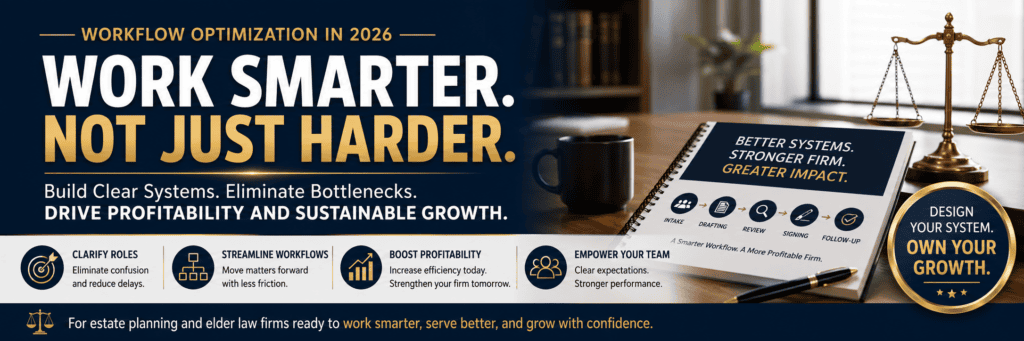
Strong law firm management in 2026 depends less on working harder and more on developing leaders who can build systems, delegate effectively, and create accountability across the firm. For small estate planning and elder law practices, leadership development is increasingly tied to operational performance, team capacity, client experience, and long-term profitability. Internal MDS leadership and operations resources consistently emphasize that sustainable growth comes from clearer ownership, stronger training systems, better role alignment, and intentional leadership development rather than simply adding staff.

Why Leadership Has Become an Operational Issue

Many small firms reach a common growth point.

The owner becomes the solution to every problem.

Questions flow upward. Decisions bottleneck. Team members wait for approval. Client matters slow down. Attorneys become involved in work that others should be equipped to own.

At first, this feels like commitment.

Eventually, it becomes a capacity problem.

Firm owners often assume the next step is hiring another employee. In reality, many firms are experiencing a leadership gap rather than a staffing gap. MDS workflow guidance notes that hiring without clear ownership, accountability, and process design often increases strain instead of relieving it.

Leadership development helps firms move from owner-dependent operations to team-driven execution.

What Law Firm Leadership Looks Like in 2026

Today’s effective law firm leadership extends beyond supervision.

It requires creating an environment where work flows predictably without constant intervention.

This includes:

  • Defining ownership clearly
  • Building repeatable workflows
  • Establishing decision-making authority
  • Creating accountability systems
  • Developing future leaders inside the firm
  • Training employees to solve problems independently

Leadership is increasingly less about individual effort and more about organizational clarity.

As firms scale, successful leaders create systems that reduce dependence on themselves rather than increase it. This theme appears repeatedly throughout MDS operational, succession, and talent development materials.

The Role of Legal Education in Leadership Development

Traditional legal education provides essential technical knowledge.

Leadership requires a different skill set.

Many attorneys receive extensive training in substantive law but limited training in:

  • Delegation
  • Team development
  • Communication
  • Coaching
  • Workflow design
  • Performance management
  • Organizational planning

As a result, highly competent attorneys sometimes struggle when transitioning into leadership roles.

Modern leadership development often supplements legal knowledge with business and operational education focused on managing people, improving workflows, and building sustainable organizations. Firms that invest in these skills frequently create stronger team alignment and clearer operational consistency.

Why Professional Coaching for Lawyers Is Becoming More Important

One of the most significant shifts in 2026 is the growing value of professional coaching for lawyers.

Many leadership challenges aren’t knowledge problems.

They’re implementation problems.

Leaders often know what should happen but struggle with:

  • Delegating consistently
  • Holding employees accountable
  • Conducting difficult conversations
  • Managing change
  • Scaling their involvement appropriately

Structured coaching helps bridge the gap between understanding and execution.

MDS leadership development frameworks emphasize coaching systems that encourage employee ownership, goal setting, self-evaluation, and ongoing development rather than relying solely on annual reviews or reactive management conversations.

When coaching becomes part of firm culture, leadership capacity expands beyond the owners and partners.

Talent Management Consulting and Leadership Growth

Many firms approach hiring and leadership as separate initiatives.

In practice, they are closely connected.

Effective talent management consulting focuses on aligning people, roles, responsibilities, and organizational goals.

This often includes:

  • Organizational design
  • Role clarity
  • Succession planning
  • Leadership pipelines
  • Team communication
  • Development planning
  • Employee retention strategies

The objective is not simply hiring more people.

The objective is ensuring the right people are operating in the right roles with the right support.

Leadership development becomes significantly easier when expectations are clear, and team members understand ownership boundaries. MDS talent-management resources consistently emphasize role alignment, accountability structures, training plans, and leadership clarity as key drivers of retention and performance.

Why Busy Does Not Necessarily Mean Profitable

This remains one of the most important lessons for growing firms.

Many owners interpret constant activity as success.

But activity can hide inefficiency.

A firm can be:

  • Busy with interruptions
  • Busy with rework
  • Busy with unnecessary attorney involvement
  • Busy correcting preventable mistakes
  • Busy managing unclear expectations

None of these activities directly improve profitability.

Leadership development helps owners distinguish productive work from reactive work.

Firms that strengthen leadership often discover that reducing bottlenecks improves profitability more than increasing workload volume. MDS growth and workflow materials also note that “more” is not always better, whether discussing leads, hiring, or operational activity. Better alignment frequently creates greater results than greater volume.

Leadership Lessons for the Modern Elder Law Practice

The modern elder law practice operates in an environment of increasing complexity.

Families arrive with more information, more questions, and often more emotional stress.

This places greater demands on firm operations.

Leadership development helps create consistency across:

  • Intake
  • Client communication
  • Matter management
  • Team coordination
  • Workflow ownership
  • Client experience

Strong leaders establish systems that allow the firm to deliver consistent service regardless of which team member is involved.

This is particularly important in elder law, where trust, clarity, and responsiveness significantly influence the client experience.

Leadership Development and Succession Readiness

Many firms think about succession planning later than they should.

Leadership development is often the foundation that makes succession possible.

A useful question appears in MDS succession planning materials:

If the owner stepped away for 90 days, what would be most vulnerable?

The answer frequently reveals leadership gaps.

Succession readiness requires:

  • Documented processes
  • Cross-training
  • Leadership depth
  • Accountability systems
  • Operational consistency

Firms that invest in leadership development early tend to build greater resilience and flexibility over time.

Building a Leadership Development Strategy for 2026

For most small firms, leadership development does not begin with a major organizational change.

It begins with a few practical questions:

  • What decisions still flow through the owner unnecessarily?
  • Where do team members need greater authority?
  • Which leadership skills are missing today?
  • What training systems exist for future leaders?
  • How are managers being developed?
  • Are workflows supporting leadership growth or preventing it?

The goal is not to create more management layers.

The goal is to create clarity.

When leadership development is aligned with workflow design, talent management, and operational systems, firms become more scalable, more predictable, and less dependent on heroic effort.

Final Thoughts

Leadership development is no longer separate from law firm management.

For small estate planning and elder law firms, leadership directly influences workflow efficiency, staffing effectiveness, profitability, client experience, and long-term sustainability.

The firms that grow most successfully in 2026 are unlikely to be the busiest.

They will be the firms that build clear systems, develop capable leaders, create accountability, and reduce unnecessary dependence on owners and partners.

Leadership, ultimately, is not about being involved in everything.

It is about creating an organization that can perform consistently because everyone understands what they are responsible for and how success is measured.

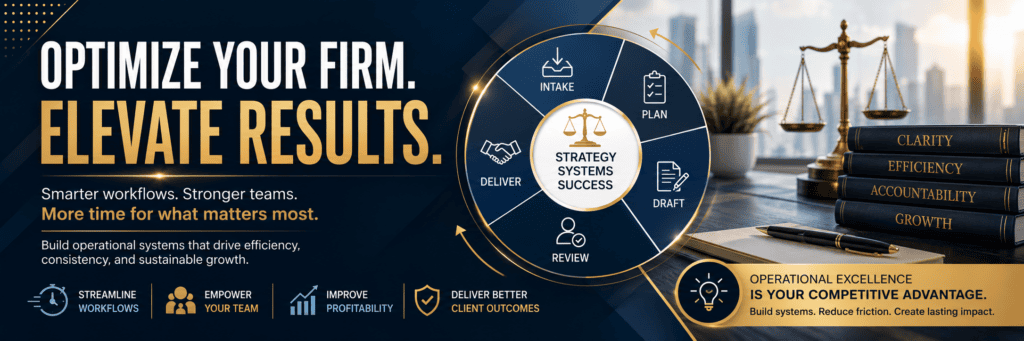
How to Optimize an Elder Law Firm in 2026

Small elder law firms rarely struggle because they lack commitment, expertise, or demand. More often, growth creates operational complexity that existing systems can no longer absorb. Firms improve performance when they intentionally design workflows, clarify team responsibilities, and build operating systems that allow work to move efficiently without constant attorney intervention.

As elder law practices continue to navigate increasing client expectations, staffing challenges, and administrative demands, operational optimization has become a business necessity rather than a growth initiative.

Why Optimization Matters More Than Growth

Many owner-led firms reach a point where the calendar is full, staff members are busy, and revenue appears healthy. Yet partners often feel trapped inside the business.

Common symptoms include:

  • Attorneys solving routine operational problems
  • Work stalling between team members
  • Inconsistent client experiences
  • Delays in drafting, review, or execution
  • Team members waiting for direction before moving matters forward

These issues are rarely caused by a lack of effort.

They are usually signs that the firm’s operational structure has not evolved alongside its growth.

Busy Does Not Automatically Mean Profitable

One of the most common misconceptions in small law firm operations is assuming workload and profitability move together.

In reality, many elder law firms experience growing demand while margins remain stagnant.

Why?

Because profitability is often lost through:

  • Rework
  • Bottlenecks
  • Excessive attorney involvement
  • Poor delegation
  • Slow handoffs between staff

When experienced professionals spend significant time coordinating work rather than advancing client matters, productivity declines without anyone noticing.

Operational efficiency creates leverage. More activity does not.

The First Question: How Does Work Actually Move?

Effective legal workflow optimization begins with visibility.

Before evaluating software, hiring staff, or adjusting compensation, firms should understand exactly how a matter moves from intake to completion.

Key questions include:

  • Who owns each stage?
  • What information is required before work advances?
  • When is attorney judgment truly necessary?
  • Where do files consistently slow down?
  • Which team members become bottlenecks?

Many firms discover that processes have evolved informally over time. Important decisions remain trapped in individual knowledge rather than documented systems.

As complexity increases, reliance on memory becomes increasingly expensive.

Why Hiring Alone Rarely Solves Operational Stress

When workloads increase, hiring often feels like the obvious solution.

Sometimes it is.

Often it is not.

Additional staff create additional communication pathways, training needs, supervision requirements, and handoffs. If underlying workflows remain unclear, firms frequently experience a surprising outcome:

They become busier without becoming more effective.

Hiring adds capacity.

Systems create leverage.

The most successful firms stabilize workflows before expanding headcount, ensuring new team members enter a structured environment that supports ownership and accountability.

Strengthening Talent Management for Lawyers and Legal Teams

Talent management is increasingly becoming an operational discipline rather than a purely HR function.

Many firms focus significant energy on recruitment while underinvesting in development, role clarity, and long-term retention.

Strong teams generally share several characteristics:

Defined Responsibilities

Every role should have clear ownership.

When responsibilities overlap excessively, accountability disappears.

Structured Onboarding

New hires should enter an environment with documented expectations, training plans, and measurable milestones. Structured onboarding accelerates productivity and improves retention.

Ongoing Coaching

High-performing firms treat development as a continuous process rather than an annual event.

Regular conversations about strengths, goals, performance, and career development help maintain engagement and alignment.

Cross-Training

Cross-trained teams reduce operational risk.

When key processes depend entirely on one individual, continuity becomes fragile. Firms gain resiliency when team members can provide coverage during absences, transitions, or growth periods.

The Hidden Bottleneck: Attorney Dependence

A recurring challenge in law firm operations is excessive reliance on attorneys for non-legal decisions.

Many firms unintentionally train staff to escalate routine questions upward.

Over time, partners become:

  • Approval centers
  • Information hubs
  • Problem-solving engines

This creates delays throughout the organization.

Operational maturity occurs when routine decisions are handled at the appropriate level while attorneys remain focused on legal strategy, client guidance, and high-value work.

The goal is not less involvement.

The goal is more intentional involvement.

Building Systems That Support Scale

Effective practice management consulting often focuses on creating repeatable operating systems.

The strongest systems answer practical questions before confusion occurs:

  • What happens next?
  • Who owns it?
  • When is it complete?
  • What triggers the next step?

When these answers exist within the workflow itself, firms experience:

  • Faster matter movement
  • Fewer interruptions
  • Better capacity planning
  • Improved consistency
  • Reduced stress

Optimization is ultimately about creating reliability.

Reliable firms tend to grow more predictably than reactive firms.

How to Evaluate Elder Law Firm Consulting Support

Not all consulting support is designed to solve operational problems.

When evaluating an elder law firm consulting partner, consider whether they focus on tangible operational outcomes.

Useful evaluation criteria include:

Workflow Visibility

Can they identify where matters stall, repeat, or slow down?

Staffing Alignment

Do they assess whether responsibilities match team capabilities and capacity?

Operational Metrics

Do they help establish measurable indicators for productivity, utilization, throughput, or bottlenecks?

Process Design

Can they create repeatable systems that reduce dependence on individual memory?

Leadership Capacity

Do they help firm owners spend less time managing daily friction and more time leading strategically?

Practice management consulting should create clarity, not complexity.

The objective is a firm that functions consistently, even when leadership is not directly involved in every decision.

The Future of Small Law Firm Services

The firms likely to thrive in the coming years will not necessarily be the largest.

They will be the most operationally intentional.

Technology will continue evolving.

Client expectations will continue rising.

Talent challenges will continue affecting the profession.

Firms that build clear systems, develop strong teams, and remove unnecessary friction will be better positioned to adapt regardless of market conditions.

Optimization is not about doing more.

It is about making the work you already do move more effectively.

A Closing Thought

The healthiest elder law firms are not defined by how busy they are.

They are defined by how reliably they convert effort into meaningful results for clients, staff, and leadership.

When workflows are intentional, roles are clear, and operational systems support the work instead of resisting it, growth becomes less stressful and far more sustainable.

How Intake Coaching Helps Elder Law Conversion

For many elder law firms, conversion challenges begin long before the attorney enters the consultation room. Sales coaching for elder law firms helps teams improve the client intake process by creating clarity, consistency, and confidence at every stage of the client journey. When intake conversations are structured well, consultations become more productive, clients arrive better prepared, and attorneys spend less time rebuilding trust or filling information gaps.

Intake Is Not Administrative Work. It Is Part of the Consultation.

Many small firms unintentionally treat intake as a scheduling function. The appointment gets booked, paperwork is requested, and the consultation begins.

In practice, however, intake often determines whether a consultation moves forward smoothly or stalls before it starts.

Strong intake processes help firms:

  • Set expectations clearly
  • Identify decision-makers early
  • Prepare clients for the consultation
  • Reduce attorney rework
  • Improve overall conversion consistency

When these elements are missing, attorneys frequently spend valuable consultation time clarifying next steps, gathering basic information, or addressing confusion that could have been resolved earlier.

Why Elder Law Consultations Often Struggle

Many firm owners assume low conversion rates are primarily a marketing issue.

Often, they are an operations issue.

Prospective clients frequently arrive overwhelmed. In many cases, adult children, spouses, or multiple family members are involved in the decision-making process. By the time they contact an elder law firm, they have already spent considerable time researching options and trying to understand a complex situation.

Common intake-related conversion challenges include:

  • Missing decision-makers
  • Unclear expectations
  • Missing documents
  • Uncertain pricing assumptions
  • Fear of making the wrong decision
  • Information overload

These issues create friction before the attorney ever begins advising the family.

What Sales Coaching for Elder Law Firms Actually Improves

The phrase “sales coaching” can be misunderstood.

In successful elder law firms, coaching is rarely about persuasion. It is about helping staff and attorneys communicate more clearly, identify client concerns earlier, and guide conversations with confidence.

Effective coaching typically focuses on three areas.

1. Asking Better Questions

High-performing intake teams follow a logical conversation flow rather than jumping immediately to scheduling.

They learn how to uncover:

  • Why the client is reaching out now
  • What urgency exists
  • Who will be involved in the decision
  • Whether the client is ready to move forward

These questions provide context that improves both preparation and conversion.

2. Reducing Client Uncertainty

Many clients delay decisions because they are overwhelmed, uncertain, or worried about making a mistake.

Coaching helps staff recognize common forms of hesitation and respond with clarity instead of pressure.

When clients understand what happens next, what information is needed, and what outcomes are realistic, decision-making becomes easier.

3. Creating Consistency

A firm may have talented attorneys, but inconsistent intake creates inconsistent results.

Coaching helps establish:

  • Standardized call flows
  • Intake checklists
  • Consultation preparation processes
  • Communication standards
  • Follow-up expectations

Consistency allows firms to measure performance and improve it over time.

Busy Does Not Always Mean Efficient

One of the more common growth mistakes among small elder law firms is assuming that increased activity automatically translates into stronger performance.

It frequently does not.

Firms become busier because:

  • More inquiries arrive
  • More staff are hired
  • More consultations are scheduled

Yet conversion rates remain unchanged.

The underlying issue is often workflow design.

Without a structured intake process, additional volume simply introduces more confusion into the system. More inquiries create more bottlenecks. More staff increase coordination demands. More consultations consume attorney capacity without improving outcomes.

Why Hiring Alone Rarely Fixes Intake Problems

When firms experience conversion challenges, the instinct is often to hire another intake coordinator, marketing employee, or attorney.

But hiring does not solve unclear processes.

If expectations, scripts, workflows, and responsibilities remain undefined, additional staff frequently inherit the same problems that already exist.

The result is:

  • Inconsistent client experiences
  • Escalating attorney involvement
  • Variable conversion outcomes
  • Training challenges
  • Reduced profitability

Improvement usually starts with process clarity before headcount expansion.

The Connection Between Intake and Law Firm Conversion Optimization

Many conversion discussions focus on sales techniques.

The stronger operational perspective is to focus on preparation.

The best consultations are often not “closed.”

They are prepared.

When clients arrive with:

  • The right information
  • Realistic expectations
  • Appropriate decision-makers
  • Greater confidence

The attorney can spend more time providing value and less time overcoming preventable obstacles.

This is where law firm conversion optimization becomes less about persuasion and more about operational design.

How Better Intake Supports Small Law Firm Growth

Growth becomes easier when work enters the firm with clarity.

A strong intake system creates benefits beyond conversion:

  • Better client experience
  • More predictable workflows
  • Reduced attorney interruptions
  • Improved delegation
  • Higher staff confidence
  • Greater operational scalability

Over time, firms that invest in coaching and intake development often discover that efficiency improvements create more capacity than additional hiring.

Final Thought

The client intake process is often the most overlooked growth lever inside an elder law firm.

While marketing generates opportunities, intake determines how effectively those opportunities move forward. Sales coaching for elder law firms helps teams create consistent client experiences, remove friction from consultations, and build operational systems that support sustainable growth.

The firms that convert more effectively are rarely the firms applying more pressure. They are usually the firms creating more clarity.

7 Things to Know Before Choosing Estate Firm Coaching

Many estate planning and elder law firms begin looking for coaching when growth feels harder than it should. Work is getting done, clients are being served, and revenue may even be increasing—yet attorneys remain deeply involved in daily operations, staff feels stretched, and bottlenecks continue to surface.

The most valuable estate planning firm coaching doesn’t simply help firms get busier. It helps them create systems, workflows, and decision-making structures that allow growth without increasing complexity at the same pace. Insights throughout this article reflect recurring operational themes found in The Million Dollar Solution’s educational materials on workflow design, intake excellence, staffing, growth strategy, and practice management.

1. Coaching Should Address Operations, Not Just Marketing

Many firms initially seek coaching because they want more cases.

The challenge is that more leads often expose existing operational weaknesses.

If intake processes are inconsistent, work depends on individual employees instead of documented systems, or attorneys serve as the default solution to every problem, additional marketing can amplify inefficiencies rather than solve them.

Strong coaching programs examine:

  • Workflow design
  • Team accountability
  • Practice management systems
  • Capacity planning
  • Operational bottlenecks

Marketing matters. But sustainable growth usually requires operational clarity first.

2. Busy Is Not the Same as Profitable

One of the most common misconceptions in small law firm growth is equating activity with success.

Many firms reach a stage where:

  • Calendars are full
  • Staff members are constantly occupied
  • Attorneys feel overwhelmed
  • Revenue increases slowly despite increased effort

In these situations, the issue often isn’t effort.

It’s workflow.

Practice management consulting should help owners understand where work stalls, repeats, waits for approvals, or depends on a single individual. Profitability frequently improves when work flows more predictably—not when everyone simply works harder.

3. Hiring More People May Not Fix the Real Problem

When workloads increase, the natural reaction is hiring.

Sometimes that’s necessary.

However, coaching should help firms determine whether the problem is capacity or process.

Adding staff to inconsistent systems often creates new challenges:

  • More training requirements
  • Increased management complexity
  • Additional communication breakdowns
  • Greater dependency on attorneys

Before expanding headcount, many firms benefit from understanding where workflow friction exists and why.

A coaching program that immediately recommends more hiring without evaluating operational systems may be treating a symptom rather than the cause.

4. Intake Is Often a Bigger Growth Lever Than Marketing

Many firms spend significant resources on elder law marketing while overlooking what happens after a prospect makes contact.

Yet intake frequently determines:

  • Client expectations
  • Consultation quality
  • Conversion rates
  • Team efficiency
  • Workload predictability

High-performing firms recognize that intake is not a scheduling function.

It is an operational function.

Client intake coaching should help teams:

  • Clarify urgency
  • Identify decision-makers
  • Assess readiness
  • Set expectations early
  • Improve information gathering

When intake improves, both marketing performance and operational efficiency often improve alongside it.

5. Good Coaching Creates Systems, Not Dependency

Some coaching programs become an ongoing source of answers.

Others teach firms how to solve problems independently.

The strongest estate planning firm coaching helps owners build:

  • Repeatable workflows
  • Clear handoffs
  • Defined responsibilities
  • Consistent operational standards
  • Measurable performance indicators

The goal is not creating reliance on an outside advisor.

The goal is increasing organizational capability.

Firms that become less dependent on individual employees—and less dependent on constant owner involvement—usually become more scalable as well.

6. Team Development Matters as Much as Strategy

Growth challenges are rarely caused solely by marketing or technology.

People remain central to every system.

Effective coaching should include conversations around:

  • Role clarity
  • Communication
  • Accountability
  • Employee development
  • Leadership effectiveness

Many operational bottlenecks emerge because expectations are unclear, training is inconsistent, or team members are working outside their strengths.

Coaching that addresses both systems and people tends to produce more durable results than strategy alone.

7. The Best Coaching Helps Firms Scale With Less Friction

Every growing firm eventually reaches the point where working harder stops working.

That transition generally involves a shift:

From output → to flow.

Instead of asking:

“How can we get more done?”

Firms begin asking:

  • Where does work slow down?
  • What decisions repeat unnecessarily?
  • Which tasks should be delegated?
  • What depends on one person?
  • What would break if a key employee were unavailable?

These questions reveal whether growth is supported by systems or dependent on effort.

The coaching programs that create the greatest long-term value help firms identify and reduce those friction points before growth magnifies them.

Final Thoughts

Choosing estate planning firm coaching should be less about finding new tactics and more about gaining operational clarity.

Most growth challenges in small estate planning and elder law firms are not caused by a lack of effort. They emerge when workflows become informal, bottlenecks multiply, and complexity grows faster than systems.

The firms that scale most effectively are often the ones that learn to improve how work moves through the organization—not simply how much work they can generate.

That distinction frequently determines whether growth creates opportunity or overwhelm.

What to Look for in Estate Planning Intake Coaching

Many estate planning firms assume intake problems are marketing problems. In reality, firms often lose momentum long before an attorney enters the conversation. A strong estate planning attorney client intake coaching program helps firms build a process that creates clarity, improves client readiness, reduces operational friction, and makes consultations more productive from the very beginning. Based on internal guidance emphasizing that intake is a growth lever rather than an administrative task, effective intake coaching focuses on trust, preparation, qualification, and workflow consistency.

Why Intake Coaching Matters More Than Many Firms Realize

In many firms, intake is treated as scheduling.

The challenge is that intake is actually the first stage of the client experience.

Prospective clients often arrive overwhelmed, uncertain, and under pressure. They are evaluating not only legal competence but also whether the firm appears organized, trustworthy, and capable of guiding them through a difficult decision. Strong intake processes establish confidence before the consultation ever begins.

When intake lacks structure, firms frequently experience:

  • Unclear expectations
  • Missing documents
  • Consultation no-shows
  • Delayed decisions
  • Attorney bottlenecks
  • Increased staff rework

These issues create operational drag that can quietly limit profitability and scalability.

The Best Intake Coaching Programs Focus on Process, Not Scripts

Many coaching programs promise better conversions through improved communication techniques.

While communication matters, the strongest programs focus on building repeatable systems.

Look for coaching that helps your firm create:

  • Consistent intake workflows
  • Defined qualification criteria
  • Client preparation standards
  • Documentation checklists
  • Consultation readiness procedures
  • Performance measurements for intake success

The goal is not to sound more persuasive.

The goal is to ensure every prospective client enters the consultation with the right expectations, the right information, and the right decision-makers present.

Coaching Should Teach Teams How to Identify Readiness

Not every inquiry is ready to move forward.

One of the most valuable aspects of attorney business coaching in the intake area is learning how to identify readiness early.

Effective coaching programs help teams evaluate:

Urgency

Why is the client reaching out now?

What changed?

Is there a meaningful timeline?

Decision Authority

Who is responsible for making decisions?

Who should attend the consultation?

Readiness

Does the client have the necessary information, documents, and commitment to move forward?

Firms that understand these factors spend less time chasing stalled matters and more time serving clients who are positioned to take action.

Look for Coaching That Reduces Attorney Bottlenecks

One of the most common growth challenges in estate planning firms is assuming that adding more consultations automatically creates growth.

Often, it creates congestion.

Busy does not always mean profitable.

A strong intake coaching program should help firms reduce attorney dependency by ensuring intake staff gather critical information before the consultation occurs.

When attorneys receive cleaner, more organized intake data, they can focus on high-value conversations rather than rebuilding context from scratch.

This improvement affects:

  • Consultation quality
  • Attorney utilization
  • Scheduling efficiency
  • Staff confidence
  • Client experience

The result is a smoother workflow rather than simply a busier calendar.

The Program Should Address Client Psychology

Many firms view intake as an operational function.

Top coaching programs recognize it is also a trust-building function.

Prospective clients frequently hesitate because of:

  • Fear of making the wrong decision
  • Family dynamics
  • Financial uncertainty
  • Information overload
  • Emotional stress

Effective coaching teaches teams how to reduce uncertainty without creating pressure.

When clients feel informed and prepared, decision-making becomes easier and consultations become more productive.

Strong Intake Coaching Supports Law Firm Client Acquisition

Law firm client acquisition is often discussed as a marketing challenge.

In reality, acquisition and intake are closely connected.

Marketing may generate inquiries.

Intake determines whether those inquiries become productive consultations and aligned client relationships.

The strongest firms understand that growth comes from attracting and qualifying the right matters—not simply generating more leads.

Good coaching helps firms:

  • Define ideal client characteristics
  • Improve qualification standards
  • Reduce low-fit consultations
  • Create more predictable workflows
  • Protect team capacity

This is especially important for firms experiencing growth-related stress.

Hiring more people rarely fixes intake inefficiencies if the underlying process remains unclear.

Evaluate the Outcomes the Program Produces

When comparing coaching programs for attorneys, focus less on the program’s description and more on the outcomes it is designed to create.

Look for programs that improve:

Workflow Consistency

Each inquiry follows a predictable path.

Consultation Readiness

Clients arrive prepared and informed.

Team Alignment

Staff understand expectations and their role within the process.

Operational Efficiency

Fewer handoff errors and less duplicated work.

Sustainable Growth

Better-fit matters move through the firm with less friction.

These outcomes tend to have a much greater long-term impact than short-term conversion improvements alone.

Questions to Ask Before Choosing an Intake Coaching Program

Consider asking:

  • Does the program teach systems or just conversation techniques?
  • Does it address workflow and operational efficiency?
  • Does it help identify client readiness?
  • Does it support delegation and staff development?
  • Does it include measurable standards and accountability?
  • Does it focus on long-term process improvement?

The answers usually reveal whether the program is designed to create lasting operational improvements or temporary behavioral changes.

Final Thought

The most effective estate planning attorney client intake coaching programs are not really about intake alone.

They are about creating a smoother path from first contact to completed engagement.

When intake becomes a structured preparation system rather than a scheduling function, consultations improve, bottlenecks decrease, and growth becomes easier to manage. Firms that scale successfully often discover that operational clarity—not volume—is what allows growth to feel sustainable. That insight starts at intake.

How to Choose Law Firm Growth Consulting in 2026

Small law firms rarely struggle because attorneys lack legal skill. More often, growth becomes difficult because operations, staffing, leadership, and client workflows fail to scale alongside demand. Choosing the right law firm growth consulting partner in 2026 means finding someone who can improve how the firm functions—not simply increase activity.

For estate planning and elder law firms, the best consulting relationships focus on profitability, operational clarity, delegation, leadership development, client conversion, and sustainable systems that support long-term growth. Many firms discover that their biggest challenge is not attracting more work, but creating a practice capable of handling growth effectively.


Why Law Firm Growth Consulting Has Changed

A few years ago, many consultants focused primarily on marketing and lead generation.

Today, firm owners face a different reality.

They are often:

  • Managing overloaded teams
  • Struggling with inconsistent workflows
  • Experiencing attorney bottlenecks
  • Fighting staffing turnover
  • Dealing with operational complexity created by growth

More cases do not automatically create more profit.

In fact, growth frequently exposes operational weaknesses that were hidden when the firm was smaller. As volume increases, unclear processes, inconsistent intake, weak delegation, and undefined ownership create friction throughout the organization.

A quality practice management consulting engagement should address those foundational issues before pursuing aggressive expansion.


Start With the Firm’s Real Problem

Before evaluating consultants, owners should ask:

What is currently limiting growth?

Common answers include:

Capacity Problems

The calendar is full, but work continues to pile up.

Workflow Problems

Work depends on memory instead of process.

Staffing Problems

Employees are busy but accountability remains unclear.

Leadership Problems

Partners remain involved in nearly every decision.

Conversion Problems

Prospective clients reach out, but many fail to move forward.

Each challenge requires a different solution.

Consultants who prescribe the same answer to every firm often create more complexity than improvement.


The Best Consultants Focus on Profitability, Not Activity

One of the easiest traps for small firms is confusing motion with progress.

Teams look busy.

Attorneys work longer hours.

Case volume rises.

Yet profitability remains stagnant.

Strong law firm growth consulting focuses on eliminating friction inside the business rather than simply adding more work to the system.

Areas that deserve attention include:

  • Process design
  • Delegation structures
  • Client journey management
  • Staff utilization
  • Leadership bandwidth
  • Technology adoption
  • Operational accountability

The goal is creating leverage throughout the organization—not making everyone work harder.


Evaluate Their Approach to Legal Operations Management

Many consulting firms discuss growth but rarely discuss operational flow.

That should raise concern.

Effective legal operations management improves how work moves through the firm from initial inquiry to matter completion.

Questions worth asking include:

Do they map workflows?

Growth becomes difficult when firms cannot clearly see where work slows down, stalls, or loops backwards.

Do they address ownership?

Every step should have a clear owner.

Unclear responsibility is one of the most common sources of bottlenecks.

Do they separate attorney work from administrative work?

When attorneys routinely handle operational tasks, profitability declines and scalability suffers.

Do they improve handoffs?

Many workflow issues appear at transition points between team members.

Strong consultants focus heavily on those moments.


Assess Their Philosophy on Hiring

Many firms assume additional hiring will solve growth challenges.

Often it does not.

Hiring into unclear systems simply adds more people to existing confusion.

The strongest consultants view hiring as part of a broader operational strategy.

They help firms:

  • Define roles clearly
  • Align responsibilities effectively
  • Improve onboarding
  • Develop training frameworks
  • Create retention plans
  • Build leadership pipelines

Organizations that establish operational clarity before expanding headcount often experience stronger and more sustainable results.

This is particularly important for owner-led firms where partners frequently become the default solution for every problem.


Consider Their Expertise in Leadership Development

Many growth issues are leadership issues wearing operational disguises.

The challenge may look like:

  • Missed deadlines
  • Poor delegation
  • Staff dependency
  • Slow decision-making

In reality, the root issue is often leadership capacity.

Strong law firm leadership coaching helps owners transition from technician to leader.

Rather than personally solving every problem, leaders learn to:

  • Establish expectations
  • Build accountability
  • Coach employees effectively
  • Develop future leaders
  • Create organizational resilience

This shift becomes increasingly important as firms grow beyond a handful of employees.


Look Closely at Their Client Conversion Philosophy

The best growth consultants understand that client acquisition and operations are connected.

Many firms focus heavily on attracting prospects while neglecting intake and qualification processes.

Strong conversion systems help firms:

  • Identify the right prospective clients
  • Set expectations early
  • Improve readiness
  • Reduce consultation friction
  • Increase confidence in the decision process

Successful firms do not simply generate more leads.

They create systems that attract better-aligned matters and move those opportunities through a predictable process.

That distinction matters.

More inquiries can create additional workload.

Better-fit inquiries improve profitability.


Why Actionstep Alignment Matters

In 2026, technology should support operations—not compensate for weak operations.

If a consultant works with firms using Actionstep, they should understand how systems, workflows, and accountability structures interact inside the platform.

Technology implementation alone rarely creates transformation.

The real value comes from aligning:

  • Intake procedures
  • Matter workflows
  • Task ownership
  • Reporting standards
  • Team accountability
  • Operational visibility

The software should reinforce the process—not become the process.

Firms that approach technology this way tend to achieve stronger adoption and more consistent outcomes.


Questions to Ask Before Hiring a Consultant

Before making a decision, ask:

  1. How do you evaluate workflow bottlenecks?
  2. How do you measure profitability improvement?
  3. How do you approach delegation and attorney workload reduction?
  4. How do you improve staff accountability?
  5. What role does leadership development play?
  6. How do you evaluate intake and client conversion?
  7. How do you align operational processes with technology platforms such as Actionstep?
  8. How do you determine whether hiring is actually necessary?

Their answers often reveal whether they focus on symptoms or root causes.


The Best Growth Strategy Is Often Simpler Than Expected

Many estate planning and elder law firms are not struggling because they need more marketing, more software, or more staff.

They are struggling because growth has exposed gaps in workflow design, leadership structure, operational accountability, and delegation.

The right law firm growth consulting relationship helps owners see those patterns clearly. From there, sustainable profitability becomes less about doing more and more about creating systems that allow good work to flow predictably.

Growth becomes easier when the firm itself becomes easier to run.

How to Optimize Law Firm Workflows in 2026

Small law firms rarely struggle because they lack effort. More often, they struggle because work moves through the firm inconsistently. In 2026, workflow optimization is less about working harder and more about creating clear systems that allow attorneys, staff, and clients to move through predictable processes with less friction and greater profitability. Insights throughout this article align with operational themes found in The Million Dollar Solution’s workflow and practice management resources, particularly the distinction between adding staff and improving workflow structure.

Why Workflow Optimization Matters More Than Growth Alone

Many owner-led estate planning and elder law firms reach a frustrating stage of growth:

  • Phones are busy.
  • Calendars are full.
  • Staff are overwhelmed.
  • Attorneys remain the default solution for operational problems.

From the outside, the firm appears successful. Internally, however, profitability often lags behind activity.

The issue is that growth and operational efficiency are not the same thing. When workflows are unclear, every new matter creates additional complexity. Bottlenecks become normal. Follow-up tasks slip through the cracks. Attorneys spend valuable time managing process failures instead of practicing law.

This is why many firms discover that being busy does not automatically translate into higher profits. A firm’s operating system must evolve alongside its growth.


The Most Common Workflow Bottlenecks in Small Law Firms

While every firm operates differently, several patterns appear repeatedly.

Intake Without Clear Standards

Many workflow issues begin before a client ever signs an engagement agreement.

When intake procedures vary between team members, firms experience:

  • Incomplete information
  • Poor matter qualification
  • Unrealistic client expectations
  • Increased attorney involvement early in the process

Strong intake systems establish clarity before work begins. They help clients understand next steps while giving attorneys the information they need to make better decisions.

Undefined Handoffs

Work frequently stalls between departments.

Files move from intake to drafting. Drafting moves to review. Review moves to signing. Yet responsibility is often assumed rather than assigned.

When ownership is unclear:

  • Delays increase
  • Accountability decreases
  • Attorneys become escalation points

Workflow optimization requires clearly defined ownership at every stage.

Attorney-Centered Operations

Many firms unintentionally design workflows that require attorneys to answer every question.

This creates a hidden ceiling on growth.

If every decision, approval, update, or clarification must flow through one attorney, the firm becomes dependent on a single bottleneck. Sustainable growth requires separating legal judgment from administrative execution whenever appropriate.


Why Hiring Alone Rarely Solves Workflow Problems

One of the biggest misconceptions in small law firm growth is that more staff automatically creates more capacity.

Sometimes hiring is necessary.

Often, however, the firm has not yet identified the underlying operational issue.

Adding employees to an inefficient system commonly results in:

  • More training demands
  • More communication complexity
  • More interruptions
  • Higher payroll expenses

The workflow challenges remain.

A useful way to think about it is this:

Staffing increases capacity. Workflow optimization increases efficiency.

Both matter, but they solve different problems.

The firms that scale most effectively typically improve workflow first and hire into a stable system second.


Building a More Efficient Practice Management System

Workflow optimization should be approached systematically rather than reactively.

1. Map the Entire Client Journey

Begin by documenting how work actually moves through the firm.

Not how it is supposed to move.

How it truly moves today.

Review:

  • Initial inquiry
  • Intake
  • Consultation
  • Engagement
  • Drafting
  • Review
  • Signing
  • Follow-up

This process often reveals hidden delays, duplicated effort, and unclear ownership.

2. Clarify Role Expectations

Operational efficiency depends on role clarity.

Every team member should understand:

  • What they own
  • What requires escalation
  • What success looks like
  • Who receives work next

When roles are clearly defined, delegation becomes significantly easier. Staff gain confidence because expectations become predictable.

3. Standardize Repeatable Decisions

Many law firms recreate the same decisions daily.

Whenever possible, build systems around recurring choices:

  • Matter readiness standards
  • Client communication protocols
  • File review processes
  • Meeting preparation procedures

Standardization reduces friction without reducing quality.

4. Measure Workflow Performance

What gets measured gets improved.

Consider tracking:

  • Matter completion times
  • Intake conversion rates
  • Draft turnaround time
  • Revision frequency
  • Client response delays

Even a few operational metrics can reveal significant opportunities for improvement.


Leadership Coaching and Workflow Optimization

Many workflow challenges are actually leadership challenges.

Firm owners often carry institutional knowledge that never becomes operational knowledge.

As a result:

  • Staff wait for direction.
  • Processes depend on memory.
  • Growth creates stress rather than leverage.

Leadership coaching helps owners transition from being the primary problem-solver to becoming the architect of the firm’s systems.

The goal is not to remove leadership involvement.

The goal is to eliminate unnecessary dependency.

When processes are documented and expectations are clear, staff members can make more decisions independently while maintaining quality and consistency.


What Law Firm Consulting Should Focus on in 2026

The strongest law firm consulting engagements increasingly focus on operational design rather than simply marketing or staffing.

Key areas typically include:

  • Workflow optimization
  • Practice management systems
  • Team structure
  • Delegation strategies
  • Operational accountability
  • Leadership development
  • Capacity planning

The objective is not faster growth at any cost.

The objective is controlled growth that protects profitability, client experience, and attorney capacity simultaneously.

For estate planning and elder law firms, this often means creating systems that allow high-value legal work to remain in attorney hands while routine operational tasks move through clearly defined processes.


Signs Your Firm Has Outgrown Its Current Workflow

Your workflow may need redesign if:

  • Attorneys spend significant time on administrative tasks.
  • Files regularly stall without a clear reason.
  • Staff frequently seek clarification on routine decisions.
  • Hiring has not reduced workload.
  • Revenue growth feels harder than it should.
  • Client communication becomes inconsistent during busy periods.

These are not necessarily staffing problems.

They are often signals that the firm’s operating system needs refinement.


A More Sustainable Approach to Small Law Firm Growth

Successful firms rarely scale because they become busier.

They scale because they become clearer.

Clear roles. Clear workflows. Clear expectations. Clear ownership.

When work moves predictably through the firm, profitability becomes less dependent on heroics and more dependent on design.

That shift creates something many owner-led firms ultimately seek: operational control.

And in 2026, operational control may be one of the most valuable growth assets a law firm can build.

How to Improve Client Intake for Elder Law Firms

Client intake is one of the most influential—and most overlooked—operational systems inside an estate planning or elder law firm. The quality of the intake process often determines whether a consultation begins with clarity and trust or starts with confusion, missing information, and uncertainty.

For firms focused on sustainable growth, improving intake is not just about scheduling appointments more efficiently. It is about creating a structured pathway that helps the right clients move forward while reducing internal friction, bottlenecks, and wasted time.

Why Intake Matters More Than Most Firms Realize

Many law firms treat intake as an administrative function.

In reality, intake is the first stage of the client experience. It shapes expectations, establishes confidence, identifies fit, and gives attorneys the information necessary to have productive consultations. When intake is handled inconsistently, attorneys often spend valuable consultation time rebuilding clarity that should have been established earlier.

This is especially important in elder law and estate planning, where clients are often making complex and emotionally significant decisions.

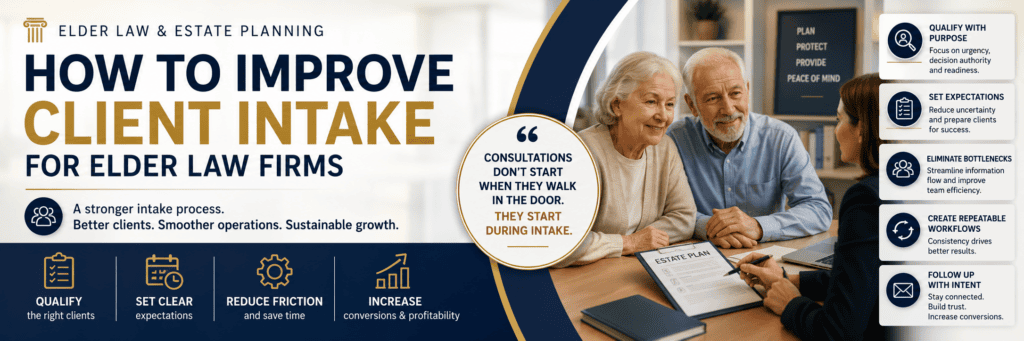
The strongest firms understand that consultations do not begin when the client walks into the meeting. They begin during intake.


Signs Your Intake Process Is Creating Growth Problems

Many firms assume conversion challenges are marketing problems.

Often, they are intake problems.

Common warning signs include:

  • Frequent no-shows
  • Consultations with missing decision-makers
  • Incomplete documentation
  • Repeated pricing confusion
  • Attorneys answering the same preliminary questions repeatedly
  • Long follow-up cycles before engagement decisions
  • Staff uncertainty about qualification standards

These issues create more work without necessarily creating more revenue.

This is where many firms become trapped in a common growth misconception:

Being busy does not automatically mean the firm is profitable.

A calendar filled with low-quality consultations, incomplete matters, and operational rework can keep everyone occupied while limiting profitability.


Build Intake Around Qualification, Not Scheduling

Many intake teams move immediately to appointment scheduling.

That approach misses critical information.

A more effective model focuses on understanding three factors before selecting a consultation date:

1. Urgency

Why is the client reaching out now?

Understanding the triggering event helps staff identify timing realities and prioritize appropriately. Urgency provides important context that influences the entire consultation process.

2. Decision Authority

Who will ultimately make the decision?

Many consultations fail simply because the necessary people are not present. Identifying decision-makers early reduces delays and follow-up cycles.

3. Readiness

Is the prospective client prepared to move forward?

Readiness includes documentation, financial understanding, emotional preparedness, and practical expectations about the next steps.

Firms that consistently assess these three elements often experience stronger consultations and smoother conversions because conversations become more focused and productive from the beginning.


Create Clear Expectations Before the Consultation

Uncertainty is one of the primary reasons consultations stall.

Prospective clients often arrive with questions they are hesitant to ask:

  • What will happen during the meeting?
  • What documents should I bring?
  • Who should attend?
  • What decisions may need to be made?
  • What happens afterward?

When these expectations remain unclear, clients often become overwhelmed or postpone action.

A structured intake system proactively answers these questions before the consultation.

The result is a client who feels prepared rather than pressured.


Use Intake to Reduce Operational Bottlenecks

Many firms attempt to solve growth challenges by adding staff.

Sometimes additional hiring is necessary.

However, hiring rarely fixes a broken intake process. In fact, unclear systems often create more complexity because new team members inherit inconsistent procedures.

A better approach is to examine where information slows down.

Consider:

  • Who owns each intake stage?
  • Where does information get lost?
  • Which questions vary by team member?
  • What decisions require attorney involvement?
  • What can be standardized?

Intake improvements often produce faster operational gains than additional hiring because they remove friction from every future matter.


Turn Intake Into a Repeatable Workflow

Growing firms tend to view intake as a system rather than an event.

Instead of treating every inquiry differently, they create a predictable workflow:

Inquiry → Qualification → Preparation → Consultation → Follow-Up → Engagement Decision

Each stage has ownership, accountability, and defined expectations.

This does not make the client experience feel impersonal.

It makes it reliable.

Consistency allows the team to spend more energy helping clients and less energy managing preventable confusion.


The Often-Ignored Role of Follow-Up

Many firms invest significant effort in consultations but little effort in what happens afterward.

Not every prospective client is ready to make a decision immediately.

In elder law and estate planning, hesitation often reflects uncertainty, family dynamics, timing concerns, or fear of making the wrong decision rather than a lack of interest.

A deliberate follow-up process helps firms:

  • Maintain continuity
  • Reduce decision friction
  • Create client confidence
  • Improve conversion consistency

The objective is not pressure.

It is providing enough structure that clients can move forward when they are ready.


Why Intake Is Really a Practice Management Issue

Many firms view intake separately from operations.

The strongest firms do not.

Intake influences:

  • Workflow efficiency
  • Attorney utilization
  • Staff capacity
  • Client experience
  • Conversion rates
  • Profitability

When intake is inconsistent, operational problems appear throughout the practice.

When intake is structured, work moves more predictably across the firm.

This is one reason law firm practice management consulting, estate planning consulting, and law firm sales coaching increasingly focus on intake systems before addressing larger growth initiatives.

The intake process often reveals where the firm’s processes, communication, and delegation systems need attention.


A Final Thought

Many estate planning and elder law firms assume growth requires more leads, more staff, or more hours.

Often, sustainable growth begins somewhere much simpler.

It begins by creating clarity before the consultation ever starts.

When intake becomes intentional, consultations improve. When consultations improve, operational strain decreases. And when operations become more predictable, the firm gains something many growing practices struggle to maintain: control.

How Estate Planning Firms Win More Clients in 2026

Estate planning firms that consistently win more clients in 2026 are not relying on better marketing alone. They are aligning estate planning marketing, client intake, and operational workflows into a system that attracts the right prospects, prepares them for productive consultations, and moves matters through the firm efficiently. Firms that treat marketing and intake as separate functions often become busier. Firms that integrate them tend to become more profitable. Based on internal growth and intake frameworks emphasizing ideal-client alignment, intake qualification, and operational clarity, sustainable growth comes from attracting better-fit matters rather than simply increasing inquiry volume.

The Shift Happening in Estate Planning Marketing

Many estate planning firms still evaluate marketing success by lead volume.

More website inquiries. More consultation requests. More phone calls.

Yet many firms discover that increased activity does not automatically improve profitability.

Prospective clients are arriving more informed, more selective, and often more overwhelmed than ever before. They are researching providers, comparing options, and looking for clarity before they ever contact a law firm. Strong firms recognize that growth is no longer about generating the highest volume of inquiries. It is about becoming the obvious choice for the right people.

This distinction matters because poor-fit matters create operational strain:

  • Excessive follow-up
  • Low-quality consultations
  • Scheduling congestion
  • Attorney bottlenecks
  • Staff frustration

In other words, busy does not necessarily mean healthy.

Why Marketing Coaching Alone Is Not Enough

Many law firm marketing initiatives focus primarily on visibility:

  • Search rankings
  • Content marketing
  • Referral development
  • Social media presence
  • Community education

These activities are important. But they only solve the first half of the client acquisition equation.

Marketing answers:

“How do people find us?”

It does not answer:

“What happens after they do?”

Without operational alignment, marketing improvements can expose weaknesses rather than create growth. Additional inquiries simply place more pressure on an intake process that was never designed to scale. Internal growth frameworks consistently emphasize that lead generation creates demand, but growth requires design.

This is where marketing coaching services and client intake coaching intersect.

The Missing Link: Client Intake Coaching

Many estate planning firms underestimate the influence of intake.

It is often viewed as an administrative task when it is actually the first stage of the consultation process.

Before a prospective client ever speaks with an attorney, intake determines:

  • Expectations
  • Preparedness
  • Confidence
  • Fit
  • Decision readiness

Effective intake coaching teaches teams to move beyond scheduling and begin facilitating informed decision-making. Firms that strengthen intake often discover improvements in:

  • Consultation quality
  • Attorney utilization
  • Conversion consistency
  • Workflow efficiency
  • Client experience

Intake is not administrative overhead. It is a growth function.

How Marketing and Intake Create a Repeatable Client Acquisition System

The most effective client acquisition systems follow a predictable sequence.

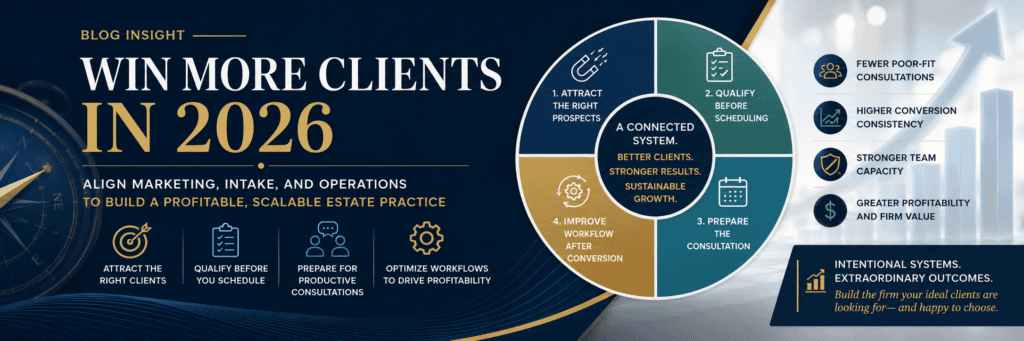
Step 1: Attract the Right Prospects

Strong estate planning marketing starts with clarity.

Firms that grow intentionally define:

  • Their ideal client
  • Preferred case types
  • Desired complexity levels
  • Values alignment
  • Decision readiness indicators

Clear positioning helps the right prospects identify themselves before they call while encouraging poor-fit prospects to self-select elsewhere. This reduces wasted consultations and preserves team capacity.

Step 2: Qualify Before Scheduling

Many firms move immediately from inquiry to calendar.

High-performing firms do not.

Instead, intake professionals gather information related to:

  • Urgency
  • Decision authority
  • Readiness

This structure helps determine whether the consultation is likely to move forward productively. It also helps prepare both the client and attorney for a more meaningful conversation.

Step 3: Prepare the Consultation

Preparation reduces friction.

Clients should understand:

  • What will happen
  • What documents are needed
  • Who should attend
  • What decisions may need to be made

When expectations are established early, attorneys spend less time rebuilding clarity and more time providing value.

Step 4: Improve Workflow After Conversion

A new client should enter the firm through a structured process.

Otherwise, growth creates operational stress.

Many firms assume hiring additional staff will solve growth challenges. In reality, bottlenecks often originate from unclear processes rather than insufficient personnel. Workflow, onboarding, delegation, and training systems frequently create more leverage than additional headcount. Operational development frameworks repeatedly emphasize systematic training, process clarity, and role alignment as key drivers of scalability.

Why Hiring Is Not Always the Answer

A common pattern appears in growing estate planning firms.

Demand increases. Capacity feels constrained. Leadership decides to hire.

Sometimes that works.

Often it does not.

Additional employees entering an inefficient system simply increase complexity.

Before adding staff, firm leaders should evaluate:

  • Intake consistency
  • Task ownership
  • Consultation preparation
  • Workflow handoffs
  • Process documentation
  • Delegation clarity

Many bottlenecks stem from work moving unpredictably rather than from insufficient staffing levels. Firms frequently discover that process improvement produces greater capacity than another hire.

What Practice Management Consulting Often Reveals

This reality connects directly to broader conversations around legal practice management consulting.

When firms investigate profitability challenges, the root cause is often not marketing.

Nor is it always staffing.

Instead, consultants frequently uncover operational friction between:

  • Marketing and intake
  • Intake and attorneys
  • Attorneys and staff
  • Staff and systems

The result is hidden inefficiency.

Work flows into the firm faster than it can move through the firm.

That is why the most successful growth strategies focus on the entire client journey rather than isolated departments.

Fixing Estate Planning Workflow Bottlenecks

Workflow bottlenecks rarely announce themselves clearly.

They often appear as:

  • Backlogged consultations
  • Repeated follow-up requests
  • Attorney interruptions
  • Delayed matter completion
  • Burnout among high performers

The solution is not simply to work harder.

It is to create clearer systems.

The strongest firms build repeatable processes around:

  • Client qualification
  • Intake standards
  • Consultation preparation
  • Matter onboarding
  • Delegation
  • Training and development

Structure reduces overload. Clarity reduces rework. Predictability improves profitability.

The Firms That Will Grow Most Effectively in 2026

The firms that win more clients in 2026 will not necessarily have the largest advertising budgets.

They will be the firms that connect:

  • Estate planning marketing
  • Client intake coaching
  • Workflow optimization
  • Team development
  • Operational clarity

When those elements work together, marketing becomes more efficient, consultations become more productive, and clients move through the firm with less friction.

Growth becomes repeatable rather than reactive.

And that often marks the transition from simply getting more clients to building a firm that can consistently serve them well.

How Do Estate Planning Firms Learn Which Clients Actually Help Them Grow?

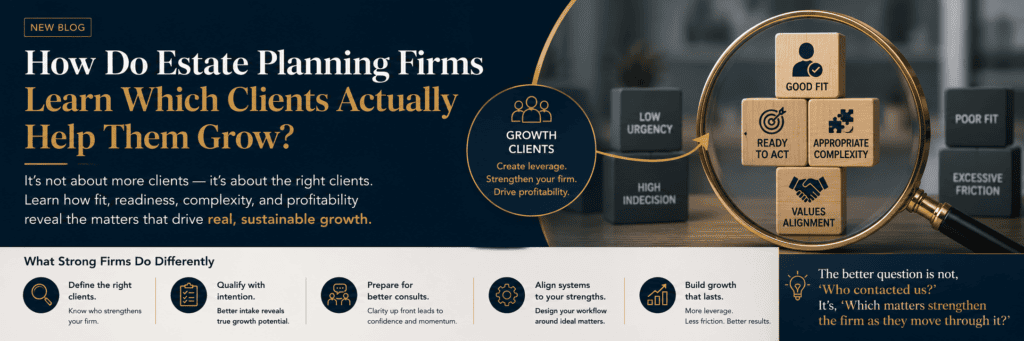
Estate planning firms learn which clients help them grow by paying closer attention to fit, readiness, complexity, and profitability — not just conversion volume. The matters that help a firm grow are usually the ones that align with the firm’s strengths, move through its systems more predictably, and support healthy margins without excessive friction.

Growth clients are not always the most obvious clients

A firm may assume its best clients are the easiest to sign or the most frequent referrals. But over time, stronger firms usually learn to evaluate matters through a broader lens:

  • Does this matter match our strengths?
  • Does it require the kind of strategic guidance we do well?
  • Does it move with reasonable clarity through intake, consult, and completion?

This is an important distinction. Some matters generate revenue while quietly creating strain. Others create less friction, better outcomes, and more dependable growth.

The client signals that matter most

Internal materials on ideal client definition emphasize four useful dimensions:

  • urgency
  • complexity
  • values alignment
  • decision readiness

These factors help firms identify which matters are likely to move forward well and which are more likely to stall, loop backward, or require repeated reassurance without forward progress.

Intake is where firms start learning this

Most firms do not learn which clients help them grow by intuition alone. They learn through better qualification. Intake is where the firm gathers the first real evidence:

  • why now
  • what outcome is needed
  • who decides
  • what level of readiness exists

When intake teams resist jumping straight to scheduling and instead clarify urgency, decision authority, and readiness, the firm gets a much clearer sense of whether the inquiry is a true growth opportunity or simply more activity.

Which matters usually create drag

The cases that tend to weigh a firm down are often not “bad” matters. They are simply misaligned matters:

  • low urgency with high indecision
  • limited readiness but high demand for reassurance
  • work that does not fit the firm’s strengths
  • expectations that exceed what the system is designed to support

Over time, these patterns affect morale, scheduling, throughput, and profitability.

What strong firms do differently

More intentional firms define not only the clients they want more of, but also the cases that consistently create friction, burnout, or stalled conversions. That kind of clarity changes:

  • marketing
  • intake scripts
  • consultation preparation
  • internal workflow planning

Once the firm names those patterns, client selection becomes more disciplined and less reactive.

Close

Estate planning firms learn which clients help them grow when they stop measuring demand by volume alone. The better question is not, “Who contacted us?” It is, “Which matters strengthen the firm as they move through it?” That shift usually marks the beginning of more intentional growth.